 Leia Larsen
Note to readers • This story is made possible through a partnership between The Salt Lake Tribune and Grist, a nonprofit environmental media organization.
Congressional Democrats have opened an investigation into Energy Fuels after the company’s CEO and chairman bought thousands of shares of stock just days before President Donald Trump downsized the neighboring Bears Ears National Monument in southeastern Utah.
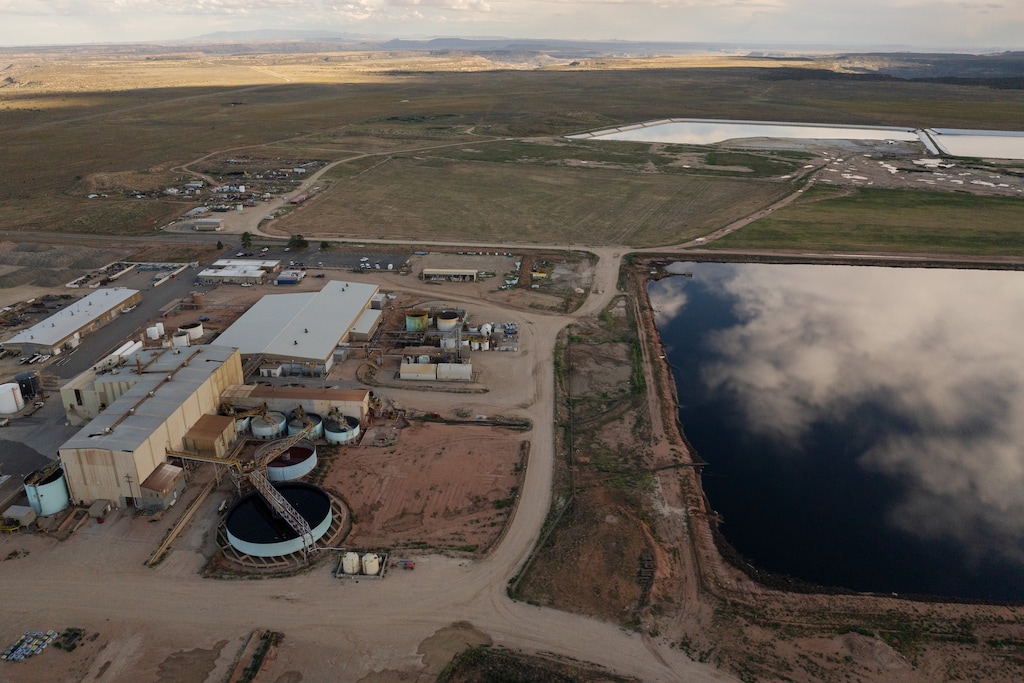
The Denver-based company operates White Mesa Mill, the last conventional uranium processing site in the nation, which sat about a mile from the Bears Ears boundary before Trump slashed the monument by 90% last month.
On July 7, 2026, CEO Ross Bhappu bought 74,000 shares of Energy Fuels, the largest insider purchase of stock in the company’s history, according to a news release issued by the House Natural Resources Committee Democrats. The trade bumped Bhappu’s ownership to 41%. Board chair Bruce Hansen acquired 4,000 shares the following day.
Less than a week later, Trump removed 1.24 million acres from Bears Ears National Monuments— making the land available again for mining.
House Natural Resources Committee Ranking Member Jared Huffman, D-Calif., and Oversight and Investigations Subcommittee Ranking Member Maxine Dexter, D-Ore., announced Monday that they had opened an investigation into the company.
“We understand that monument boundaries were redrawn in a way that could benefit Energy Fuels,” the lawmakers wrote in a letter to Bhappu.
A spokesperson for Energy Fuels said company leadership was aware of the letter and takes it seriously.
(Bethany Baker | The Salt Lake Tribune) The Indian Creek area of Bears Ears National Monument near Monticello on Thursday, Dec. 19, 2024.
“The Company is unaware of any evidence supporting claims of wrongdoing in the referenced letter and strongly rejects any suggestion that the Company or its executives engaged in any improper conduct,” the spokesperson wrote in a statement Wednesday. “The White Mesa Mill has never been located in the Bears Ears National Monument, Energy Fuels holds no properties, mining claims or economic interests in the monument, and we have not actively advocated for any changes to the monument with the current Administration.”
Bears Ears has long been subject to a political ping-pong match, as administrations have shifted between greater protections and a larger role for tribal nations in managing the lands, and limiting those protections to make more federal land available for mining energy development and other uses.
Documents show Energy Fuels previously pressured the Trump administration to to shrink Bears Ears in a way that would benefit the company in 2017, just months before Trump reduced the monument originally established in December 2016 by President Barack Obama. President Joe Biden restored the monument’s boundaries in October 2021.
The White Mesa Mill previously produced uranium and vanadium with material mined outside of Utah, according to 2021 information from the Utah Geological Survey. But it began processing locally sourced ore in 2024. Trump’s Interior Department fast-tracked the reopening of the Velvet-Wood uranium mine, owned by Canada-based Anfield Energy Inc., in southeast Utah in 2025.
Energy Fuels’ mill lies less than a mile east of Bears Ears’ former boundary, and the monument’s sandstone deposits include both uranium and vanadium.
Energy Fuels announced late last month that it had broken ground on an expansion of the mill to produce heavy rare earth materials used in data centers along with the automotive, energy and robotics industries. The Department of Defense issued a $725 million loan to the company on June 18 to support developing rare earth elements.
In an investor presentation filed in July with the U.S. Securities and Exchange Commission, Energy Fuels noted “strong government support” as one of its competitive advantages.
Gov. Spencer Cox and his Office of Energy Development have touted the White Mesa Mill as an asset for Utah. The state has applied to become the one of nation’s first “nuclear lifecycle innovation campuses,” which will include processing, recycling and storing radioactive waste. Late last month, the Trump administration announced Utah was a finalist for hosting a campus.
But the Navajo Nation and environmental advocates have asserted the White Mesa Mill is not a good neighbor. The company faces accusations that it secretly transported radioactive material through tribal lands and the the material it stores poses a risk to water quality and public health in water-strapped southeast Utah.
(Brooke Larsen | The Salt Lake Tribune) People protest President Donald Trump's shrinking of Bears Ears and Grand Staircase-Ecalante national monuments in St. George on Monday, July 20, 2026.
“Energy Fuels cannot credibly claim to be a responsible operator while the nation’s last uranium mill functions like an unregulated, bargain-bin waste dump on the doorstep of an Indigenous community,” Democratic lawmakers wrote in their letter to the company CEO. “Instead of respecting the Tribes for whom Bears Ears is sacred, you appear to be enriching yourself from their devastation.”
The lawmakers are demanding communication between Energy Fuels executives and federal officials, along with the company’s lobbying contracts.
Energy Fuels said in its statement that it follows federal, state and local regulations to protect communities and the environment.
“The White Mesa Mill is one of the most highly regulated mineral processing facilities in the United States,” the company spokesperson wrote, “and plays a critical role in strengthening domestic supply chains.”
Correction • 1:10 p.m., Aug. 17, 2026: This story has been updated to correct the year that Bears Ears National Monument was first established.