 Julie Jag
 Samantha Moilanen
Elberta • Residents of the historic silver-mining town of Eureka had little more than 20 minutes of warning before they were ordered to evacuate because of the encroaching Iron Fire in June.
Joe McClellan, 66, grabbed his guns. At the last second, he also scooped up the ammunition. He didn’t think firefighters needed to deal with explosions in addition to a wildfire — all as he worried about where he was going to sleep, if his house would burn, whether his cat had found shelter and how long he would be stuck in limbo.
The items people grab in the chaos of fleeing a wildfire or flood are as personal as they are wide-ranging. One person might meticulously pack Grandma’s antique Bavarian tea cups, where another will pack butter. Some save space for every animal, even the chickens. Others barely escape with the shirt on their backs.
Utah has developed a wildfire action plan that uses a three-tiered, “Ready, Set, Go” warning system to prepare people who are potentially in the path of a fire to evacuate.
Benjamin Donner, the executive director of the American Red Cross for central and southern Utah, takes it one step further, advising people to make a list of things to take, and pack a “go bag” filled with those items, before a fire ever starts.
That way, as soon as “Ready” mode is enacted, people can put those packed go-bags in their car. When it turns to “Set,” he said, they should be gathering any uncollected animals and valuables and getting ready to run.
When people don’t have a plan, Donner said, important things get left behind.
“If you’re in that ‘Set’ stage for 10 minutes, the adrenaline’s pumping, you’re obviously in a different state [of mind] than you normally would be,” he said. “ … In that moment, where they could pull the trigger on ‘Go’ at any moment, if you’re looking at that list, then you’re not trying to figure it out in the moment.”
Kristina Owen found herself facing that choice when the Cottonwood Fire forced her to flee her mountain home near Eagle Point ski resort in June.
“When you get the evacuation notice, it’s like, ‘Oh my gosh, what do I do? What do I grab?’” she said.
In the rush to leave, Owen had to suddenly decide what mattered most beyond her family of four, their dog and their cat.
Losing any belongings to a disaster can be devastating, but she said the hardest losses don’t always have the highest price tags — they’re the items that can’t be replaced.
“I recommend to anybody just pack things that you really find of value to you,” she said, “whatever it is, and just pack it in a little plastic container, maybe two, and and have it ready to go.”
Even the butter?
When Cottonwood Fire forced evacuations in June, Tara Tucker, executive director of the Beaver, Iron and Garfield Chamber of Commerce, said her husband, who was at one of their properties near Eagle Point ski resort, grabbed two unexpected items on a whim: a massage gun and the 1985 comedy film “Better Off Dead.”
He snagged the family’s photo albums, too, Tucker said. But the movie and massage gun were a “funny” addition because, at the time, they didn’t think the evacuation would last.
Weeks later, when July 19 flooding from the Cottonwood burn scar forced Beaver residents near the town’s Grove neighborhood to evacuate, Tucker said her 13-year-old daughter remembered what her dad had taken during the fire and made sure those same two items went into the car with them.
Luckily, Tucker said, the family had just returned from a trip to Las Vegas and had not fully unpacked, so they had already had some essentials on hand.
Tucker was sitting in Sunday church service when word came that residents needed to prepare to evacuate. The service ended early, and families rushed home to gather what they could.
Tucker grabbed their important documents, loaded their still-packed suitcases into the car and left for a relative’s home.
(Utah Department of Public Safety) Flash floods washed through parts of Beaver on July 19, 2026.
While Tucker had some warning (city and fire officials had been preparing Beaver residents for possible flash flooding for weeks), many others facing disaster have little time to think before they have to leave.
The adrenaline rush got to Brandie Miles’ son-in-law. She said he was “freaking out” as he prepared to evacuate her home in Eureka in June.
“He packed everything,” she said. “He even took butter with him.”
But, she added, he forgot to turn her water off, which made her worry about an expensive bill.
(Francisco Kjolseth | The Salt Lake Tribune) Eureka resident Daniel Rosenbaum describes the harrowing experience of escaping the Iron Fire as it descended on the town, Monday, June 22, 2026. Rosenbaum evacuated to the neighboring town of Elberta with neighbors and family, where he anxiously awaited news of being able to go back home.
Daniel Rosenbaum also forgot something important. In the midst of getting his own five kids, dogs and chickens out the door, he neglected to pack his prescription medications. He wasn’t the only one.
A Juab County Sheriff’s deputy spent much of one day escorting people to and from Eureka so they could collect medicine left behind or animals that had been hiding.
Bree Lynn Skinner’s family, meanwhile, had drilled what they would do in a fire thanks to her fear that her home would burn.
She had all their important documents — marriage and birth certificates, insurance information, etc. — all collected in a pink binder the family called the “pinkbook.”
(Francisco Kjolseth | The Salt Lake Tribune) Eureka residents Gary Skinner holds his bearded dragons Anthony and Alice after fleeing the Iron Fire to the neighboring town of Elberta on Monday, June 22, 2026. The family of six escaped with six rabbits, two beared dragons, two dogs and three cats.
The professional photographer had also instructed her family on what hard drives to grab to save her trove of photos as well as those taken by her now deceased grandfather.
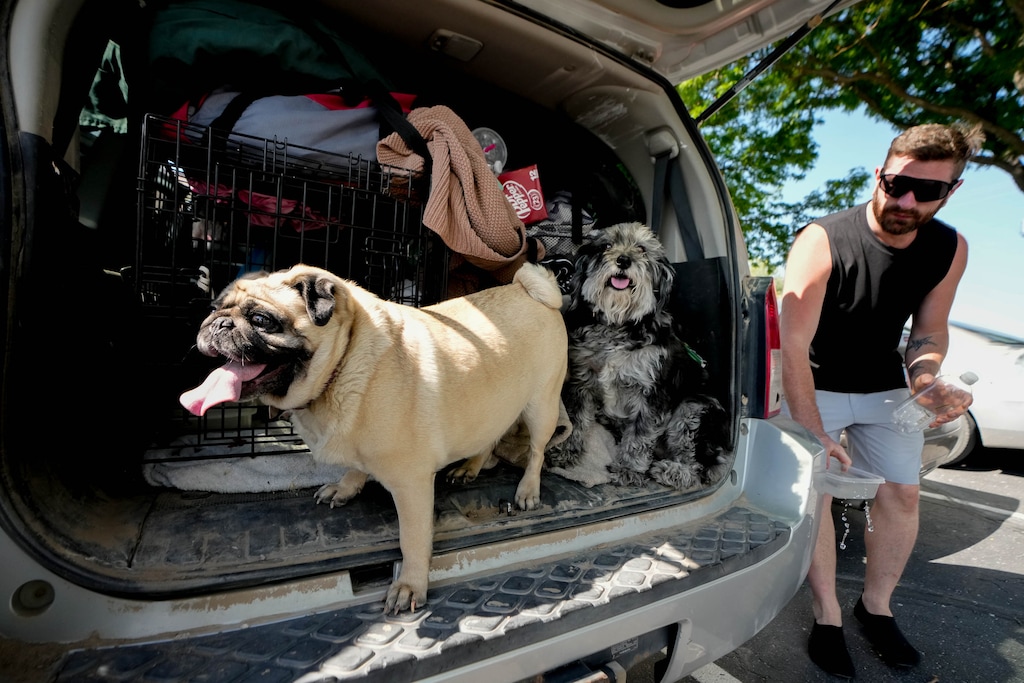
When fire officials gave the “Go” order for the Iron Fire, that binder made it into the back of their older-model Nissan Pathfinder. So did her husband, all four kids, pillows, blankets, a few mementos and a menagerie of animals.
All together they brought six bunnies, three cats, two dogs and two bearded dragons.
The only creatures left behind, she said, were the ants in her ant farm.