 Courtney Tanner
Utah Valley University leaders and the school’s police chief repeatedly tried to raise security concerns ahead of conservative commentator Charlie Kirk’s scheduled appearance on campus last year.
But, according to a much-anticipated independent review released Friday, Kirk’s team brushed off those warnings.
The report indicates school staff suggested a few weeks before the event on Sept. 10, 2025, that Turning Point USA should move it to a more secure location. The organization, though, insisted on having it in the open campus courtyard.
UVU also requested an estimated attendee count, but Turning Point USA, which contended that it would control ticketing for the event, never provided that number, the report states.
Shortly before the event, the university’s police chief, Jeff Long, personally texted Kirk’s private security adviser to meet about final safety measures. That meeting, according to the review, “did not occur.”
Roughly 80 minutes later, as Kirk was answering a question, he was killed when a single shot was fired from a nearby campus rooftop.
The 158-page report largely defends UVU for its efforts to work with Turning Point USA and trying to provide sufficient policing with the limited information it had.
“It is the opinion of the project team, based on our review of all available information, that at no time during the events leading up to the assassination of Charlie Kirk, or in its aftermath, did any employee or agent of UVU act in bad faith or in willful and wanton disregard for the safety of others,” the review states.
It doesn’t completely absolve the school of responsibility, suggesting UVU could have done more and shouldn’t have ceded its authority to Turning Point USA.
It also states that while the university had policies in place for controversial events, implementation was “significantly inconsistent” and led to confusion after the shooting. Students and employees on campus didn’t receive a first alert until 19 minutes later, and the messages that followed offered contradicting and inaccurate information.
In a statement Friday, an attorney representing the Kirk family responded to the report, arguing, “UVU hosted this event, and in doing so, assumed responsibility for the safety of all in attendance, including Charlie.”
“The buck stopped with UVU leadership and law enforcement,” the attorney, Brett Parkinson, continued.
(Trent Nelson | The Salt Lake Tribune) Charlie Kirk appears at Utah Valley University on Sept. 10, 2025, before he was fatally shot on campus. To the right, in blue, stands the head of Charlie Kirk's private security detail.
Turning Point USA declined to comment and pointed to Parkinson’s statement; the report noted that officials from the organization declined to speak with its investigators.
Kirk’s family is currently planning to sue the school and has filed a formal legal claim in order to do so. They allege UVU wasn’t prepared and didn’t provide enough security.
The new report comes two weeks after the one-year anniversary of Kirk’s death. In the days after, the school promised to hire outside consultants to review what happened and how to “strengthen safety practices.” There have been delays and stacking costs since then to finish the investigation.
The school has spent at least $440,657 on the report, according to receipts through the end of August that UVU shared with The Salt Lake Tribune through public records requests.
The school hired Brownstein Hyatt Farber Schreck, a law firm based in Colorado, as well as The Lake Forest Group, a security consulting company in Illinois, to conduct the review. They interviewed more than 70 people, watched hours of security videos and reviewed thousands of pages of documents.
The report was released Friday morning with a limited statement from UVU’s new president, Jon Anderson, who started the job Aug. 10. The school declined to respond to any questions.
“Our commitment does not end with this report,” Anderson said. “Its findings will guide our continued safety efforts as we move forward together with care, civility and resilience.”
Before the event
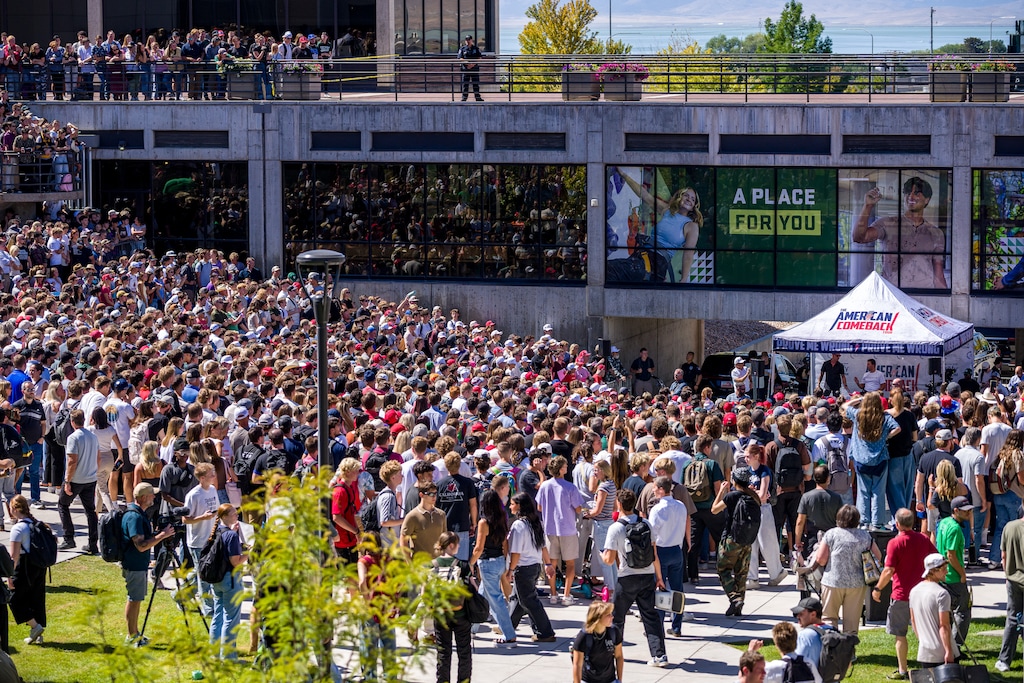
(Trent Nelson | The Salt Lake Tribune) A crowd of people gather to listen to Charlie Kirk speak at Utah Valley University on Wednesday, Sept. 10, 2025.
UVU officials over the past year have largely declined to talk about the shooting or what led up to it, pointing the report’s eventual publication.
For the first time, the document addresses — and validates — many of the criticisms the school has faced since: that it assigned too few officers, failed to communicate with local law enforcement for extra support and neglected to sweep and secure rooftops before Kirk spoke.
Investigators found most of the fault boiled down to the school failing to fully assess the “foreseeable” risks ahead of time or address concerns as they came up.
Originally, the school’s Turning Point USA club submitted a request to hold the event, guessing in their application it would draw 600 attendees and wouldn’t be controversial.
They also noted they wanted to hold it at the campus courtyard, a request they said “came straight from the TPUSA team,” according to an email from the club that’s cited in the report.
When school advisers received the request, they properly forwarded it to the school’s events committee for formal review. At the time, Chief Long was looped into communications, but it was Aug. 21, 2025 — only 20 days in advance — which investigators said wasn’t enough time.
That’s also where the process hit a wall.
(Trent Nelson | The Salt Lake Tribune) Police tape cordons off part of the roof of Utah Valley University's Losee Center after Charlie Kirk was shot and killed from the rooftop during a campus event on Wednesday, Sept. 10, 2025.
UVU’s Major Events Assessment Committee held a planning discussion on Aug. 25, 2025, with at least one person from Turning Point USA present.
The report says several committee members raised concerns during the meeting, including about the outdoor location, ticketing, hosting a high-profile speaker and the potential for controversy and protests after similar events Kirk held across the country.
But the organization’s field representative, according to the report, declined to consider alternate venues and insisted that Turning Point USA handle tickets. (The representative also declined to speak with the report’s investigators.)
The committee approved the event in line with Turning Point USA’s requests — without otherwise addressing its concerns or raising them with UVU leadership. Then-UVU President Astrid Tuminez requested information about the event on Aug. 31, 2025, according to the report, but it doesn’t note what she wanted to know or what she was provided; it doesn’t appear she pushed for any changes.
“Those decisions placed the event in an area that was more difficult to control and limited UVU’s ability to obtain reliable, real-time information regarding anticipated attendance and crowd size,” the report states.
The school, investigators wrote, “should have retained decision-making authority over key security-related issues.”
During the committee meeting, Chief Long asked to speak with Turning Point USA’s security directly so they could coordinate, the report adds; he didn’t hear back for more than a week, after asking a second time.
(Bethany Baker | The Salt Lake Tribune) FBI Director Kash Patel take a phone call on Thursday, Sept. 11, 2025, from the scene of Charlie Kirk's fatal shooting on Utah Valley University's campus.
In the meantime, the school didn’t conduct a standard security assessment and didn’t draft a formal written plan. That should be required before any event is approved, investigators said.
An assessment would’ve included gathering intelligence on social media and reviewing past Turning Point USA events to better understand vulnerabilities and threats. UVU and its police force had the resources to do that, the report notes, but didn’t.
That could’ve given the university more pull to counter Turning Point USA and require that the event be held in a more secure location.
It also could’ve helped UVU’s police force better understand whether to ask neighboring law enforcement agencies for help, which UVU didn’t do.
“Chief Long did not initiate a mutual aid request to Orem Police Department or other local public safety partners before the event, and additional external resources were not requested after the crowd size became apparent,” investigators wrote.
The morning of the event
It wasn’t until Sept. 3, 2025 — seven days before the event — that Chief Long first spoke with Turning Point USA’s security staff.
They talked for five minutes and 28 seconds, the report states. Later that day, a second call lasted 48 seconds, during which Chief Long again requested ticketing totals; he was never given a count, the report states, despite asking several more times.
Turning Point USA never actually issued tickets, the report noted. The organization instead asked attendees to register on its website, but staff never checked anyone’s registration, and the courtyard was left open to all.
More than 3,000 people ultimately attended. But without more information, UVU police instead staffed the event based on the club’s original guess of 600, or 80% fewer, people.
Initially, Long assigned only himself and two others to patrol the event. By 11 a.m. though — an hour before Kirk was set to appear — the crowd size prompted him to ask three more officers to join, the report states.
In total, those six were “all officers on duty that day” for UVU. At the time, the school’s entire police force totaled 13 officers.
(Trent Nelson | The Salt Lake Tribune) People pack in to Utah Valley University's campus courtyard to listen to Charlie Kirk speak on Wednesday, Sept. 10, 2025.
An additional two plainclothes officers from Utah State University were also there to assist and watch operations; Kirk was scheduled to appear at the Logan campus later that month. Two emergency technicians were also on scene, but no ambulance.
Turning Point USA has said it had somewhere between eight and 12 private security there too, according to the report. The organization’s security supervisor didn’t participate in the report.
In the days leading up to the event, and on the day of, Long reached out to the Utah Statewide Information and Analysis Center to check on several threats. The statewide coordination center run by federal, local and private sector partners consider find them credible, the report states.
Two days before the event, Turning Point USA’s security supervisor reached out to Chief Long directly, concerned about a campus walkway known as the Hall of Flags; the glass indoor hallway looks out onto the courtyard.
The supervisor also flagged an outdoor balcony above that. He was worried protesters could organize there and asked Long to secure it. The chief replied in a text: “I got you covered,” the report states.
The day of the event, Turning Point’s security team arrived at 9 a.m., three hours early. The supervisor again texted Long about the balcony, where protesters had already gathered. Long replied indicating that he was aware but said his event officers wouldn’t arrive until 11 a.m.
By 11:20 a.m., UVU police had cleared the balcony, taped it off and stood watch. Shortly before the event began, another group of protesters tried to access a third-floor balcony in the nearby Fugal Gateway building; campus police stopped them too and taped it off.
(Trent Nelson | The Salt Lake Tribune) The indoor glass-lined Hall of Flags, and the taped-off balcony directly above it, can be seen as people pack in to Utah Valley University's campus courtyard to listen to Charlie Kirk speak on Wednesday, Sept. 10, 2025.
The chief had asked the supervisor to meet face-to-face that day, but it never happened, the report states without explaining why. It seems to blame Turning Point USA, noting UVU tried to set up meetings but received “no clear coordination.” The organization also never requested a security walk-through.
That meeting would have helped address line-of-sight concerns, assign roles and detail contingency plans — “a critical missed opportunity,” the report states.
Even without Turning Point USA, UVU should have at least walked through the courtyard that morning to assess weakness and potential access points, investigators wrote.
They also come down hard on university police, whose live video surveillance streams sat unmonitored. Footage later showed Kirk’s shooter accessing the nearby Losee Center roof at 12:17 p.m.; the fatal shot was fired six minutes later.
The school also had building lockdown capabilities, as well as a tool to detect human activity in restricted areas, such as rooftops, but used neither.
UVU police didn’t have a drone to help with aerial surveillance, but Orem police did — a potential asset the campus agency failed to ask about.
At the same time, investigators wrote, campus police departments are chiefly trained to respond to criminal activity, investigate incidents, collect evidence and make arrests.
Protecting a specific individual, like Kirk, is called “executive protection,” the report notes. Private security teams — whose core purpose is to reduce exposure, control access and prevent danger — are typically more equipped.
The report’s investigators tried to speak with the head of Kirk’s contracted security team, but he declined to participate. They noted he contradicted much of the report’s evidence in a Nov. 17 podcast interview, including an assertion that the school forced Kirk to speak in the courtyard.
Hours after the event
(Trent Nelson | The Salt Lake Tribune) A view toward the Losee Center minutes after Charlie Kirk was shot at Utah Valley University on Wednesday, Sept. 10, 2025.
It’s “exceptionally rare” for someone with no connection to a school to carry out a campus attack, investigators found. They came to that conclusion after researching school shootings as far back as Virginia Tech in 2007.
In some ways, that makes anticipating and preparing for an assassination difficult.
“External threats may not involve prior contact with the institution, may not appear in campus records, and may not generate observable warning behaviors known to university personnel before an incident occurs,” the report states.
But a school is responsible for how it responds afterward, and UVU’s emergency communications in the aftermath “were among the most significant challenges” investigators identified.
No single individual was assigned to lead information dissemination, the report states. The first campuswide message came relatively late and inaccurately stated a shooting suspect was in custody.
“The delays, inaccuracies and inconsistencies in emergency communications created confusion among students, faculty, staff and visitors,” the report says.
(Trent Nelson | The Salt Lake Tribune) Police work to secure Utah Valley University's campus after Charlie Kirk was fatally shot during an appearance at the school on Wednesday, Sept. 10, 2025.
One problem: Many key administrators were either off campus or on vacation. Then-President Tuminez, for example, was traveling out of state (and flew back to Utah once she learned).
Robin Ebmeyer, UVU’s director of emergency management, was also out of state; she joined the emergency response by phone.
And UVU Vice President Val Peterson, who was charged to lead the school in Tuminez’s absence, was 45 minutes away; he also joined by phone as he drove in.
That caused significant confusion, the investigators said. And Long, who was busy actively responding to the situation, couldn’t immediately help direct the school’s broader emergency response.
Without more direction, investigators said, staff debated for more than 20 minutes if the situation qualified as an active shooter event, and if so, how that affected what to communicate to people on campus.
By 1:04 p.m., they also learned a suspect wasn’t in custody. But it took another seven minutes to alert campus.
Eight minutes later, they instructed people on campus to immediately leave. Seventeen minutes after that, they said told students and employees to secure in place until officers came.
Then, a fifth alert was “unintentionally issued,” and two minutes later, staff sent a follow-up message telling people to disregard it.
By 5:45 p.m., a final alert informed campus there was no ongoing threat — five hours and 22 minutes after Kirk was shot. By then, campus was relatively deserted, with bags and water bottles strewn across the ground from those who fled.
(Trent Nelson | The Salt Lake Tribune) The scene after Charlie Kirk was fatally shot during an appearance at Utah Valley University on Wednesday, Sept. 10, 2025.
The report acknowledges errors can happen while working to get information out quickly “in extremely difficult conditions.” But it also states UVU knew it had communication issues ahead of the September 2025 event.
In January 2023, the school conducted an active shooter training. That “identified communication and situational awareness challenges … and recommended additional exercises.”
But the school never seemed to address those deficiencies and hadn’t held a similar training since.
The school’s crisis communications playbook had last been updated in February 2024, the report found, and it wasn’t fully followed, investigators determined.
At the time of the shooting, only 68% of people eligible for campus emergency texts were signed up. The school has since tried to raise awareness; now, 98% are, the report states.
The report also notes that local and state authorities were called one minute after the shooting, and they immediately responded. Despite UVU not including them ahead of time, that indicates the school had good, informal partnerships, the report found.
UVU’s new president has pushed to strengthen those relationships.
“We know who they are; they know us,” Anderson recently told The Tribune. “We know what our capacity is, and we know what their capacity is.”
Recommendations for the future
(Trent Nelson | The Salt Lake Tribune) Charlie Kirk appears on Utah Valley University's campus with the head of his private security detail on Wednesday, Sept. 10, 2025.
On the day of the shooting, there were some limitations UVU had no power over.
A state law at the time, for instance, permitted both open and concealed carry on public college campuses, making gun screening more complicated. (The law has since been changed to prohibit open carry.)
Even if a school anticipates controversy, the First Amendment “significantly limits the ability of public universities to restrict speakers, deny event requests or impose burdens,” the report notes.
Still, investigators credit UVU with making substantial changes to what it can since the shooting.
The report recommends more improvements, including a major suggestion to hire more police.
UVU says it’s working on that; it hired two more and is in the process of hiring an extra six. That would bring its force up to 21. The school also plans to make officer pay more competitive.
Additionally, UVU is working to:
• Provide more officer trainings.
• Conduct joint training with local law enforcement under clearer partnerships.
• Consider additional police accreditation requirements.
• Improve communications and implementation of policies already on the books.
• Work with the Utah System of Higher Education to improve information sharing and collaboration, particularly with a new statewide campus safety task force.
The school will also create a new chief public safety officer position after investigators discovered the school’s police chief doesn’t have a direct line to UVU leadership to raise concerns.
The new hire will act as a liaison between police and administrators, as well as direct emergency management overall and champion the report’s recommendations.
In his statement, President Anderson noted: “September 10 will always be part of UVU’s history, but it will not define our future.”
“Our responsibility is to care for our community, learn from the findings of this review, and follow through on its recommendations,” he wrote. “This requires humility, an honest examination of our policies and practices and a commitment to act on what we learn.”
(Francisco Kjolseth | The Salt Lake Tribune) Utah Valley University President Jon Anderson sits for a portrait following an interview about the anniversary of the Charlie Kirk shooting, the independent review the school commissioned and his first four weeks on the job on Wednesday, Sept. 2, 2026.