 Courtney Tanner
After more than a year of negotiations, the Ute Indian Tribe has agreed to continue allowing the University of Utah’s sports teams to use its name in exchange for the school offering bigger scholarships to more of the tribe’s youth.
It’s a major update to the longstanding agreement between the tribe and the state’s flagship school.
The school has a “significant responsibility” to honor the tribe, said Mark Harlan, the U.’s athletics director, in a statement.
“We look forward to carrying the name forward with understanding and respect toward our state’s namesake people,” he said.
Under the new memorandum of understanding (MOU) renewed last month, the U. must now offer up to $6,000 per semester to each Ute student awarded a scholarship. The tribe will also have more say in who qualifies — opening it up to more students than ever before.
Previously, under terms that hadn’t been changed since 2014, the U. was offering $4,000 a semester and a maximum of $8,000 per year, which matched the school’s tuition rate. But in the dozen years since, tuition has jumped to roughly $5,500 per semester including fees, leaving recipients with a sizable gap.
The U. previously declined to increase that scholarship amount outside of a formal update to the MOU.
Now, each recipient can get up to $18,000 total each year, over the course of three semesters (fall, spring and summer).
Any student who ends up being awarded more scholarship money than needed to cover tuition can also now cash out the remainder, so they can put it toward books or housing.
Tribal leaders pushed for that change because Ute students were having a hard time finding affordable housing in Salt Lake City; many come from the tribe’s Uintah and Ouray Reservation, about 130 miles away in eastern Utah.
And in perhaps the most major change, a student’s scholarship eligibility is no longer dependent on the strict Ute blood quantum requirement set by the U.S. government. That’s the amount of ancestry needed to formally enroll as a member of the tribe. (For the Utes, it’s ⅝, the highest of any tribe in the country.)
Now, students with any amount of Ute lineage can apply, so long as they are in good academic standing and intend to take a full course load at the U.
Their applications will be reviewed by the Ute Tribe’s governing Business Committee; that group alone will issue an approval letter if they feel an applicant is a good fit.
(Trent Nelson | The Salt Lake Tribune) Members of the Ute Indian Tribe perform at halftime during a basketball game in 2024.
Tribal leaders have long argued to drop the quantum limitation, because it leaves a lot of students out who are otherwise connected to the Utes and their culture.
The tribe’s chairman, Shaun Chapoose, declined to comment on the new MOU, noting that the tribe’s Business Committee plans to issue a collective statement soon.
The Utes have maintained that the school’s use of the tribe’s name is a source of pride. The MOU says it “raises tribal visibility and community awareness.”
How has the MOU shaken out in the past?
In 2024, a Salt Lake Tribune investigation found the previous MOU seemed to benefit the university more than the Utes.
There has been an understanding in place since at least 1972 over usage of the Utes name and formal MOUs since 2003.
The U. is one of only a few schools the NCAA still allows to use Native imagery, giving it a relatively unique brand that rakes in millions for the U. in merchandising alone.
This fiscal year, a combination of media rights, sponsorships, advertising and ticket sales are are anticipated to bring in $118 million in revenue for the school’s sports enterprise.
(Trent Nelson | The Salt Lake Tribune) Merchandise at the University of Utah Campus Store.
Meanwhile, in return for using its name, the tribe has asked the U. to help educate its children — both in K-12 and college.
The U., however, historically accepted few Ute students over the years, The Tribune’s reporting showed, with no substantial enrollment changes since the 1950s. The total has typically hovered at fewer than 10, according to the school’s estimates, though the university does not formally track student enrollment by tribe.
Even fewer were awarded Ute scholarships, with roughly three recipients selected each year, on average, The Tribune found.
Some years, no students were selected, because neither the previous MOUs nor the updated agreement set a minimum amount of awarded scholarships.
Based on the changes, the U. says that 14 students have qualified for the scholarship this year.
And now, moving forward — for the first time — the school will provide an annual report to the tribe’s Business Committee on the total amount of scholarships awarded, how much money each student received, and the graduation rate of Ute students.
The U. says it has provided that information informally and voluntarily in the past.
(Christopher Cherrington | The Salt Lake Tribune)
What else is new?
Under the new agreement, the U. promises to better assist Ute applicants and better support enrolled students on their path to graduation.
The U. will continue to help fund K-12 education on the reservation, the MOU indicates — at $100,000 a year, which supports tutors, mentoring and after-school programs.
The U. also hosts a summer camp each year for Ute and other tribal students. And the MOU states the school must teach all first-year students about the tribe at freshmen orientation.
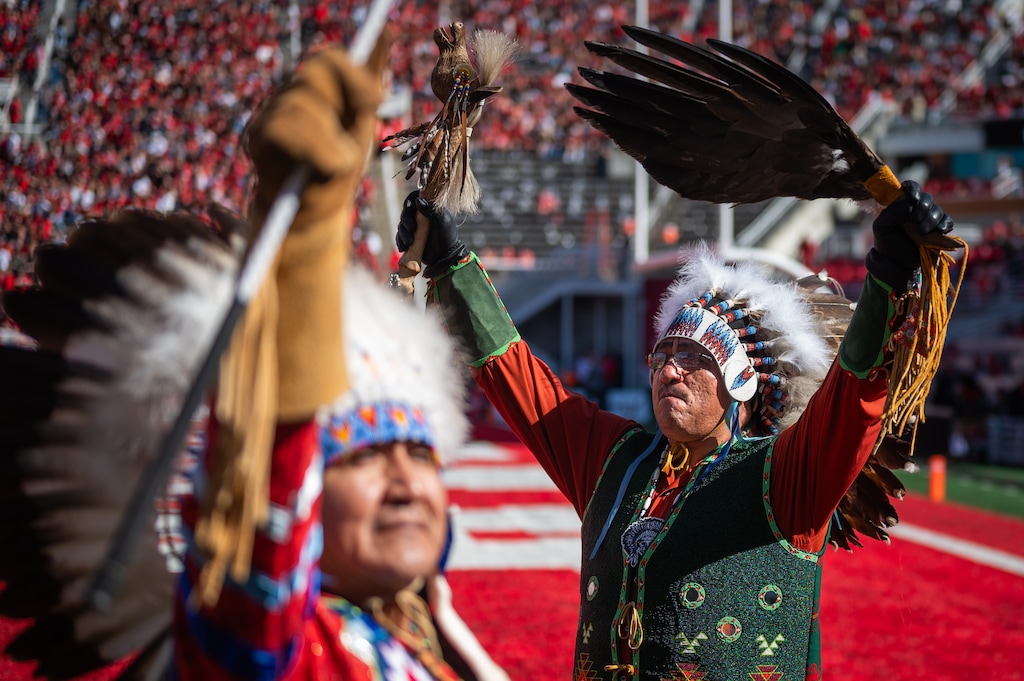
Several past provisions will continue, including featuring a Ute Proud halftime performance at one football game, basketball game and gymnastics competition each year to showcase the tribe’s heritage.
(Francisco Kjolseth | The Salt Lake Tribune) Members of the Ute Indian tribe are honored during a football game against the TCU Horned Frogs in Salt Lake City on Saturday, Oct. 19, 2024.
Moving forward, the Ute Tribe will also help select a special adviser to President Taylor Randall on Native American affairs. That will be a part-time, unpaid role. That position has previously been filled by Samantha Eldridge, who is Diné (Navajo) and also the director of the U.’s Center for Native Excellence & Tribal Engagement.
Another add: A promise from the U. to send its University of Utah Health mobile clinics to the reservation three times a year. That includes its buses for wellness, cancer screening and dentistry.
“This agreement is a wonderful example of how a state university can work in collaboration with a sovereign nation to support each other,” said Lori McDonald, the U.’s vice president of student affairs, in a statement.
Each MOU typically lasts five years. The last one was supposed to expire in 2025 but was extended an extra year during negotiations. The next agreement is set to be renewed in 2031.