 Courtney Tanner
Hunter Kozak didn’t recognize the man pacing on the grass in front of his apartment.
In the days before, reporters from across the country had basically set up camp there. But they’d mostly gone by now.
The man started to approach Kozak, then seemed to change his mind. Then he got closer. “Are you Hunter?” the man demanded.
“What news station are you from?” Kozak responded. The man wouldn’t answer. He seemed cagey, nervous.
Kozak was just getting back from the hospital after visiting his baby girl in a neonatal intensive care unit, where nurses told him her lungs weren’t yet fully formed. Earlier in the day, he’d been questioned by the FBI. He’d avoided his apartment because of the carousel of TV cameras, but now he was exhausted and was looking forward to collapsing into a familiar bed.
The man spoke again. “I know you were in on it,” he said. Kozak froze.
Kozak had already received hundreds of online death threats with that same message. Until then, he didn’t think anyone would actually show up where he lived, where his son and wife could be asleep upstairs.
Instinctually, Kozak recalled, he yelled at the man, like trying to scare off a wild animal. “Get the hell out of here,” Kozak barked. “Now. Leave.”
The man was spooked. So was Kozak.
“I felt so terrified,” Kozak said, reflecting back on it. “It really freaked me out.”
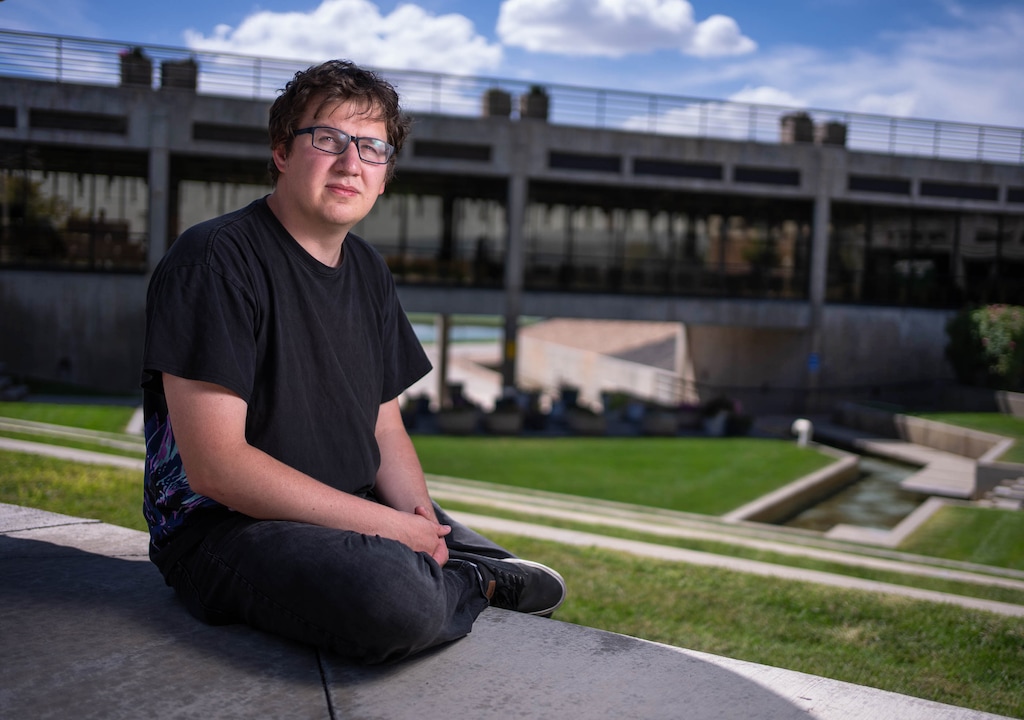
(Francisco Kjolseth | The Salt Lake Tribune) Hunter Kozak, who asked the last question of Charlie Kirk before the commentator was killed, sits down for an interview at Utah Valley University nearly a year later.
He went inside and bolted the door of his Orem apartment — which he’d often left unlocked, so siblings could crash on the couch as they pleased. He texted his family to stay away, at least until the storm quieted. But it still hasn’t.
As a Utah Valley University student, Kozak was the last person to ask Charlie Kirk a question before the conservative commentator was assassinated on campus Sept. 10, 2025. A year later, the threats and conspiracy theories have kept his life turned upside down.
“It’s crazy when I look back over all the stuff over the last year,” Kozak said. “I don’t think people understand how bad it’s gotten.”
The day of the shooting
A few days before the anniversary of Kirk’s death, Kozak stood in the courtyard at UVU where it happened.
“I was right there on the grass, in the middle,” he pointed. “And Charlie Kirk was right there on the cement. That’s where his tent was set up.”
(Trent Nelson | The Salt Lake Tribune) Charlie Kirk appears at Utah Valley University in Orem on Wednesday, Sept. 10, 2025. Kirk was shot minutes later.
That’s where Kozak’s life changed. He still walks by the spot almost every weekday, as he rushes to class at the school where he’s still a student or stops for a chicken sandwich at the food court. It feels somehow routine and eerie at the same time.
Kozak, now 30, had decided to attend Kirk’s Turning Point USA event for a break. His daughter was born three days earlier, and he and his wife were practically living at the NICU.
They both love politics, he said, and it seemed like a good diversion.
Kozak has long run a popular TikTok account where he shares his liberal views and occasionally tried to counter some of Kirk’s takes. It’s why he hoped Turning Point USA organizers would pick him to ask Kirk a question. He was excited when they did.
Like many of the thousands who ultimately showed up, the Kozaks got there hours early.
Since then, Kozak said, commenters across the world have scanned every second of every livestream that captured the event, dissecting his every move leading up to his question.
(Trent Nelson | The Salt Lake Tribune) People run after a gunshot struck Charlie Kirk at Utah Valley University in Orem on Wednesday, Sept. 10, 2025.
Before he approached the microphone, they say, Kozak formed a gun with his hand and pointed it toward the spot where Kirk was set to stand. Footage shows he did point two fingers, but Kozak said it was a casual gesture that’s been misinterpreted.
“Did I do that? I guess I did,” he said. “Like how often do you just sort of, you know, point at someone and you use two fingers?”
“That spot there,” Kozak pointed to in the courtyard, is where he said he stood most of the day, waiting for the event to start.
There, commenters also claim, he could be seen rehearsing how he’d react when the gun went off. An earlier clip showed Kozak waving his hands by his ears. After he heard the bullet shoot past his head, he made a similar motion before dropping to the ground. It’s a reaction he was later surprised to see himself; he felt more collected in the moment.
They opine that he overreacted to the shot but underreacted later — that he didn’t look traumatized enough in interviews afterward. “His body language feels off,” one person said on a YouTube video.
“I guess if you were going to try to look more guilty,” another popular online personality said, “you could buy a shirt that says, ‘Yes, I was in on this crime.’”
Kozak has watched the footage dozens of times as he’s relived that day.
“I felt really picked apart,” he said. “Any small, subtle movement I really noticed could just be blown out of proportion.”
(Francisco Kjolseth | The Salt Lake Tribune) Hunter Kozak sits down for an interview at Utah Valley University nearly a year after the shooting.
Online, commenters tied it all back to the question Kozak asked Kirk — one, in the days after, Kozak said he wishes he wouldn’t have posed. They claimed the shooter was listening for Kozak’s words to fire.
At the mic, Kozak briefly debated asking Kirk about convicted sex offender Jeffrey Epstein’s connection to President Donald Trump. Instead, he detoured.
The question
“Do you know how many transgender Americans have been mass shooters over the last 10 years?” Kozak asked.
Kirk responded, “Too many.”
Kozak replied that the number is five. Then he asked, “Do you know how many mass shooters there have been, in America, over the last 10 years?”
Kirk said, “Counting or not counting gang violence?”
As Kozak began to reply, saying “great,” the bang of a single gunshot rang out.
In the days after, Kozak tried to explain — in news interviews, on his TikTok account, in responding to comments and messages on social media — that it was an unfortunate coincidence, not collusion. No matter how much he said, though, it seemed to make it worse.
“If they already think you’re in on it, they’re just going to think even more that you’re in on it,” he said.
He tried to explain that he reached out to the FBI instead of waiting for agents to contact him, worried about how it looked. He shared his contact details and the video his wife had been recording as he spoke.
When agents talked to him a few days later, the conversation was short and friendly, Kozak said. They didn’t see him as a suspect.
But doubters combed through his social media, where they found his relatives on Facebook and posted their addresses online.
They shared his wife’s name, too. They learned the couple’s daughter was in the NICU and questioned why they were at the event.
“One day I will find you … when you least expect it,” one wrote. Another said, “We’re coming for you Hunter.” Others threatened him with torture.
As fast as Kozak could block or report users, 100 more would regenerate. It hasn’t stopped.
“Just today I blocked someone,” Kozak said. “It happens daily. … The conspiracy theorists have only ramped up in their fervor.”
The constant reminders, he said, have made it “impossible to move past” that day.
For the most part, he assumed people were more brazen behind a screen. But when that man showed up to his apartment, Kozak was so unnerved he could hardly function.
He and his wife decided they needed to move. They had just signed a year lease, though, and ended up having to pay six months of rent in a settlement to break it. That debt is just now barely paid off.
One commenter wrote: “Oh poor boy had to move and he has kids.”
The shift
A few months ago, Kozak was fed up and fired back at a woman who sent him a message online. She’d called him “a crisis actor” and said he was going to hell.
Kozak was angry. He told the woman she needed to get help. “What the hell is wrong with you?” he typed.
She responded, “Wow I didn’t deserve that. I’m just a mom of 3.”
“I’m a father of 2,” Kozak countered. “… You started this.”
(Screenshot) Pictured is a message exchange Hunter Kozak, responding in the blue bubbles, had online.
The woman said she didn’t think he was going to respond and apologized. The exchange spurred a shift in Kozak.
He regretted what he said, and he realized he didn’t want to treat people the same way those online were treating him.
In the past few months, he’s reached out to some to try to better understand their points of view.
Through those conversations, which he’s compiling in a YouTube video, he’s been struck by how many commenters seem to come from a place of fear and distrust. In some ways, he understands that perception of the world.
But he doesn’t want to live in paranoia. He doesn’t want to be terrified to leave his home.
“I want to trust the people around me,” he said. “I think that’s the only way through.”
It hasn’t been easy, but he’s trying. He said he’s become friends with members of UVU’s Turning Point USA chapter, who have also become embroiled in conspiracy theories since Kirk’s death.
Together, they have heated debates — over what it means to be an American, and whether Sharon McMahon should’ve been shouted down as UVU’s commencement speaker — but they’re always respectful, Kozak said.
Online, ignoring the commenters didn’t work. Defensively responding wasn’t the answer either.
Empathy, understanding — talking when it’s possible, he said — is.
“That has been this defining feature in the last year, to rebuild trust,” Kozak said. “That’s been my way of dealing with the trauma.”
The future
(Francisco Kjolseth | The Salt Lake Tribune) Hunter Kozak sits down for an interview at Utah Valley University nearly a year after the shooting.
Kozak is in weekly therapy, which he said Utah Valley University has agreed to cover.
“I’m very pro-therapy,” he said.
He’s also turned to movies, TV shows and books, in search of stories he can learn from. He’s particularly resonated with “Manchester by the Sea” and “The Leftovers.” Those, he said, have taught him the best way to move forward isn’t to pretend like nothing happened or dwell on it constantly, but a middle ground.
For Kozak, living in the middle is sometimes a daily negotiation.
He failed a class in abstract algebra after returning to campus in the aftermath; he’s retaking it this semester.
He is adamant about not dropping out again, like he did at Brigham Young University, where his younger self felt he “couldn’t hack it.”
At UVU, though, with support from teachers, Kozak wrapped up his degree in philosophy this past spring and is now finishing his second bachelor’s in math education. He wants to become a math teacher.
“I do want to be back here,” he said. “I want to be here with my community.”
He tries to focus on the many positive messages people have sent him instead.
“If you need an ear, I am here,” one said. Another added, “I’m sorry people are blaming you.”
Kozak’s daughter is now a healthy 1-year-old. And his son and wife are OK, too.
He thinks back on the man who showed up outside their apartment. Kozak doesn’t know what his intentions were. But he knows his own.
“I know that I can’t lock myself up,” he said.