 Courtney Tanner
When Jessica McCombs joined a support group for women of color at the University of Utah, she was too nervous to speak.
But after a few meetings, she realized it was a place she could safely vent about navigating a demanding pharmaceutical graduate program where no one looked like her — a fact her white peers frequently reminded her of in passing remarks.
“I’m having a breakdown,” McCombs, who is biracial, remembers saying.
“No,” she recalls Debra Daniels, the leader of the support group, replying with a laugh. “You’re just having your women’s awakening.”
The group joined in a cathartic fit of giggles. And McCombs said that moment —and Daniels’ special brand of advocacy, delivered with heart and humor — changed her trajectory.
“She was really there as a rock for me and so many others,” McCombs said.
McCombs reflected on that memory after hearing of Daniels’ death, a blow that came just two years after the campus Women’s Resource Center that Daniels ran for nearly two decades shuttered.
Daniels, who became known as a fierce advocate for women and diversity in Utah — a state that routinely ranks last in measures of equality — died last month after a yearslong battle with Alzheimer’s. She was 70.
“There was no guessing with Deb what she cared about, and what was important to her,” said Kirstin Maanum, who worked with Daniels at the center for years and briefly took over as director after Daniels retired. “Her CV was clear. She lived it out.”
Daniels led the center from 2003 to 2020. Her tenure ended with the celebration of a newly reopened and renovated Women’s Resource Center, four short years before the U. ultimately closed the space after the state Legislature’s 2024 anti-diversity, equity and inclusion, or DEI, mandate.
(University of Utah) Debra Daniels cuts the ribbon during the March 3, 2020, grand opening of the new Women's Resource Center at the University of Utah. Daniels, the former director of the center, died on Aug. 14, 2026.
Prior to the U., Daniels also led the state’s YWCA program for survivors of domestic violence and served as the clinical director of Utah’s Rape Recovery Center.
In 1989, she spoke with City Weekly about working at the YWCA: “The women who come through here are brave, courageous women.”
Those who knew Daniels said she was the bravest and most courageous.
‘We have to hire this woman’
Daniels believed in the power of education to “change individual and community lives,” said Kim Hall, who also worked with Daniels at the center as its associate director.
After growing up in Ogden, Daniels became the first in her family to earn a bachelor’s degree, graduating from Utah State University in 1979. She then completed her master’s in social work at the U. in 1984, while balancing work as a summer tutor who helped schoolers from low-income households enroll in college.
Together, Daniels and Hall launched the Go Girlz Community Initiative at the U. in 2004, which welcomed girls in middle and high school to campus, so they could envision a future there. The program continued for about 15 years.
Daniels later served as vice president of the U.’s Women’s Enrollment Initiative — launched under the university’s first female president, Ruth Watkins — that pushed for more women to apply to the school.
(Francisco Kjolseth | The Salt Lake Tribune) Ruth Watkins laughs at her gift, a pillow with the printed words "A Utah Woman Am I," presented as she was inaugurated as the University of Utah's 16th president on Sept. 21, 2018.
Much of Daniels’ work aimed to support women of all backgrounds — veterans, mothers, transgender women, women returning to school later in life, immigrants.
She and Hall created a specific pro bono group on campus that offered legal help for women seeking a divorce. They also launched an emergency fund meant to help women on the verge of losing housing, or dropping out, because of their financial situation.
“We were throwing seeds everywhere,” Hall said. “And we were serving everyone.”
That included men, who were welcome at the Women’s Resource Center, too, where they could also receive scholarships, Hall added. She doesn’t believe the Legislature understood that when lawmakers pushed for identity centers to be shut down.
Over the course of working together, Hall and Daniels also became lifelong friends. And in her final years, Hall became her caretaker.
Kari Ellingson, who oversaw the Women’s Resource Center, remembers being elated when she first saw Daniels had applied to be director.
“I was literally dancing around my office.” Ellingson recalled. “I remember saying, ‘Do I even have to do a search? We have to hire this woman.’”
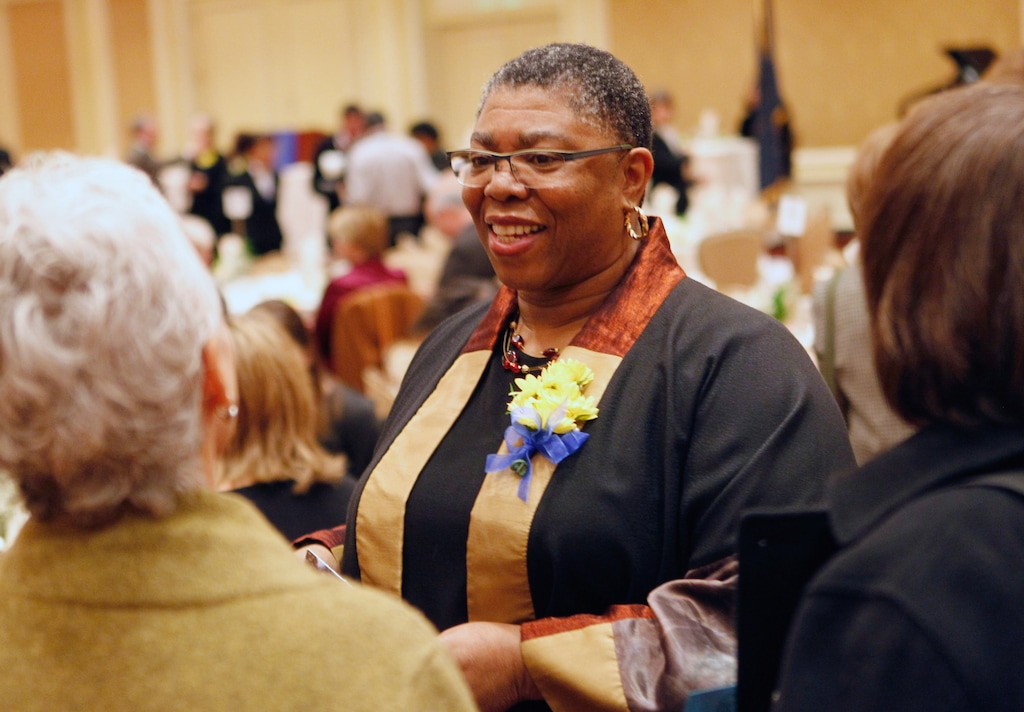
(University of Utah) Debra Daniels, the former director of the U.'s Women's Resource Center, who died on Aug. 14, 2026.
Daniels was equally excited. In 2020, reflecting back at her retirement, she recalled: “I thought, ‘If I don’t apply for it now, that will never come up again in my work cycle.’ So, I applied and here I am 17 years later.”
During Daniels’ tenure, Ellingson said, donations to the center’s scholarship fund ballooned, jumping from $60,000 to split among 12 students up to $250,000 available for more than 100.
Daniels also launched tutoring programs, meant to help support students working full-time or raising families, Ellingson said.
“It became a real, living part of the campus,” she said.
Ellingson, who also served as the U.’s associate vice president of student development, said Daniels changed her, too.
“I felt like I was her supervisor,” she said, “but she was my mentor.”
Challenges on campus
The jobs she did weren’t always easy, Ellingson acknowledged. But Daniels always seemed to find a way to reach people.
“She’s a born teacher,” Ellingson said. “But what’s fantastic about her is that you don’t know you’re being taught.”
(Al Hartmann | The Salt Lake Tribune) Debra Daniels speaks during a Salt Lake City's Human Rights Commission news conference in 2009.
A lot of Daniels’ approach came from her training as a licensed clinical social worker, where she spent the first 25 years of her career. She was able to explain oppression and privilege in easy-to-grasp ways that didn’t pass blame.
In one instance, Hall said, the U.’s administration called on Daniels to help address a situation where a white male supervisor mooned others in the office.
Daniels took the man out to lunch to explain why it was inappropriate and why it made his female staffers feel uncomfortable. He ended up thanking her “for letting me walk out of here with my dignity,” Hall recalled.
It aligned with one of the “Deb-isms” people knew her by: “People have to have their dignity,” Daniels would say. Another was, “It’s hard to hate anybody whose story you know.”
Several who knew Daniels said she was warm but firm. She preached living in the balance.
“She was compassionate, but she told you when you needed to be told,” Ellingson said.
The U. also asked Daniels to lead a 2015 discussion with students of color who felt ignored by the school’s administration. It became a meaningful conversation about safety and belonging — and how the university could improve.
“Of course you matter,” Daniels told the group, The Salt Lake Tribune reported at the time.
Hall, with a smile, said she “basically saved the administration’s a--.”
(University of Utah) Debra Daniels speaks at the grand opening of the U.'s updated Women's Resource Center on March 3, 2020.
A social work legacy carries on
Sonya Martinez-Ortiz first met Daniels at the center in 2008, when she interned there as a social work graduate student.
At the time, Martinez-Ortiz was struggling in her program. Daniels responded with encouragement, telling her the community needed more social workers like her.
“I can’t tell you how meaningful that is when you’re one of few women of color in your classes and on campus,” Martinez-Ortiz said, choking up. “I had this idea after getting to know her that I want to be like Deb.”
Sonya Martinez-Ortiz
She ended up following in Daniels’ footsteps and later served as the director of the Rape Recovery Center, like Daniels. Now, Martinez-Ortiz is a therapist and assistant professor at the U., training more students.
Claudia Navarro also worked with Daniels at the center, where she completed a 2012 practicum as a social work undergraduate student. There, she found “a sense of solidarity” in the women of color support group.
Navarro is now the director of clinical services at the U.’s University Counseling Center, where she hopes she carries on Daniels’ legacy.
“She’s just a titan in our community,” Navarro said. “We have lost a very powerful and special woman.”
The pieces that remain
A lot of the programs Daniels started no longer exist, Ellingson noted. That includes a campuswide Diversity Council.
But other pieces of her legacy carry on, including in a scholarship Daniels and Kai Medina Martinez set up.
Medina Martinez, who led the U.’s LGBT Resource Center before it was also shut down, worked down the hall from Daniels at the student Union building. Together, the two decided to pool their own money to support first-generation students studying social work. They each contributed what they could, about $1,000 a year.
The Daniels Martinez Scholarship is still awarded to a bachelor’s student each year, and now it’s endowed, so it will continue for years to come.
Daniels’ name also remains affixed to the many awards she received during her lifetime: the Linda K. Amos Award for Distinguished Service to Women of the University of Utah (2010); the Salt Lake Branch of the NAACP’s Rosa Parks Award (2013); and the Pillar of Hope Award from the Rape Recovery Center on its 50th anniversary (2024).
(Paul Fraughton | The Salt Lake Tribune) Debra Daniels in 2003, then as the client services director for the Rape Recovery Center.
There are little reminders, too, of Daniels in every day life. Maanum will think of her when she hears R&B music, recalling how Daniels loved to “let loose on the dance floor.”
Daniels loved southern barbecue, too, and had a light, jingly laugh that Ellingson said she can still hear.
She is survived by her two sons and a brother, who also carry her passion. She is preceded in death by her wife and partner of more than 30 years, Johna Gustin, as well as her parents and four brothers.
McCombs said even though the women of color support group no longer gathers, she’s grateful for “the awakening” it gave her and what Daniels taught her.
McCombs said, “Nothing to do but carry her spirit of service forward.”
Note to readers • Family and friends have organized a community celebration of life for Daniels on Sunday. It’s being held from 6 to 8 p.m. at Cactus & Tropicals in Midvale, 7696 S. Main Street.