 Courtney Tanner
A Utah university is considered “on the brink” of having to shut down due to serious financial shortfalls, according to a new national analysis.
Westminster University in Salt Lake City received a D grade in Forbes Magazine’s annual examination of the financial health of private colleges and universities across the country. That’s the lowest possible score and is considered by many higher education experts to be a deathblow portending inevitable closure.
The small private university tucked in the foothills of the Sugar House neighborhood has been struggling in recent years with rapidly declining enrollment.
Now, according to the Forbes analysis, Westminster is among the 27% of worst-ranked private schools nationally, receiving a D grade, and one of 20 considered “in dire straits financially” and “borrowing money and burning through their restricted donor funds to stay afloat.”
The analysis was released late last month and counts 928 private, not-for-profit colleges and universities in the U.S. that have more than 500 students. Three Utah schools are included, with Brigham Young University and Western Governors University also making the list.
BYU, which is owned and operated by The Church of Jesus Christ of Latter-day Saints, received an A+ ranking this year. That’s up from a B+ last year.
Western Governors University, an online school headquartered in Salt Lake County, received a C; it wasn’t included in the 2025 rankings.
Westminster University dropped from a C+ last year to now being among those with a D grade, or the equivalent of a 1.61 grade-point average (GPA). Forbes says that means it’s “on life support.”
Westminster acknowledged in a Tuesday statement that it has been facing recent challenges. But the Forbes analysis, a school spokesperson said in a statement, “doesn’t show the full breadth of Westminster University’s financial picture.” And it doesn’t account for, the school said, its strong student retention rate.
In 2025, 86% of first-year students stayed on for a second year. By comparison, the University of Utah’s rate is similar, at 85%. BYU is at 90%. The national average is 68%.
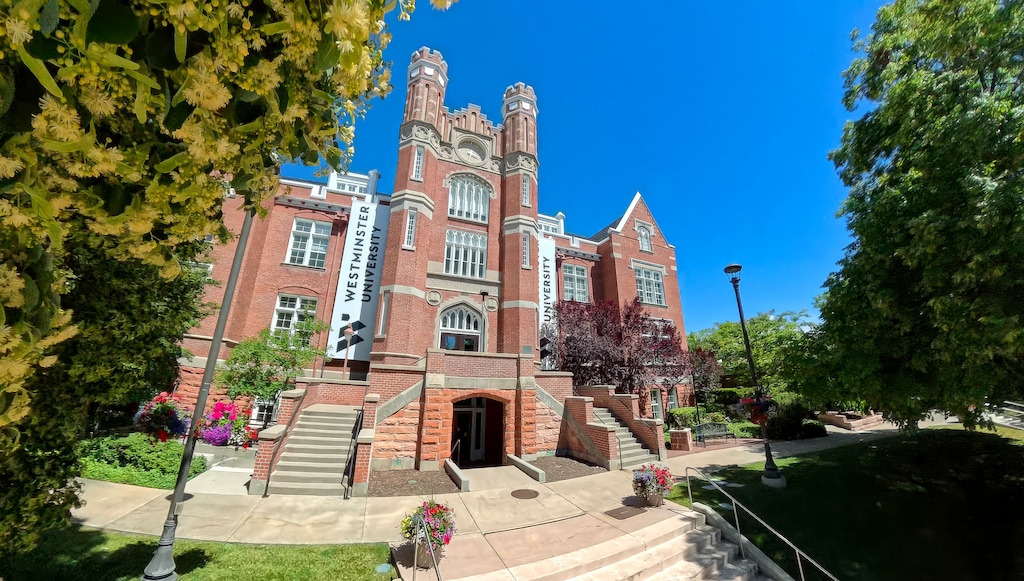
(Francisco Kjolseth | The Salt Lake Tribune) Westminster University is pictured on Tuesday, June 2, 2026.
The school added in its statement: “Over more than 150 years, Westminster has evolved many times to meet the changing landscape of higher education, and we are confident in our ability to innovate to address these challenges and continue to offer a meaningful life through learning.”
That evolution and innovation will likely have to come quick, financial disclosures indicate. In its most recent public 990 form, for the fiscal year ending in June 2024, the university reported about $6 million less revenue than the year prior.
For the year, it had collected $69.2 million in revenue, while expenses outpaced that at $81.7 million. That’s a negative net income of $12.5 million.
Overall, revenue has gone down for the school each year since 2018, when it was at $106 million. According to the federal 990 forms, that’s the last time the university was operating in the black.
The snowballing deficit has been accompanied by significant drops in enrollment.
The school had 2,692 students total, including graduates and undergraduates, in fall 2016. That fell to 1,168 total for fall 2025 — a steep 57% drop in a decade — according to numbers from Westminster’s common datasets.
Enrolling fewer students means bringing in less tuition money. Westminster carries a price tag that is among the highest in Utah, at about $46,000 annually, including fees, for the average in-state student, according to estimates on its website. (Most students there, though, receive some sort of financial aid or scholarship to attend.)
Westminster announced in April its pick for a new president to lead the school, Sylvia Torti. The university said Torti’s priority will be “growing enrollment and ensuring the university’s long-term financial health.”
(Westminster University) Pictured is Sylvia Torti, who was named the next president to lead Westminster University.
That includes, the school said, “expanding community partnerships, increasing fundraising [and] improving how Westminster tells its story to prospective students.”
In its statement Tuesday, Westminster added that its fundraising efforts “have never been stronger,” noting it has collected $100 million over the last 10 years. The 990s also reflect that.
Torti previously led the College of the Atlantic, a small private school in Maine. She is credited with building new donor relationships that helped fund operational expenses and new student scholarships.
The last time it’s clear the College of the Atlantic turned a profit was in fiscal 2021; its most recent 990 form shows it also has been running at a yearly deficit, with a $2.4 million difference in fiscal 2024 between revenues and expenses.
Torti’s tenure started at the college in July 2024; newer 990s are not available for that time frame. The school is not eligible for the Forbes list because its enrollment is too small, at 350 students.
The Forbes rankings look at 10 different factors to assess an institution’s financial health, including operating margins, endowment assets, debt coverage and enrollment growth. The point, according to the magazine, is to evaluate “true liquidity.”
The measure weighted the most is Unrestricted Assets Exclusive of Plant, or UNAEP.
That is meant to show, according to Forbes, “how much money a college actually has available each year to cover its expenses by removing illiquid items like dorms or academic buildings.”
Westminster ranked low on that, with a deficit of $24.8 million for the measure, and a three-year UNAEP decline of 38%.
(Francisco Kjolseth | The Salt Lake Tribune) Westminster University is pictured on Tuesday, June 2, 2026.
Forbes says 192 private colleges and universities are currently operating with negative UNAEPs.
“Many are essentially insolvent, drawing down credit or dipping into their donor restricted funds in order to make payroll and keep the lights on,” the magazine reported.
Private schools are in a particularly difficult place in an already challenging higher education landscape, Forbes acknowledged. A looming demographic cliff across the country has meant fewer high schoolers are seeking college degrees. President Donald Trump’s administration has also seemed antagonistic to universities and colleges.
The federal “One Big Beautiful Bill” capped student loans, which impacts higher-priced private schools more heavily. The administration has also deported and threatened international students, a demographic that often pays higher tuition rates and is now seeing lower enrollment.
Elite, selective schools, such as Princeton and Yale, have been able to weather that best, earning A+ rankings because they have higher endowments and more wealthy donors to rely on.
Smaller schools have suffered and shut down.
Hampshire College in Massachusetts, for instance, received a D ranking this year, and a 0.77 GPA equivalent. It is slated to shutter by the end of 2026, if not sooner.
Four schools that received D rankings last year all closed due to financial reasons.
Overall, the Forbes rankings show more private schools slipping. Roughly half this year were graded a C or worse. That’s the worst performance since Forbes started its annual private school financial health rankings in 2013.
Correction • June 10, 3:20 p.m.: The story was updated on June 3 to correct that Westminster University was among the 27% of schools Forbes analyzed to receive a D grade, the worst of Forbes’ rankings. On June 10, this story was updated to clarify that Westminster was also one of 20 schools Forbes considered “in dire straits financially” and “borrowing money and burning through their restricted donor funds to stay afloat.” The Salt Lake Tribune failed to disclose the June 3 update at the time.