 Mark Eddington
St. George • Jack Hoopes is going to trial next week over a $50 ticket for honking in support of a southern Utah “No Kings” protest. Legal scholars say he has a compelling constitutional argument to make.
But proving he was singled out for his political views could make his case difficult to win in court, they say.
Hoopes, an Ivins resident who served as a county prosecutor in southeast Idaho during the 1980s, is set to go to trial Nov. 24 in St. George Justice Court. The dispute stems from a March 28 “No Kings” demonstration protesting the Trump administration at Vernon Worthen Park.
After attending the event with his wife, Lorna, Hoopes said he tapped his horn in solidarity while driving past protesters lining 400 East. A St. George police officer pulled him over and cited him under a Utah law banning unreasonably loud or harsh horns and limiting highway horn use to safety warnings. According to Hoopes, the officer intended to give a warning at first, only to write a ticket after Hoopes questioned why another honking driver was not stopped.
Scholars told The Tribune were divided about Hoopes’ odds of prevailing in court. Frederick Gedicks, an emeritus professor at Brigham Young University’s law school, said Hoopes should prevail but stops short of predicting that he will.
Because honking while driving past demonstrators is a widely recognized way to show nonverbal solidarity, it meets the legal standard for protected speech, he said. In Hoopes’ case, the driver intended to support the “No Kings demonstration,” and bystanders would naturally understand that message.
“In sum, the honking at issue here is constitutionally protected speech,” said Gedicks, who taught constitutional law for four decades.
While courts often uphold general noise ordinances even when they incidentally limit speech, Gedicks argues the government has no valid reason to punish a few brief horn blasts in a business district during the workday. Unlike loud, repeated honking late at night in a quiet neighborhood, brief daytime honks do not disrupt the public peace, he added.
“The weakness of the government’s interest in punishing the honking,” he added, “is highlighted by the citing officer’s statement that he initially intended to only issue a warning, and wrote a citation only after the driver showed attitude.”
Gedicks also raised concerns that local officials may have targeted the driver over the protest’s anti-Trump message rather than the noise itself, noting that St. George and Washington County are heavily conservative and supportive of President Donald Trump.
“It’s hard to imagine that, if this had been a MAGA rally, as opposed to a ‘No Kings’ protest, a St. George police officer would have cited motorists for honking in support, or that a prosecutor would have pursued the charges,” he said.
Enforcing the law selectively based on a driver’s political beliefs would constitute illegal viewpoint discrimination, Gedicks said.
Uphill battle
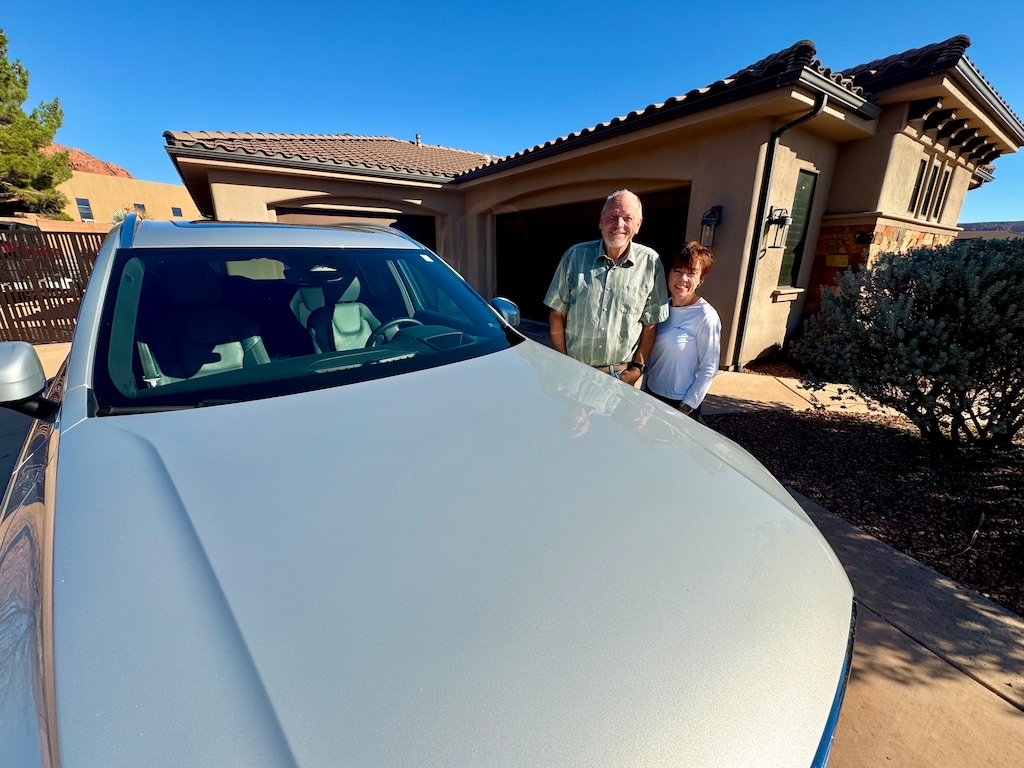
(Mark Eddington | The Salt Lake Tribune) Jack and Lorna Hoopes examine court documents related to Jack's citation stemming from honking his car horn in support of protesters during a "No Kings" rally in March in St. George.
Other legal and political observers, however, caution that Hoopes could face an uphill battle.
Clifford Rosky, a University of Utah law professor, said political honking can qualify as expressive conduct, but states may still prohibit horn use unrelated to road safety. Rosky pointed to a 2023 Ninth U.S. Circuit Court of Appeals ruling — which isn’t binding in Utah — that upheld a similar California restriction after finding no proof of discrimination in its enforcement.
Rosky said Hoopes would need concrete evidence that officers treated comparable expression at opposing political rallies and other events differently.
“I’m having some trouble getting across the finish line without evidence that the state declined to enforce this law against people expressing other political viewpoints by honking,” Rosky said.
As for the officer opting to write a ticket after Hoopes questioned him, Rosky noted that retaliation claims are also hard to win if an officer had probable cause for the stop.
Anthony Peacock, director of the Center for the Study of American Constitutionalism at Utah State University, echoed Rosky’s argument. Courts treat vehicle horns differently because they serve a traffic-safety function, he said. Comparing selective enforcement claims to a driver getting a speeding ticket while other speeders go without citation, Peacock questioned whether Hoopes would prevail.
“Even if you do have a political reason for showing support, it would have been better just to get out of the car and yell or wave your hands or do something like that, but not honk the horn,” Peacock said.
Hoopes, who plans to call witnesses and question the officer about enforcement practices at other demonstrations, said his defense focuses not on a blanket right to honk, but on unequal prosecution of the state statute in question.
“I’m not going to argue that just honking your horn is a constitutional right, but it’s the discrimination in the prosecution of it,” Hoopes said.
While acknowledging the case could go either way, Hoopes said he will pay the $50 fine if he loses.