 Jordan Miller
With lions and tigers, zoologists can determine when they’re expecting cubs. Bears? It’s not so easy.
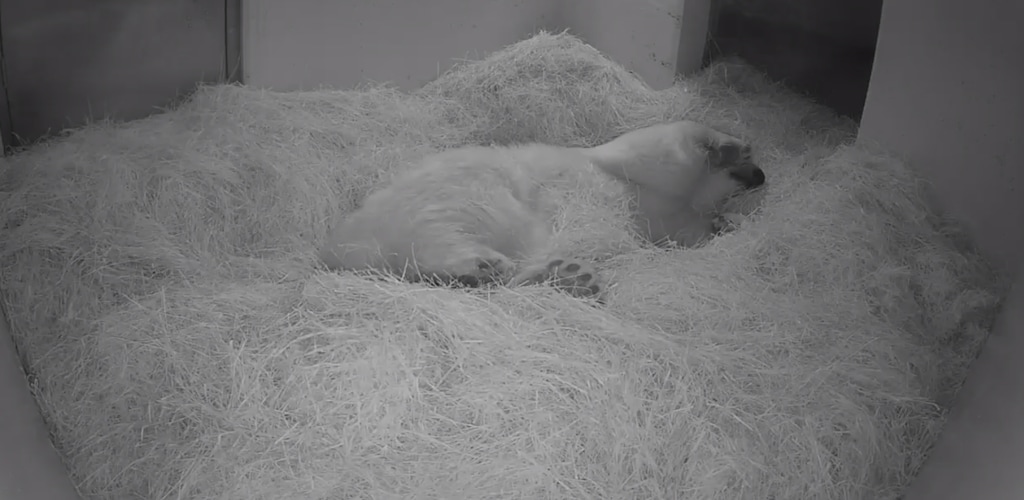
Hogle Zoo’s resident female polar bear, Neva, might be pregnant. The 10-year-old bear is being kept in a separate denning enclosure for the next few months, when she either gives birth or she doesn’t.
Polar bears don’t give any hints when they’re expecting. Blood and urine pregnancy tests aren’t effective for polar bears, and ultrasounds can’t penetrate their extra thick layers of fat, according to the Hogle Zoo.
Neva and her potential baby daddy, Nikita, have mated every year since they came to the Hogle Zoo in 2022, said Clair Hallyburton, the zoo’s associate director of animal care. Hallyburton oversees animal care within the Rocky Shores habitat, which houses bears, eagles, sea lions, seals and otters.
At 19 years old, Nikita is a bit more mature than his bear bride, but is “known to be a gentleman” in his interactions with Neva, Hallyburton said.
“He is very respectful of Neva when they’re together,” Hallyburton said. “He listens to the boundaries that she sets, he’s a pretty easygoing bear overall. I would say Neva has grown a lot in her time here. She came to us when she was pretty young … so she’s learned and grown a lot since she’s been here and she’s gotten a lot more confident, in especially that relationship with Nikita.”
(Trent Nelson | The Salt Lake Tribune) Neva, a 5-year-old female polar bear, explores her new home in the Rocky Shores exhibit at Hogle Zoo in Salt Lake City on Tuesday, Jan. 4, 2022.
Neither Neva nor Nikita have ever had cubs before, and that’s not uncommon. In the past decade, the Association of Zoos & Aquariums has found its accredited facilities are having less success breeding polar bears, Hallyburton said.
Polar bear breeding programs are still “very successful” in European facilities, Hallyburton noted, and experts at AZA facilities across the U.S. are working with veterinarians and researchers to determine why the American reproduction rate has reached such a “critical point.”
“At this point, we really don’t know,” Hallyburton said. “They’re really not eliminating anything. They’re looking at a lot of different things, environmental factors, for sure, just a lot of different stuff. They really don’t have the answers at this point, unfortunately.”
However, Neva has packed on weight in preparation for her denning season this year. She weighed in at about 822 pounds when staff moved her into her private denning enclosure, which is the equivalent of about five standard beer kegs and the heaviest she’s ever been in her life. It’s unclear if additional weight is an indicator for pregnancy, but “we’re all crossing our fingers and toes,” Hallyburton said.
(Rick Egan | The Salt Lake Tribune) Nikita the polar bear swims in the during the Polar Bear Freeze event at the Hogle Zoo, on National Polar Bear Day, on Saturday, Feb. 24, 2024.
Neva’s private den is kept as dark and quiet as possible, and the zoo staff keeps the temperature between 30 and 40 degrees, Hallyburton said. The den itself is covered in soft grass hay and is about 6 feet-by-5 feet — similar in size to what a bear would dig out in snow in the wild — and is connected to a larger antechamber stocked with food and water.
The sow will remain in her den until she has cubs, or shows zoo staff she wants to leave, Hallyburton said. Then she’ll be reintroduced to Nikita, who remains in their main habitat year-round.
“Once she goes into the den, your goal is to not disturb her at all and not go back in at all,” Hallyburton said. “The keeper staff move out — that’s where their office is, in the bear building, so they move completely to a different building during denning season. … We have to close down the road, which impacts our entire zoo staff and the way that everybody travels around the zoo. So it’s a pretty significant process that involves every department of the zoo.”
If Neva does give birth, she’ll likely have two cubs. They’ll remain in the denning area for a few months after their birth and eventually be moved to a separate enclosure, where they would be on exhibit but away from Nikita — because polar bear fathers don’t play a role in rearing their young, Hallyburton said.
“The cubs would probably stay with Neva until they were probably close to 2 years old, maybe right before,” Hallyburton said. “After that, it would be most likely that they would probably go to another facility, especially given the critical state of the polar bear population. There’s a lot of need for making new breeding pairs in the future.”