 Brooke Larsen
Conservation groups planned to help Utah’s national parks with major projects next year, ranging from surveys of newly exposed shorelines around Lake Powell to whittling down the backlog of historical preservation needs at Capitol Reef National Park.
The Interior Department blocked those efforts and several others last month, though, withholding $1.7 million in funding agreements with organizations that support research, visitor experience and resource protection at lands managed by the National Park Service across the state, according to internal government data posted by the Center for Western Priorities.
Across the nation, the department blocked $25.9 million in funding for 130 projects at national park sites, The Washington Post reported after reviewing internal government documents.
Interior spokesperson Aubrie Spady told The Washington Post that the department disapproved “agreements with groups actively working against the best interests of the American people and the priorities of this administration.”
The department did not respond to The Tribune’s questions about why the Utah projects were blocked.
All but one of the 12 agreements blocked in Utah were with the Great Basin Institute, a nonprofit that conducts environmental research and service with public land agencies. The Student Conservation Association led the other project that the department blocked.
The Great Basin Institute found no “through-line or commonality” between the 25 organizations whose agreements were blocked across the nation, Peter Woodruff, CEO of Great Basin Institute, said in an email to The Tribune.
“As a non-partisan partner to public land management agencies for over two decades, GBI does not decide or influence policy—we execute it,” he said.
(Bethany Baker | The Salt Lake Tribune) A car drives past the sign for Capitol Reef National Park near Torrey on Saturday, June 7, 2025.
The Interior Department canceled 74 of Great Basin Institute’s projects nationwide, which will result in 184 personnel not being hired or extended on their current projects, Woodruff told The Tribune.
“That’s 184 salaries that won’t be spent in gateway communities; that’s 184 people’s careers who have been redirected from projects they love and would have been invested in. Thousands of personnel hours not deployed to high priority park projects,” Woodruff said.
Great Basin Institute learned incrementally, project by project, about the disapprovals from the National Park Service. The Interior Department did not provide the nonprofit any notice or reason for the move, and the grant portal still shows “pending” for the projects as of Sept. 28, Woodruff said.
Previously, the projects had been approved by the park service and the assistant secretary of fish, wildlife and parks, Woodruff added.
“Every one of these projects had its funding secured, and parks were counting on the work getting done,” Kate Groetzinger, communications director for the Center for Western Priorities, said in a statement. “Blocking these agreements did not save a dollar. It pushed the work down the road and likely made it even more costly in the future.”
The Center for Western Priorities published a map and details on the disapproved agreements from an internal database it received from a source within the National Park Service. The list of disapproved projects reflects the status of projects as of Sept. 9. Here’s what it shows for Utah’s national parks:
Glen Canyon National Recreation Area
The department blocked four agreements with the Great Basin Institute for work in Glen Canyon National Recreation Area.
The largest chunk of funding blocked, $799,885, would have supported archaeological surveys of the thousands of acres and hundreds of archaeological sites recently surfaced around Lake Powell as the reservoir levels have dropped.
Without the funding, the park won’t be able to complete assessments and adequately manage sites exposed as Lake Powell drops, according to Woodruff and the database.
Another $20,000 would have also supported cultural resource surveys to assess the effects of increased recreation in some areas around the reservoir.
The department also blocked $138,572 for compliance and permitting support and $160,036 for two research associates who would further efforts to protect native fish and remove non-native fish.
The Colorado River is home to endangered and threatened native fish, including the humpback chub and razorback sucker, which are threatened by non-native fish such as the smallmouth bass. Federal and state agencies have invested extensive resources to try to protect these species and reduce the presence of smallmouth bass.
(Francisco Kjolseth | The Salt Lake Tribune) Anna Penner with the Glen Canyon Institute glides a skiff alongside Mike and Jenny Fiebig under Gregory Natural Bridge as it begins to reemerge from being completely submerged in Fiftymile Canyon, a tributary of the Escalante Arm of Lake Powell, as water levels continue to decline, Sunday, April 26, 2026.
Zion National Park
More than $315,000 in blocked funding would have supported four different cultural resource, archival and museum projects led by the Great Basin Institute at Zion National Park.
This included support photographing museum objects to expand digital access, historic research, processing resource management archives and inventory of museum records to resolve discrepancies.
Without these projects, collections may remain undocumented and inaccessible, preservation work could be delayed and unreliable data may persist, according to Woodruff and the database.
The department also blocked $69,292 for young people to help update, organize and digitize park maps at Zion. The work may have extended to Cedar Breaks National Monument and Pipe Spring National Monument.
Without this work from the Great Basin Institute, the park may lack updated maps and accurate resource data, which could affect quick responses to emergencies such as fires, according to the database.
Southeast Utah parks
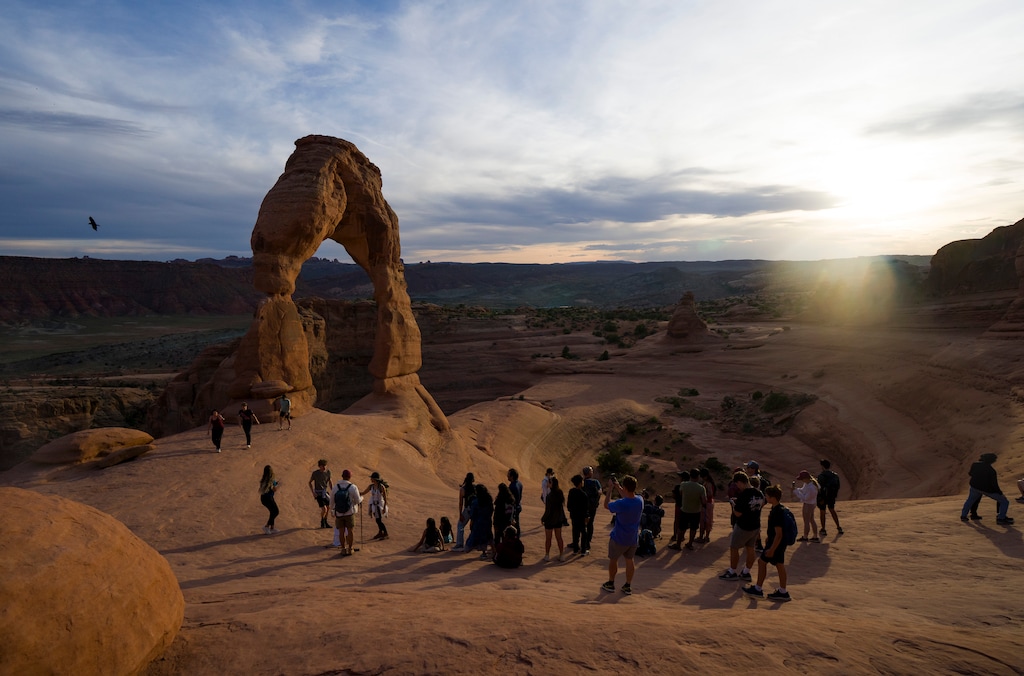
(Bethany Baker | The Salt Lake Tribune) Tourists hike in the Windows Section inside Arches National Park near Moab on Thursday, April 9, 2026.
The department blocked $51,783 that was awarded to the Student Conservation Association for two 23-week youth internships at the Southeast Utah Group parks and park service-managed monuments, including Arches National Park, Canyonlands National Park, Natural Bridges National Monument and Hovenweep National Monument.
The interns would have greeted visitors, helped with trip planning, issued permits, led walks and talks, assisted with school groups and supported Junior Ranger programs.
Bryce Canyon National Park
The department blocked $70,989 for the Great Basin Institute to support Bryce Canyon National Park with archival documentation and museum management. Without funding, research, data and collected items may remain “lost or undocumented,” according to the Center for Western Priorities.
Capitol Reef National Park
The Great Basin Institute sought $100,322 to support the management and protection of cultural resources at Capitol Reef National Park, particularly with high-priority, deferred maintenance and infrastructure projects.
That could include project planning, compliance with the National Historic Preservation Act, archival research, managing data, professional report writing and consulting with the Utah State Historic Preservation Officer.
Without the funding, the park could face additional challenges in managing cultural resources, as well as planning and compliance for high priority projects, according to Woodruff.