 Jose Davila IV
Cross E Ranch, the family-friendly farm in Salt Lake City, is back open for its famous fall festival, but attendees might want to soak it all in this year.
That’s because changes may be afoot.
The ranch’s owners have asked the city to allow homes to be built on 65 acres of their property, including where the festival facilities sit now.
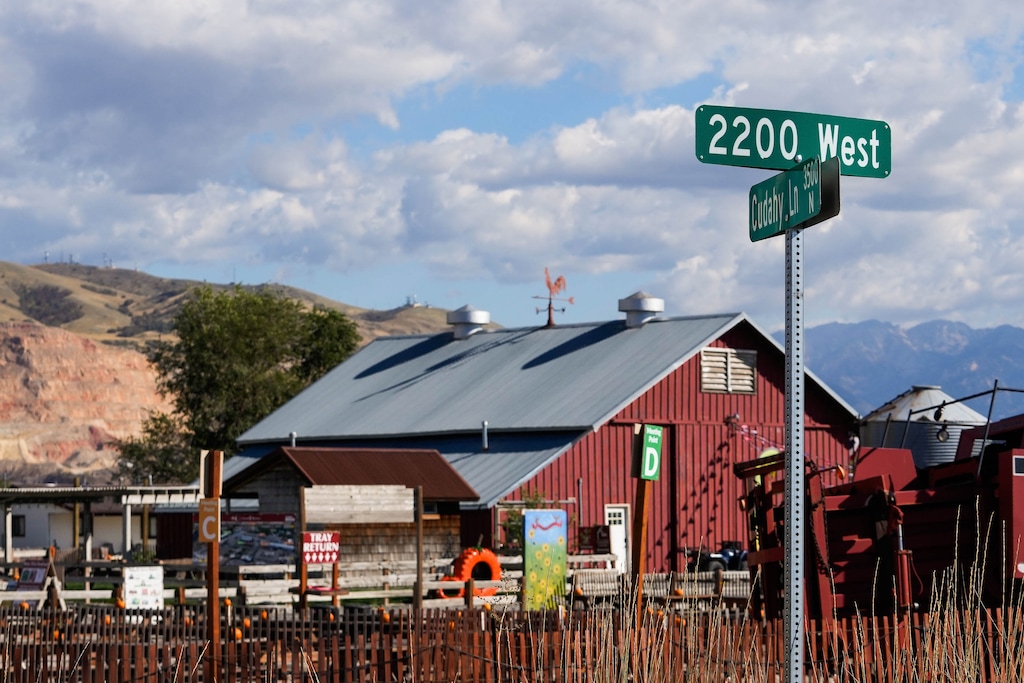
(Francisco Kjolseth | The Salt Lake Tribune) Cross E Ranch is pictured on Tuesday, Sept. 29, 2026. Its owners have asked city officials to allow homes to be built on part of the property.
Co-owner Heather Limon said the goal would be to sell the land to a developer if the rezone petition is approved. If that happens, she and her brother Dalon Hinckley would be able to keep the ranch — and its cider doughnuts — open to the public on the north side of Center Street.
“We’ve made it in a way that we can move over across the street and still keep the same farm charm, we hope,” she said, “and make that just a really fun place for people to still come and visit.”
The property up for the rezone lies south of Center Street (also known as Cudahy Lane), north of 3300 North and on both sides of 2200 West, the main road to the farm. The owners are asking City Hall to designate 25 of the acres, the southernmost portion, as suitable for multifamily housing up to four stories tall, and the other 40 acres for lower-density homes. The company is also looking to ink an agreement with the city that would allow the ranch to continue operating on a roughly 150-acre parcel to the north.
(Francisco Kjolseth | The Salt Lake Tribune) Cross E Ranch is pictured on Tuesday, Sept. 29, 2026. Its owners have asked city officials to allow homes to be built on part of the property.
Development news website Building Salt Lake first reported the application Monday.
Limon’s ranch is one of a few farms still in operation in Salt Lake City and is the best-known destination in the rural-but-changing Northpoint neighborhood. Development pressure has grown in the hamlet as developers eye its open spaces and easy freeway access for new factories and warehouses.
In the ranch’s case, though, some of Limon’s siblings have stakes in the land but don’t want to be in the farm business any longer. With the rezone and possible future sale, she’d be able to pay out those family members and keep the ranch going as a destination for Utah families.
“This is our last effort in trying to keep the ranch going,” she said.
(Francisco Kjolseth | The Salt Lake Tribune) Cross E Ranch is pictured on Tuesday, Sept. 29, 2026. Its owners have asked city officials to allow homes to be built on part of the property.
If the rezone petition is approved as-is, the owners have calculated that the land could hold up to 29 housing units per acre, or 1,885 in total.
The application also outlines four other benefits the city would receive from the deal: continued protection of the Jordan River where it runs past the northern parcel; the ongoing operation of the ranch as a community asset; a promise to build out the necessary infrastructure for the development; and an agreement that would protect flights into Salt Lake City International Airport.
If city officials reject the owners’ request, Limon said they would likely sell the land to a developer looking to build a warehouse or factory on it instead, which is allowed under the parcels’ current zoning.
(Francisco Kjolseth | The Salt Lake Tribune) Cross E Ranch is pictured on Tuesday, Sept. 29, 2026. Its owners have asked city officials to allow homes to be built on part of the property.
Any profits from a deal like that, however, probably wouldn’t be enough to keep the ranch going, she said.
City spokesperson Sofia Jeremias said the proposal will go before the city’s planning commission and then the Salt Lake City Council after a 45-day public comment period once the application is complete and reviewed by city staff.