 Andy Larsen
 Jose Davila IV
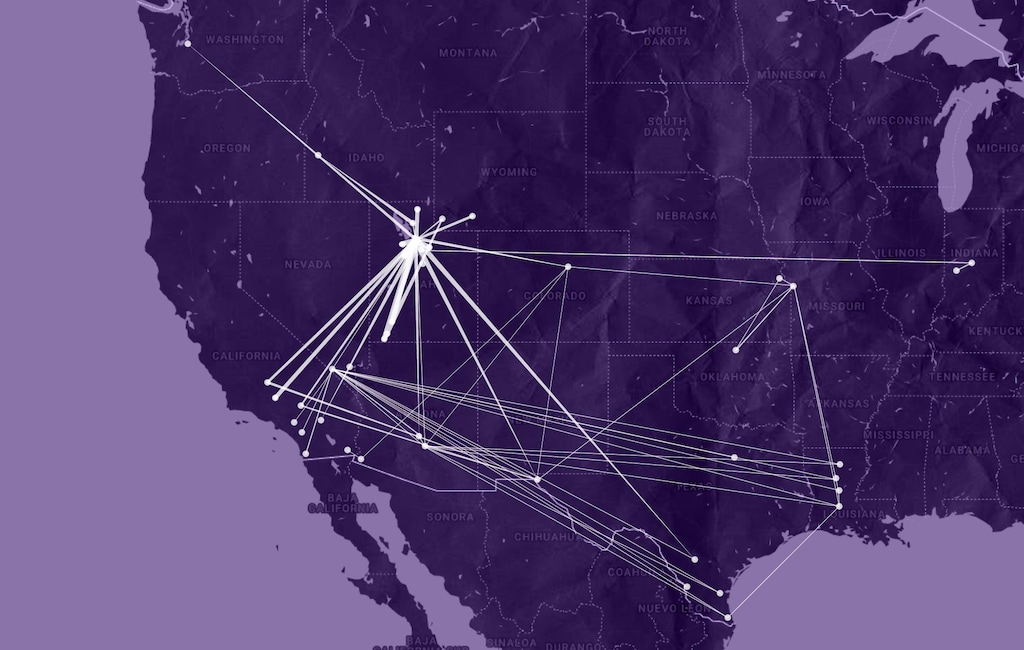
One Utahn who was arrested by U.S. Immigration and Customs Enforcement in Salt Lake City was first taken to Wyoming, then Nevada, California, Arizona, Texas, Louisiana and Mississippi before finally landing in Guatemala.
Another was picked up in West Valley City and moved 19 times before eventually being released.
Since the start of President Donald Trump’s second term, ICE has arrested and detained more than 7,400 people in Utah — about the population of Nephi. And almost 95% of those people were later moved to detention facilities out of state, according to early August numbers from the Deportation Data Project.
The opaque and constant ferrying of detainees — to places like Pahrump, Nevada; Tacoma, Washington; and Pine Prairie, Louisiana — isolates people from their families, complicates access to legal support and restricts due process, Utah immigration lawyers say.
“It has been very difficult, very frustrating, very tiring,” attorney Ysabel Lonazco said. “We are sad, but we keep fighting, you know, because that’s all we can do: keep fighting for our clients.”
(Chris Samuels | The Salt Lake Tribune) A person in shackles boards an Eastern Air Express plane for a U.S. Immigration and Customs Enforcement flight at Salt Lake City International Airport, Monday, April 6, 2026.
Under Trump, ICE arrests have surged across Utah, and with limited space to hold detainees, the federal agency has taken to moving people to larger facilities it controls elsewhere. It’s a practice that attorneys say impedes access to clients, creates more favorable conditions for the government to win deportation cases and extends unconstitutional detentions.
The Department of Homeland Security, meanwhile, says ICE’s detention decisions are made on a case-by-case basis and follow federal law.
“Despite a historic number of injunctions, [DHS] is working rapidly and overtime to remove these aliens from detention centers to their final destination — home,” a spokesperson said. “All detainees have access to phones they can use to contact their families and lawyers. All illegal aliens receive due process.”
Data reveals ICE’s transport trends
The Deportation Data Project, a joint effort from UCLA and the University of California, Berkeley, uses ICE data from public records requests and anonymously tracks detainees’ progress through the federal agency’s sprawling system of detention facilities. The data is current as of Aug. 6.
The tool below compiles that data into an interactive explorer. Pick one of the top 15 cities in Utah for ICE arrests, then see how the agency transferred those detainees through a chain of holding rooms, jails and detention facilities across the U.S.
On average, Utahns who are arrested by ICE are sent to 4.6 different facilities over the course of their detention, but the paths vary widely. The longest such path took a West Valley City arrestee from Salt Lake City to Somalia after 499 days in custody, with stops in Denver, Kansas City, Oklahoma, Louisiana, Texas and Arizona, with some of those stops repeated.
The path of detention for a given arrestee is unpredictable.
It’s not always the case, but many who are arrested in northern Utah end up going to Wyoming or California, while many who are arrested in the southern part of the state go to Nevada or Arizona. Paths seem to change over time — for example, 19% of arrestees statewide have been sent to California in 2026, compared to just 7% in 2025.
The federal government looked to turn a warehouse on Salt Lake City’s west side into a massive detention center earlier this year — part of an effort to expand its deportation capacity nationwide. DHS has since backed off of that plan.
Representing ICE detainees
For attorneys, finding their clients in ICE’s system is one of the initial hurdles they run into when someone is picked up by agents. Utah immigration attorney Nicholle Pitt White with Contigo Law said it’s relatively easy to find someone if they’re being held in the Salt Lake County jail, for example, but after that it gets harder.
“I’ve had days where I’ve been able to find a client, and I can tell their family exactly where they are. I can schedule an appointment because I know where they are,” Pitt White said. “And then the next day, they disappear from the system completely with no explanation. And all I’ve been told is that that means they’re in transit.”
In that situation, she won’t learn where they are for another 24 to 72 hours, cutting into her ability to prepare for their case. Under a new ICE policy rolled out earlier this month, finding detainees could be even harder for lawyers because the agency largely stopped sharing the locations of those who have a final order of removal from the U.S.
About 70% of out-of-state detention stays have been longer than 72 hours, the data shows. Once someone has landed in a longer-term facility — as opposed to a place like the Salt Lake County jail where immigration-related bookings are time-limited — their civil immigration case often moves to that new jurisdiction with them.
Lawyers struggle to access clients, courts
For Lonazco, most of her out-of-state detained clients are held in Adelanto, California, where there are two ICE detention facilities: the Adelanto ICE Processing Center and the Desert View Annex. Getting appointments to meet with those clients, even remotely, is frustratingly difficult and limits how she can advocate for them.
“In Adelanto, I struggle. It takes about a week for me to talk to my clients,” Lonazco said. “So, when I schedule a bond hearing and I want to talk to them before the bond hearing, it’s nearly impossible. So, I rely on information provided by the family members.”
That information, though, is often limited. Lonazco said if a client is in Utah, then she can interview them in person and get better answers about sensitive situations — like domestic abuse the client may have suffered — that could qualify them for some immigration relief.
Once detainees’ lawyers are able to schedule a bond hearing for their client in the new, out-of-state immigration court, actually getting in front of the judge is a whole other issue.
The immigration court system is separate from the independent federal judicial system. Immigration cases are handled by the Executive Office for Immigration Review, which is part of the Department of Justice, and, by extension, the executive branch of the U.S. government.
And while judges in the system have a procedure manual to follow, the rules differ significantly from judge to judge. For example, many adjudicators don’t let detainees’ lawyers appear through a video or phone call, forcing them to make expensive flights out to the court.
“By hamstringing lawyers and our ability to appear, it affects the clients,” attorney Kendall Moriarty said. “They know that clients are more effective if they have representation, and so it really actually helps achieve their agenda to make it really hard for lawyers to appear. And they’re doing a good job at doing that.”
Because the judges and the government lawyers ultimately work for the executive branch, Moriarty said it’s two versus one during bond hearings and deportation proceedings.
Even if Utah lawyers can get in front of an out-of-state immigration judge, the result is far more unpredictable than what it might be if the case were still in the Salt Lake City court. In Adelanto, for example, Lonazco said the court embraces frivolous points from government lawyers.
“The law is the law, but despite the law being the law, we still have arguments that are baseless, and the judge pays attention to those, and it’s like throwing a coin,” she said.
What can lawyers do?
Even if Lonazco, Pitt White or Moriarty are able to secure the release of someone held out of state, actually getting them back to their families is hard, too. ICE generally does not move detainees back to where it arrested them and instead “pushes them out the door,” Moriarty said.
She had one client who was released on bond from another California detention center and she only got four hours’ notice of when he would leave the jail. Luckily, she said, someone was within a two-hour drive and could pick him up.
“Otherwise, he would have just been in the middle of nowhere, like, walking,” she said.
Of those arrested in Utah and detained by ICE during Trump’s second term, only 579 people, or about 8%, have been released. Almost 5,500 people originally arrested in Utah have been deported. That’s roughly the population of Perry.
Some detainees have been fighting back against the out-of-state moves by filing wrongful detention lawsuits against the federal government. Utah-based federal public defender Benji McMurray has been working on some of those petitions, which usually argue that ICE hasn’t followed immigration law when it decides whom to detain.
The agency is supposed to make an individualized determination of someone’s flight risk and danger to the community when it opens a deportation case against them, McMurray said, and that’s not happening.
“Even though ICE has discretion to [move people], I think that by adopting a policy that says we’re just going to move everybody and let the California court figure it out,” McMurray said, “that extends the unconstitutional arrest and detention.”
McMurray said it’s important to keep detainees in Utah because they only have to wait about a week for a bond hearing here. In California, he said, there’s a much longer backlog of cases.
Heading out of state also means it’s going to be much harder for them to fight their case, with or without a lawyer by their side.