 Jessica Schreifels
Spanish Fork • Douglas Stewart Carter walked out of the Utah County jail Monday evening unshackled and without handcuffs. For the first time in 41 years, the former Utah death row inmate was free to leave.
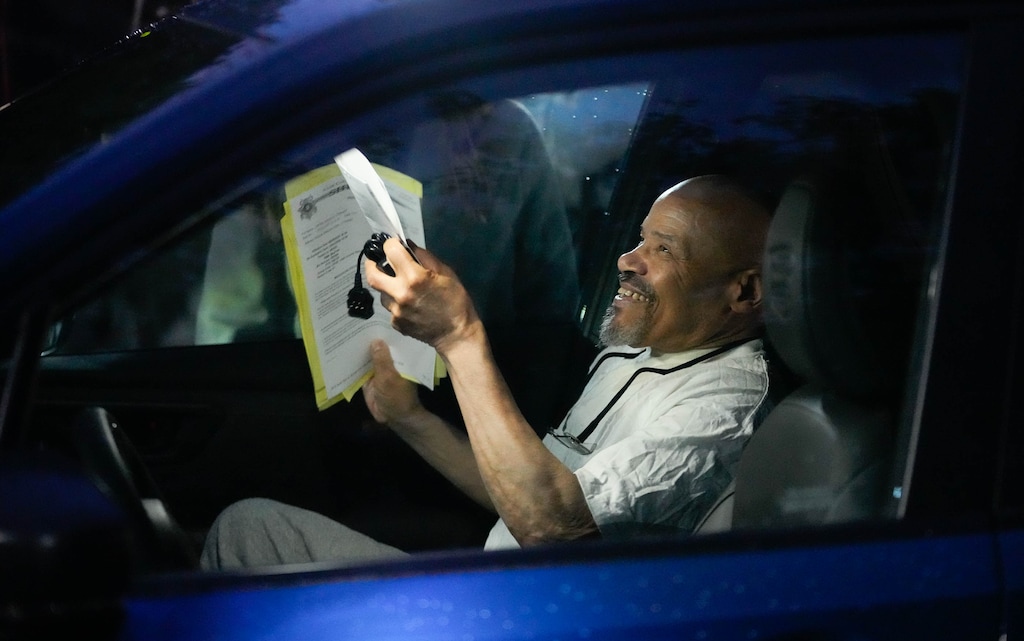
Carter didn’t speak as he was quickly led from the jail to his son’s Subaru, and he held paperwork to block his face from the bright lights of television cameras. His son, Tyler Anger, walked next to him and pushed a cart of all his father owned – a pillow with Carter’s inmate number written on it, and stacks of legal filings.
(Francisco Kjolseth | The Salt Lake Tribune) Former death row inmate Douglas Carter, who was charged 41 years ago, is joined by his biological son Tyler Anger, as he is released from the Utah County jail after it was recently determined that crime scene DNA doesn't match his, Monday, Sept. 28, 2026.
The now-71-year-old still faces an aggravated murder charge in the 1985 killing that sent him to Utah’s death row. But a judge allowed him to be released after new testing found crime scene DNA does not match Carter’s, prompting prosecutors to drop their pursuit of the death penalty.
Carter is required to wear an ankle monitor, among other strict restrictions.
Anger was adopted when he was 5 days old, he has said, and has never been able to meet his biological father in person. He brought his father a cup of coffee, he said, which he hoped was still warm after waiting for hours.
He hoped Carter would be able to see the stars when he walked outside.
“I’d like for him to just get a life that we all get to live,” he said. “None of us understand what this guy’s going through.”
Carter’s attorney, Neal Hamilton, called for prosecutors to drop the case — and asked the Utah attorney general’s office to support the defense team in their factual innocence petition, a rare legal step which would require a payout from the state. That money, Hamilton said, will help Carter support himself.
“He doesn’t have retirement. He doesn’t have savings,” Hamilton said, adding that police and prosecutors “took that opportunity away from him.”
Carter was convicted in 1985 of murdering Eva Olesen, a Provo woman who was the aunt of the then-Provo police chief. She was killed in her home, stabbed ten times and shot in the back of the head. Her husband, who said he had been out visiting a friend, told police he returned home and found her body partially undressed with her hands tied behind her back.
Eva Olesen was fatally stabbed and shot during a 1985 robbery of her home in Provo.
Olesen’s family had long believed that Carter was her killer. They strongly opposed Carter’s release during a Monday morning court hearing, saying they feared for their safety and weren’t convinced that the man didn’t have a role in Olesen’s death.
Theresa Olesen, Eva’s daughter-in-law, acknowledged in her statement to the judge that “procedures did not happen as carefully as they do now.” But she said they want him to remain in jail until prosecutors decide what to do next.
“We still do not believe he is completely innocent,” she said. “Hopefully the investigation will continue. We just want justice for Eva. And if he had any part of it, we want that to be known.”
(Chris Samuels | The Salt Lake Tribune) Theresa Olsesen, the daughter-in-law of victim Eva Olesen, speaks to media after a hearing for Douglas Carter in 4th District Court in Provo, Friday, April 3, 2026. Carter was sentenced to death for a 1985 killing, which was overturned in 2025.
Prior to the DNA revelation, the case against Carter was already shadowed by allegations of police misconduct that had led 4th District Judge Derek Pullan to vacate Carter’s conviction in 2022.
Pullan found that Provo police engaged in misconduct when they paid and threatened witnesses who later said they lied about Carter confessing to them that he killed Olesen. Carter’s defense team has also accused then-Lt. George Pierpont of coercing Carter to confess to the crime and destroying or ignoring evidence along the way that didn’t support Carter as the suspect.
In one court filing, the defense accuses Pierpont of steering focus away from Olesen’s husband, Orla, as a potential suspect. Orla Olesen, who died in 2009, allegedly had taken a polygraph test indicating he was being deceptive, and prosecutors in 1985 had considered filing criminal charges against him.
Carter’s defense team urged prosecutors to drop the case, but added that Utah officials need to do more, including commissioning an independent investigation into the circumstances of Carter’s prosecution. And Hamilton said he believes Pierpont’s other police work should be reviewed for potential problems.
(Francisco Kjolseth | The Salt Lake Tribune) Defense attorney Neal Hamilton, speaks to the media following the release of former death row inmate Douglas Carter from the Utah County jail on Monday, Sept. 28, 2026. It was recently determined that crime scene DNA doesn't match his.
Hamilton said Carter will now start figuring out his life in a world that’s changed profoundly since his arrest in the 1980s. He’ll be able to make choices about what he wants to eat and how he wants to spend his time. He’ll be able to open his own doors — something that’s been done by jail guards for decades.
“This is not going to be just a day at a time, but a minute-by-minute at a time,” he said. “He has a lot ahead of him. He has a lot of healing because the state has been traumatizing him every moment of every day for 41 years for something he did not do.”