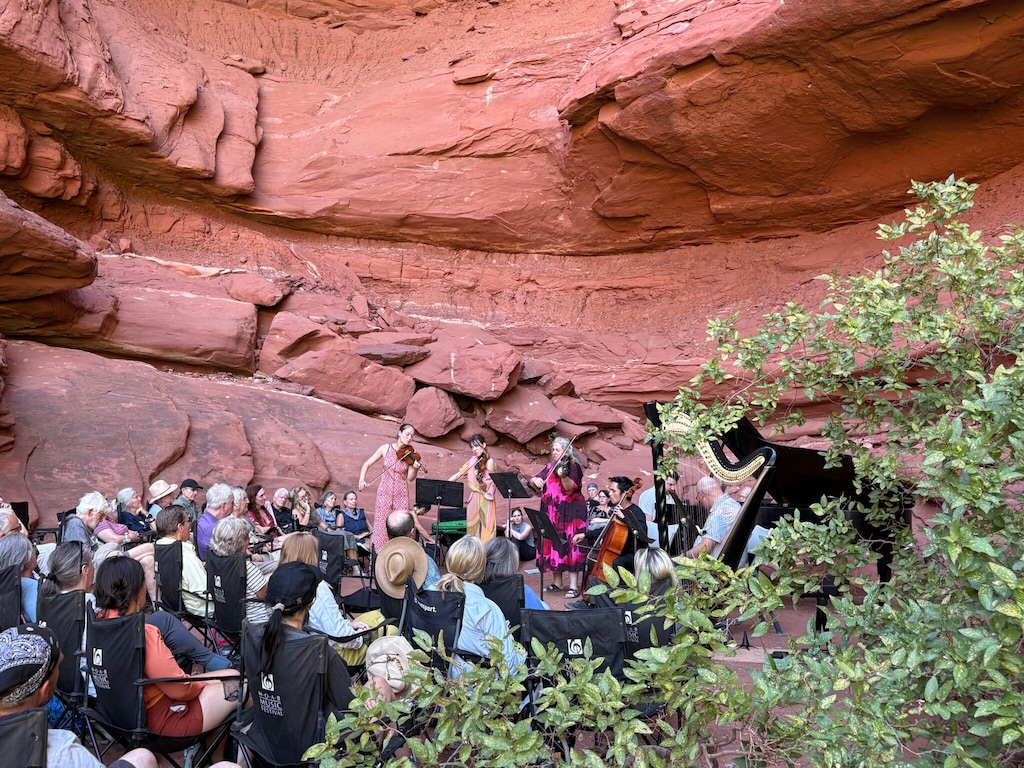
Before an audience could hear Schubert inside a remote Canyonlands National Park grotto, a team of about a dozen people had to unload a grand piano from a jet boat and move it along a sandy path into place.
The grotto is a broad, shaded alcove that forms a natural amphitheater framed by towering layers of red sandstone. Green vegetation borders its sandy floor, which has no permanent stage or seating.
The work began the night before, when crews loaded trucks with instruments, chairs and supplies, said crew member Duane Phillips. By about 6:30 a.m. Sept. 3, they were loading the piano onto a jet boat at the Potash Boat Ramp.
Wrapped and secured with ratchet straps, the piano traveled down the Colorado River. Crews also transported a harp, 89 camp chairs and other equipment.
By late morning, the piano was in place and tuned. Rows of black chairs covered part of the sandy floor, and the musicians gathered for a sound check beneath the layered rock.
“The rehearsal felt magical, and then playing for everyone, it just felt like time stopped,” violist Beth Guterman-Chu said after the performance. “It was really remarkable.”
Grotto I: Fantasy was the first of three concerts scheduled at the site during the 34th annual Moab Music Festival. The festival concluded Sept. 18 with performances at wilderness, outdoor and historic venues around Moab.
The roughly 75-minute concert brought together eight musicians on clarinet, harp, piano, violin, viola and cello in a program that the festival’s artistic director, Tessa Lark, built around musical freedom and departures from established forms and traditions.
Lark said the festival presented its first Grotto concert in 1994. The series has since become one of its signatures, partly because of the spectacle of presenting music in the remote setting and partly because its natural acoustics cannot be reproduced in a constructed venue, festival manager and production stage manager Josie Kovash said.
For audience members, the experience began aboard passenger jet boats. They traveled separately from the musicians, then walked from a riverbank landing into the amphitheater after the roughly 20-minute ride.
“By the time you get here, you’re already in this sort of different state of mind,” pianist Peter Dugan said.
(Andrew Christiansen | The Times-Independent) Musicians follow temporary boards along the sandy path from the Colorado River landing to the Grotto concert site Sept. 3, 2026. Crews install temporary walkways when needed rather than permanently modifying the wilderness site.
Working with the landscape
Staging that experience requires crews to work within conditions they cannot control. Weather and water can alter boat landings, access routes and the areas available for chairs and instruments.
The festival presents the concerts under a National Park Service permit. Because the site is in wilderness, Kovash said, crews cannot permanently modify it. Workers scout the grotto before each concert and adapt the production to the conditions they find.
Flash floods can leave mud or gullies where chairs and instruments previously stood, Kovash said. In written responses to The Times-Independent, Lark said the festival’s primary concern as river conditions change is access between the boats and the grotto, which can shift after each rain. Crews bring tools and materials to make the route safe.
Workers tie plants back rather than cut them and build temporary walkways when needed, Kovash said. After a major flash flood a couple of years ago kept boats from getting as close to the grotto, crews built a temporary bridge. Staff also monitor where rain is falling and where the water could travel.
“We are totally at the will of Mother Nature,” Kovash said.
Low river levels posed another challenge Sept. 3, when the boat carrying the musicians briefly struggled to leave the Potash Boat Ramp amid debris. The river nevertheless had risen substantially in the preceding days.
(Andrew Christiansen | The Times-Independent) Audience members disembark at a landing along the Colorado River before walking to the Moab Music Festival’s Grotto concert site in Canyonlands National Park on Sept. 3, 2026.
Provisional measurements from a U.S. Geological Survey gauge on the Colorado River at Potash show discharge increasing from about 1,440 cubic feet per second on the afternoon of Aug. 30 to about 2,800 cfs around the time of the concert. Lark said the increase made travel downriver easier.
Kovash said producing a Grotto concert can involve more than two dozen operations crew members, festival staff members and musicians, along with river operators, caterers and emergency responders. She credited the operations crew with carrying most of the load.
“They’re here super early and they’re here super late because we have to leave this exactly as we found it within a single day,” Kovash said.
Kovash compared the production with a metaphor she said Moab Music Festival Executive Director Mette Bryndum often uses: A duck’s legs work furiously beneath the water while the bird appears to glide across its surface.
“Hopefully you just see the duck gliding,” Kovash said.
(Andrew Christiansen | The Times-Independent) Musicians perform during the Moab Music Festival’s Grotto I: Fantasy concert Sept. 3, 2026, in a natural amphitheater along the Colorado River in Canyonlands National Park.
Listening to the landscape
The river journey also serves an artistic purpose. Lark said it gives people time to slow down and step away from work, cellphone service and the pace of ordinary life. Once inside the grotto, she hopes the music offers audience members, musicians and crew members a moment of respite.
“It’s a little bit of escapism, but it’s also a return to the truth of what life is,” Lark said. “… It’s just a moment back into being a human and nothing more.”
Before the music began, Rosa Tran, a National Park Service backcountry program manager, spoke about the relationship between people and wilderness.
“But how do you preserve something that you don’t feel a part of?” she asked.
Tran said imagination can connect people even with places they have not visited, while art and music can deepen that relationship.
“I believe that art and music connect the soul to spaces,” she said. “It carries you outside of yourself and deep within yourself.”
(Andrew Christiansen | The Times-Independent) Moab Music Festival Artistic Director and violinist Tessa Lark, left, and pianist Inon Barnatan perform Franz Schubert’s “Fantasy in C major, D. 934” during Grotto I: Fantasy on Sept. 3, 2026.
Introducing the program, Lark told the audience that a friend once described the opening of Franz Schubert’s “Fantasy in C major, D. 934” as sounding “like God is whispering the truth in your ear.”
Before the first piece, Lark invited the musicians and audience to observe a minute of silence, a Grotto tradition festival co-founder Michael Barrett began to let visitors hear the setting before the music, Kovash said.
The minute ended as pianist Inon Barnatan began Schubert’s “Fantasy,” with Lark on violin. Harpist Charles Overton, who was experiencing the grotto for the first time, described the transition from silence into the piano’s quiet rumbling as “definitely a moment I won’t soon forget.”
How those notes reached listeners depended on where they sat.
“It’s much clearer right in front of you, and then the further back you get, there’s this sort of natural reverberation,” violinist Geneva Lewis said.
Cellist Jay Campbell said someone walking through the grotto could hear the music’s tone and reverberation shift in real time, unlike in a concert hall designed to optimize sound throughout the room.
(Andrew Christiansen | The Times-Independent) Musicians rehearse William Grant Still’s “Ennanga” during a morning sound check beneath the Grotto’s towering red-rock walls Sept. 3, 2026. The piece features harp, string quartet and piano.
For musicians, however, the effect could be difficult to assess from the performance area. Clarinetist Mark Dover, another first-time Grotto performer, said he initially could not tell how the music was reaching listeners. After hearing much of the concert from the audience, he found the sound unexpectedly intimate.
“You can hear every little detail,” Dover said.
The landscape could add sounds of its own. Lewis recalled previous concerts when the wind began moving through the trees.
“All of a sudden the wind starts and the trees rustle, and it really adds to the music in a pretty profound way,” she said.
Campbell said that unpredictability could relieve some of the pressure musicians experience in formal venues because the instruments and sound might not behave as they would indoors.
“It helps not to be, like, super precious about everything,” he said.
Silence itself also felt different in the canyon. Guterman-Chu said the pauses within her music seemed more consequential there, a feeling she connected to the scale of the surrounding landscape.
“In general, this area feels so infinite, and then we’re surrounded by these incredibly tall, seemingly alive, moving rocks,” she said. “It doesn’t look like they’re standing still.”
(Andrew Christiansen | The Times-Independent) Harpist Charles Overton, right, and clarinetist Mark Dover rehearse Robert Schumann’s “Fantasiestücke,” Op. 73, during the morning sound check at the Grotto on Sept. 3, 2026.
Freedom within structure
The landscape helped shape not only how the concert sounded but what the musicians played.
The program began taking shape during last year’s festival, when Barnatan first visited the grotto and imagined performing Schubert’s “Fantasy in C major” there. Lark built the rest of the concert around that idea, linking musical fantasy to the 250th anniversary of the United States and composers’ freedom to depart from established forms and traditions.
The program included works by Schubert, Johann Sebastian Bach, Robert Schumann, Roberto Sierra, Kenji Bunch and William Grant Still, along with Lark’s own composition.
“The irony of freedom is that the more discipline and structure that exists, the more you can intentionally depart from it,” Lark said.
Her “Appalachian Fantasy” transformed a melody used in Schubert’s piece into an old-time ballad and fiddle medley. Lark framed the composition as a reversal of classical composers’ long history of drawing from folk music.
“I’m stealing classical themes and making them into folk tunes,” she told the audience.
Lark performed the piece in an alternate tuning on a carbon-fiber violin. Unlike the rare, centuries-old instruments the musicians often play, the waterproof instrument can travel on the festival’s multiday rafting trips.
Not every departure was intentional. One of Overton’s harp strings broke, a risk he said accompanies playing the instrument outdoors.
While he replaced it, Dugan and Campbell filled the pause with an impromptu rendition of Camille Saint-Saëns’ “The Swan” from “The Carnival of the Animals.” They finished just as Overton was ready to resume. Lewis later said she loved that the performance included the “mishaps and malfunctions” of a Grotto concert alongside its “moments of transcendence.”
Another unscripted moment arrived during Schubert’s “Fantasy.” As the music changed keys, a hummingbird flew into the grotto and remained briefly. Guterman-Chu and first-time attendee Lorraine Grant both noticed it.
“I couldn’t believe it because I felt like the hummingbird was participating and invested in the music,” Guterman-Chu said.
To Lark, the festival joins “the beauty of nature” with “the most beautiful thing I think humans do, which is make art and music and come together.”
The setting also humbled her. Lark said she still becomes nervous before every concert, but less so in the grotto, where the landscape’s scale reminds her that people and performances are temporary. That perspective, she said, brings greater gratitude.
“The grotto will be here somehow long after we’re gone, and this is just a moment in time for us,” Lark said.
(Andrew Christiansen | The Times-Independent) Violinist Tessa Lark and pianist Inon Barnatan rehearse Franz Schubert’s “Fantasy in C major, D. 934” beneath the Grotto’s sweeping sandstone walls Sept. 3, 2026. Lark is also artistic director of the Moab Music Festival.
Leaving without a trace
Grotto I was one of the festival’s benefit concerts. Tickets cost $500 including fees, with $200 considered tax-deductible. Bryndum said proceeds support school assemblies, music student scholarships, outreach at local care and senior centers and events offered to the Moab community without charge.
This year’s festival also included floating concerts, music and dark sky hikes, performances at ranches, lodges and private homes and a multiday musical raft trip.
Kovash acknowledged that the Grotto concert’s extensive production contributes to its high price. She said people can volunteer at the festival’s music hikes to experience music outdoors without buying a ticket. The festival also presents free community events.
Audience boats began the return trip upriver around 3:30 p.m., while crews remained to reverse the morning’s work. They packed the chairs, instruments and other equipment, with the grand piano scheduled to begin its return trip around 5 p.m.
By day’s end, every chair, instrument and piece of equipment had to be removed. The concert hall existed for only a day.
Lewis said the experience could endure far longer.
“I remember every time I’ve been here, and if it had only been once, it would stay with me forever, undoubtedly,” she said.
This story was first published by The Times-Independent.