 Sean P. Means
Last week, a group of Utah hikers caught in a severe thunderstorm near the summit of Mount Timpanogos took shelter in a nearly century-old structure called the “Tin Shack.”
As they tried to shield themselves from the elements, lighting struck the steel enclosure, killing a 19-year-old in the group. The other nine hikers suffered minor injuries, the Utah County Sheriff’s Office has said.
What is a “Tin Shack” doing atop the mountain, and why was it first built? Here’s what we know.
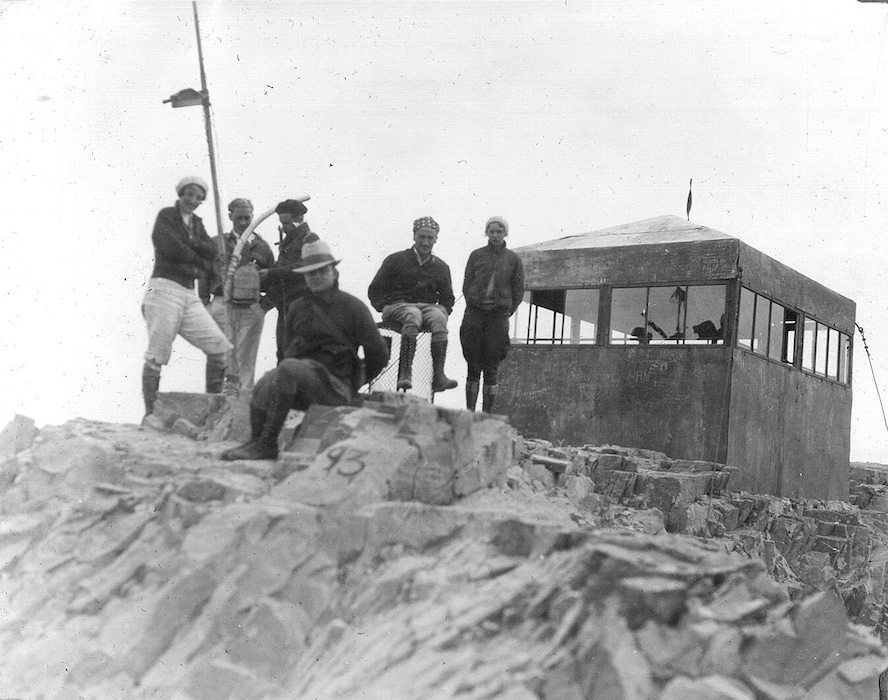
It was originally an observation station
The structure was built in 1927 as an observation station — one that allowed visitors to see “a great circle of almost 200 miles,” according to a report in The Salt Lake Telegram, the longtime afternoon edition of The Salt Lake Tribune.
From the lookout station, one could see Dugway Mountain 90 miles away in the West Desert, The Telegram reported, “while King’s Peak, 72 miles to the east, is the extent of visibility in this direction.”
(Rudy Mesicek | The Salt Lake Tribune) A view from inside the "Tin Shack" near the summit of Mount Timpanogos on June 20, 2026.
The ranger who supervised the construction, Vivian N. West, broke camp in September 1927, shortly after completion and before snow arrived, The Telegram reported.
West’s son, Fred, told The Tribune in 1980 that his father hired a local man at Mutual Dell in American Fork Canyon whose burros hauled sand and building materials to make the concrete for the building’s base.
The structure originally had visual markers set up inside to guide visitors’ views to landmarks below, The Tribune reported. Over the years, people took the markers as souvenirs and gusty winds broke out many of the windows.
Those former windows inspired the building’s other nickname, “The Glass House.”
After years of disrepair, inmates from the Utah State Prison climbed up the mountain in 1980 and gave the building a new coat of aluminum paint. Not only did the paint cover years of graffiti, The Tribune reported, but it also reflected beams of sunlight off the mountain for the first time since the windows were broken.
For decades, the Tin Shack served as a formal resting spot for an annual July group hike to Mount Timpanogos summit. That hike began in 1912, about 15 years before the shack was built, and ran for nearly 60 years, according to Marc Jonathan Wein, a Brigham Young University historian.
The organizer of the first hike, Eugene Roberts, was BYU’s first director of physical education and had the nickname “Timp.” Nineteen students went that first year; by 1957, four years after Roberts died, 1,297 hikers made the trip, Wein wrote.
The U.S. Forest Service asked BYU to discontinue the organized hike in 1970, citing concerns over erosion, The Daily Universe reported in 2015.
It’s not the mountain’s only metal landmark
Hikers on Mount Timpanogos sometimes encounter more metal — wreckage from a U.S. Air Force bomber that crashed on March 9, 1955.
According to the Hill Aerospace Museum website, the World War II-era B-25 bomber was on a training flight from Montana to southern California, and stopped to refuel at Hill Air Force Base near Ogden.
After taking off from Hill, the plane encountered winter weather and low visibility and crashed into the east side of the mountain.
All five men on board — three crew members and two civilian passengers — were killed.
Three “daring mountaineers” found the wreckage and dug three of the victims’ bodies from the snow, The Tribune reported. The remains of the final two were recovered a month later, as snow melted, according to the museum’s account.