 Jose Davila IV
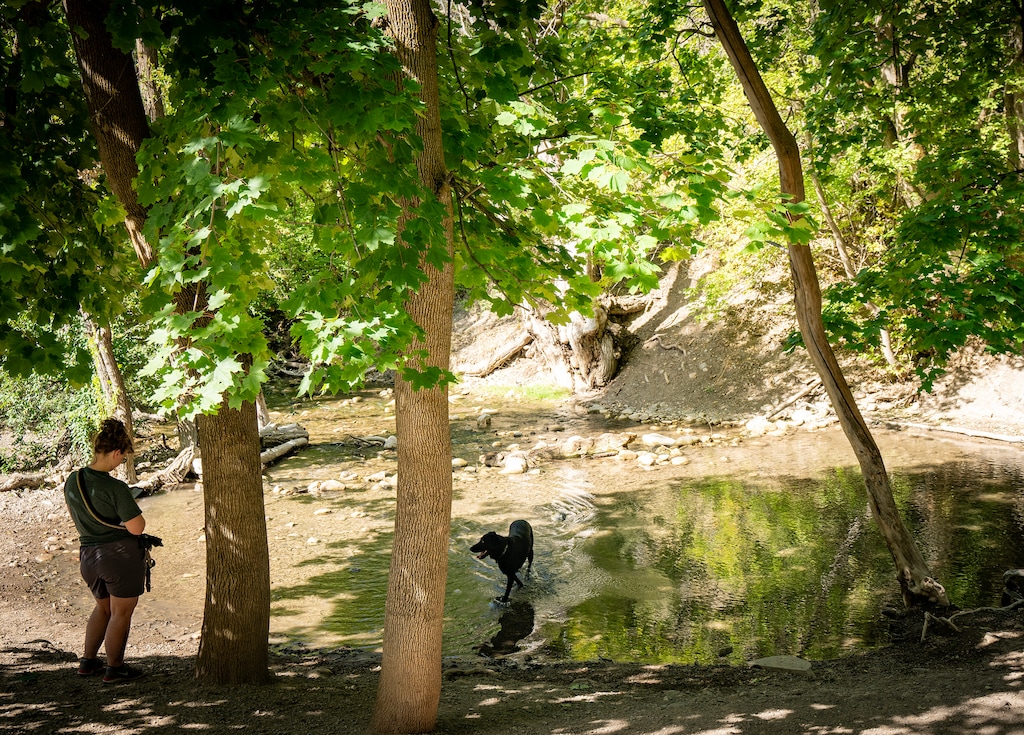
Sid the Corndog enjoys a morning stroll along City Creek every day.
The pooch and his owner, Anna Palmer, like the shady Freedom Trail that parallels the watercourse in City Creek Natural Preserve because he can be off-leash and cool down in the brook when he gets hot.
“It’s in the city, just close enough, but you still feel like you’re in nature, and it’s just gorgeous,” Palmer said during a September visit to the preserve. “I think having the water is nice for the dogs to cool down. We love it here.”
But there are some sinister bacteria lurking in the creek: E. coli, specifically. The microscopic organisms can cause gastrointestinal issues for humans and sickness in dogs, too. They’re also an indicator for other waterborne pathogens present in the creek.
Earlier this year, the Utah Water Quality Board confirmed that City Creek below Bonneville Boulevard saw amounts of E. coli higher than the state’s allowable levels, so Salt Lake City’s Public Lands Department put up signs at the preserve warning dog walkers of the pollution. At the same meeting in June, the water panel said Bingham Creek, which flows out of the Oquirrh Mountains and into the Jordan River, had its own E. coli problem.
Palmer knows the signs are up, but after some initial caution early on, she generally lets Sid drink and play in City Creek. He wasn’t the only dog splashing around; There were at least 10 other canines enjoying the water that morning.
Palmer said Sid hasn’t had any health issues since the signs went up, but it’s hard to know when the water is actually safe.
E. coli levels in City Creek usually peak in the early fall, according to a study by state water quality experts. The brook is listed as impaired under state guidelines, but that doesn’t mean it’s constantly inundated with high levels of bacteria.
In the warm-weather recreation months (think May through October) from 2014 to 2024, state data showed City Creek had elevated bacteria levels 44% of the time and exceeded the maximum allowable level 15% of the time.
In short, it’s not bad every day, but the state doesn’t think it’s worth risking.
Managing creek access
(Rick Egan | The Salt Lake Tribune) The entrance of the Freedom Trail at Memory Grove on Saturday, Sept. 12, 2026.
For Salt Lake City resident Sierra Champion and her dog Maggie Mai, it’s hard to tell when the creek is unsafe. Earlier this month was the first time she brought Maggie Mai to the preserve this summer.
“My friend warned me about the E. coli level [and] the sign,” Champion said. “So, I wasn’t really sure what that meant for the health of my dog.”
The most up-to-date water quality readings for City Creek are publicly reported by Salt Lake County, but that data comes out just once a month and includes only one sample, making it hard to gauge pollution on a daily basis. Since May, there have only been four data points reported, with one of them — Sept. 2 — showing E. coli above allowable levels.
“I am aware folks want to see real-time data for waterways but at the current time that is not possible,” county watershed manager Bob Thompson said in an email. “Each sample requires a technician to fill a 100 [milliliter] bottle with stream water, transport that bottle back to our office, add E. coli reagent, incubate for 24 hours then read [and] record the sample in our database.”
Utah’s Division of Water Quality doesn’t currently list the brook as one of its priority waterbodies for monitoring.
Champion would love to see a sign similar to the ones posted at entrances to national forests that show fire danger on any given day, so that she can tell when it’s safe to let Maggie Mai play in the creek.
Salt Lake City Public Lands spokesperson Jana Cunningham said that was “a good idea and is something we can look into.”
As for possibly restricting access to the creek more significantly, Cunningham said her department wasn’t planning to do anything else immediately. Next year, Public Lands will start a public service campaign focused on getting residents to clean up after their pets.
How to boost water quality
University of Utah ecologist Jennifer Follstad Shah said controlling dog poop is key along City Creek, because that seems to be a major cause of contamination. (E. coli can also come from human, farm animal and wildlife waste.)
“It’s really critical that pet owners make sure that their animals don’t defecate in or along the banks of the creek,” Follstad Shah said, “or if they do, pick it up right away and dispose of it properly.”
Jordan River Commission Executive Director Soren Simonsen said if residents can restrict their pets from entering the water, they’d help both the health of the creek and their furry friends. (City Creek, like Bingham Creek, eventually flows into the Jordan River, which also has high E. coli levels.)
“Keeping pets out of the water is both a protection from fecal matter that may come from pets,” he said, “but it’s also to protect the pets themselves from the E. coli.”
Cunningham said the city wasn’t considering closing off the preserve to dogs and that Public Lands’ goal is to change visitors’ behavior through education.
Officials are, however, considering changes to the creekside landscape in the preserve.
“Working with Salt Lake City, we would really like to start increasing the health of the streamside vegetation near City Creek itself,” watershed manager Thompson said, “because that acts like a buffer and it filters a lot of the pollutants that could come from the walking trails.”
Thompson said it’s also possible that the city and county could add some fencing along the creek to keep pets out of certain sections.
It’s a strategy that has seen success elsewhere in Utah’s capital. Adding plants and fencing along Parleys Creek in Parleys Historic Nature Park — another beloved off-leash spot — helped cut E. coli levels there, he said.