 Tony Semerad
A larger and more sweeping version of Salt Lake City’s debate on hotly controversial license plate-reading cameras deployed by police is now blowing up statewide.
For several members of the City Council, it has also turned more than a little invasive and scary, after a series of recent uninvited visits to their private homes related to the issue.
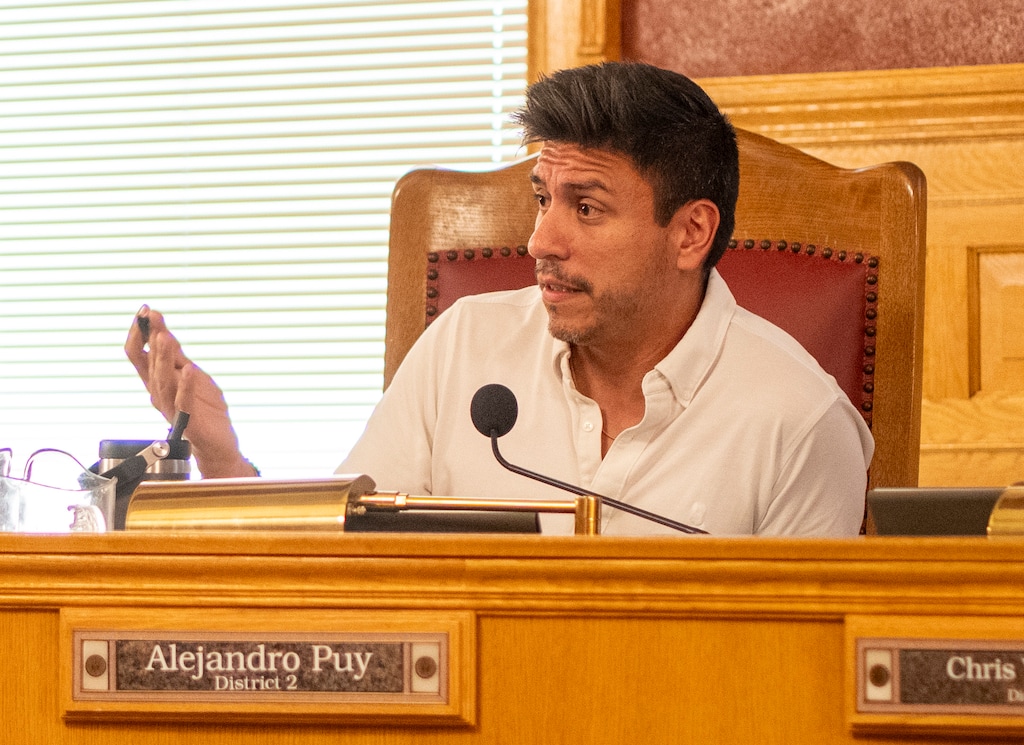
Council Chair Alejandro Puy said he had delayed a key public hearing set for Tuesday at City Hall on a new draft ordinance to add guardrails on law enforcement use, access and data-sharing related to automatic license plate readers.
Many refer to these devices generally as Flock cameras, but Utah’s capital uses a different brand called Vigilant.
Its contract with that Motorola subsidiary has been in place for years, but issues surrounding deployment of license plate readers on city streets elsewhere have recently escalated into an explosive national debate about privacy, civil rights and mass surveillance.
Puy said he sought the hearing delay with a direct eye on Utah’s Capitol Hill, with word that state lawmakers were already opening related bills in advance of their January session and plan to weigh in.
“It’s obvious,” he said, “that passing an ordinance that could potentially immediately have to change is something that is a waste of everybody’s time and resources. So we decided to wait for a minute and see what direction some of the legislators are going.”
Council members said late Tuesday the item would be rescheduled for a hearing once a revised version was ready for public review.
Then at a legislative hearing Wednesday, lawmakers made clear they do intend to propose new laws regulating the cameras and other police and, potentially, private-sector surveillance technologies.
“[License plate readers] are hot because that’s what’s in the news,” said Sen. Calvin Musselman, R-West Haven and chair of the Senate Judiciary, Law Enforcement, and Criminal Justice Committee.
“But there’s lots of other technologies that we need to have guardrails on,” Musselman said, “and they’re all just as concerning.”
Home visits viewed as ‘intimidation’
Puy, who represents the city’s west-side District 2, confirmed that he and several council colleagues had an as-yet-unidentified person — or perhaps multiple people — target their homes in recent days with an assortment of stickers and signs related to the camera controversy.
Puy said the unwelcome visitor then appeared to highlight their actions in a since-deleted post on social media, tagging at least Puy with a seemingly taunting caption: “the surveillance economy goes both ways.”
Puy said the incident last week, which he reported to police, felt intrusive and had breached his personal boundaries. It also happened to damage one of his own cameras put in place to monitor his home.
“There are ways of disagreeing, having a conversation and debating issues that don’t get to that point,” the council chair said. “I can move past it, but I can also see with the agitation, how people can quickly cross the line.”
Council colleague Victoria Petro, a single mom with three children living with her, posted a video on social media voicing anger over a similar experience of coming home to find the same sign and sticker plastered on her front door.
“They came to my house and they made sure they put a marker up,” Petro said in the emotional five-minute video, “so that when I go to sleep at night, I know that they know where I live.”
The District 1 council member cast the incident as a blatant — and failed — attempt to intimidate her, even though she has continued in her council role to scrutinize police use of cameras and said she hasn’t “found the path yet to approve these license plate readers.”
“Take your bloodlust and find somewhere else for it,” Petro said to whomever tagged her home. “I’m not intimidated. I’m not backing down. I’m doing my damn job.”
Council member Erika Carlsen, in Ballpark-centered District 5, said she also had the same kind of flyer placed at her home.
“It’s unsettling because my home is also my family’s home,” Carlsen told The Salt Lake Tribune. “There are many ways to make your voice heard and hold us as elected officials accountable without intimidating families or loved ones.”
Several others on the council said their homes had not been similarly targeted, including council member Dan Dugan, who nonetheless decried the incidents, as did others.
“I understand the concerns of residents,” said Dugan, who represents east-side District 6, “but the intimidation tactic is not the way to a healthy productive dialogue.”
Capitol Hill vows to weigh in
As issues around license plate readers continue to roil Utah’s capital and other cities, lawmakers heard Wednesday of a host of privacy safeguards already part of state laws enacted since 2013, including a series of restrictions on how police and other government entities can use them.
Mirroring the contours of Salt Lake City’s draft ordinance, Utah law also tightly limits the cameras only for use:
• As part of an active criminal investigation.
• To apprehend subjects of outstanding police warrants.
• To locate stolen vehicles.
• Or to locate missing or endangered persons.
State code also limits how long captured data can be retained to no more than nine months — a limit the American Civil Liberties Union has said it wanted added to Salt Lake City’s ordinance.
Lawmakers were told that officers who violate access protections can face criminal sanctions, as well as investigations and loss of their credentials through the state’s Peace Officer Standards and Training, or POST.
Law enforcement authorities, meanwhile, also shared a number of “success stories” on how the technology has been used to solve major crimes, while also committing to responsible use.
“Nobody in Utah law enforcement leadership supports broad-scale indiscriminate tracking of the American public,” said Herriman Police Chief Cody Stromberg, who also serves on the Utah Law Enforcement Legislative Committee.
“And if anybody in law enforcement would support that principle,” Stromberg added, “then they clearly don’t understand the oath that they swore to the Constitution.”
Lawmakers confirmed the contentious topic will be on their agendas come January.