 Brock Marchant
Note to readers • Cache Valley’s rapid growth presents challenges. We are exploring potential solutions to give you the context and facts you need to make informed decisions. Donate here to help us continue solutions-first reporting for Cache Valley.
Logan Canyon • In 1985, the second-coldest temperature ever recorded in the Lower 48 was reached in Utah.
The frigid air, collected at the basin of Peter Sinks in Logan Canyon, had dropped to 69.3 degrees below zero before Zane Stephens, then a Utah State University meteorology student, hiked into the sinkhole to collect the reading.
In an interview with Utah Public Radio decades later, Stephens recalled that those subzero hikes he took to monitor the station — which he braved in moon boots and snowshoes — occasionally left him with frostbite.
It was a much more comfortable — albeit notably bouncy — journey in late July of this year, when scientists with the Utah Climate Center made the voyage in trucks, jostling along the somewhat precarious canyon road as the vehicles occasionally kissed the rocks beneath.
With them was András Dobos, a Hungarian scientist who aims to further study the weather phenomenon that often makes the bottoms of sinkholes colder than their rims.
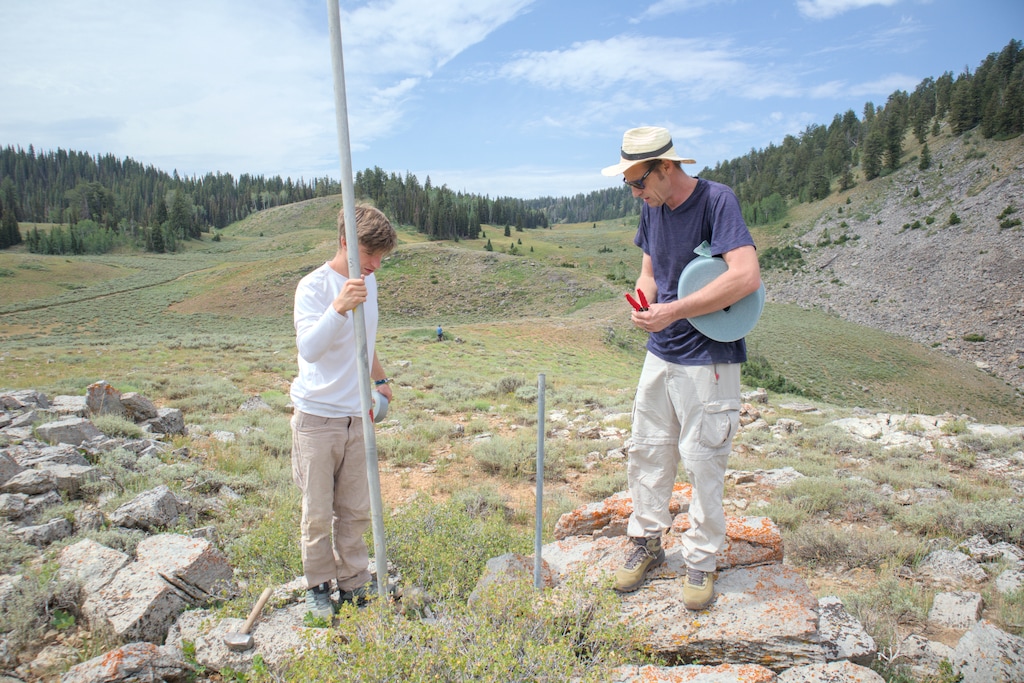
(Brock Marchant | The Salt Lake Tribune) Scientist András Dobos, left, and Utah State University graduate research assistant Tim Wright climb the edge of a basin in Logan Canyon to install a temperature sensor on July 29, 2026.
It’s a concept many Utahns are undoubtedly familiar with: inversions. They happen when a layer of warm air traps cold air below, and in places like the Salt Lake Valley and Cache Valley, they can also trap wintertime pollution.
Dobos, whose research spans the globe, wants to know more than the difference between the temperature at the top and bottom of Peter Sinks, as well as other sinks in northern Utah. With the help of the Utah Climate Center, he set up measuring stations at different heights in the limestone bowls.
These measurements, he said, will help scientists better understand how the microclimates differ from other geographical basins that host mini inversions.
And this, he said, can help Utahns.
“In Utah, cold air pools and generally the basin [effect] can impact our daily life,” he said in an email. “Understanding these processes can also help with agriculture, forestry, environment protection and adaptation to local climate conditions.”
Tim Wright — a graduate research assistant at USU’s Plants, Soils and Climate Department — said a better understanding of inversions can improve the weather forecasts that predict them.
(Brock Marchant | The Salt Lake Tribune) Scientist András Dobos installs temperature sensors at Peter Sinks in Logan Canyon on July 29, 2026.
“If the forecasts are improved then more preemptive steps can be made to reduce emissions,” he said. “The research can also inform air quality studies in refining how bad air quality can get during inversion episodes.”
While inversions can’t be prevented or mitigated, Wright said, pollution can.
And that’s something people can act on.
Why Peter Sinks’ temperature sinks
Between navigating difficult patches of the dirt road’s grab-handle-testing ruts and rocky ridges, Wright explained the weather anomaly.
Here’s the simple version:
The Earth cools at night. As the air also cools, it flows into sinkholes like water might flow into a depression. Given calm conditions, when there’s nothing to clear the sinks out, that dense air can stay at the bottom of the basin and the temperature can vary significantly from the rim.
Dobos, the Hungarian scientist, said his current research isn’t about capturing eye-catching (or scientist-frostbiting) temperatures.
“It’s very important to say that our research is definitely not about the records,” he said.
(Brock Marchant | The Salt Lake Tribune) A temperature sensor installed at Peter Sinks in Logan Canyon.
He’s more interested in comparing how weather affects sinkholes around the world. His research has also taken him to the Mohos sinkhole in Hungary and sinkholes in the Slovenian Alps.
Dobos plans to continue his Peter Sinks research until the middle of next summer. That will be followed by processing, analyzing and publishing the data.
What comes then, he said, is still up in the air.
Note to readers • This reporting position is a partnership with Utah Public Radio, a division of Utah State University.
 I’m Brock Marchant, The Salt Lake Tribune’s Cache Valley reporter in partnership with Utah Public Radio. As a valley native, I’ve seen firsthand the issues that people face everywhere from Richmond to Avon — unaffordable housing, dwindling open space and a rapidly increasing population that has cities struggling to keep up. I want to explore local problems by reporting on the ground, not just quote elected officials and news releases. As residents work diligently to overcome challenges, I want to tell their stories and share their solutions. Smart, hard-working people have built the valley’s history, and I’m certain they will frame its future.
As a nonprofit newsroom we rely on donations from readers like you to make this work possible. Donate today to support this reporting.