 Brock Marchant
Note to readers • Cache Valley’s rapid growth presents challenges. We are exploring potential solutions to give you the context and facts you need to make informed decisions. Donate here to help us continue solutions-first reporting for Cache Valley.
Nibley • Every week, Sheri Schiess says she hears from people who are grateful she’s holding onto her farm.
Her 25.5 acres in Nibley sit on the corner of 4000 South and 640 West, not far from rapidly developing parts of the town.
But Schiess’ vast, open farmland couldn’t feel more different from the nearby hustle and bustle. And because she entered into a conservation easement with the nonprofit Bear River Land Conservancy, that’s not likely to change.
“I always tell everybody that comes here this will be the last piece of green in Nibleyville,” she said. “It just fills my soul.”
The nonprofit, which was founded in 2011 to preserve land at the banks of the Bear River near Trenton, uses a mix of government and donor money to buy the development rights of properties like Schiess’ farm.
(Brock Marchant | The Salt Lake Tribune) Gabriel Murray, the executive director of the nonprofit Bear River Land Conservancy, stands on Sheri Schiess' land in Nibley. With help from the nonprofit, Schiess entered into a conservation agreement that will prevent over 25 acres of her farm from ever being developed.
Gabriel Murray, the executive director of Bear River Land Conservancy, said Schiess and her late husband, Boyd, donated most of the development rights in this case.
The agreement — which the couple made in 2022 not long before Boyd died — means that Schiess can never develop the land. Neither can her children, nor her children’s children.
Such arrangements are growing in popularity in Cache Valley as governments and organizations seek to preserve the area’s open space.
For people looking for publicly accessible open space, though, these agreements have some drawbacks. In Schiess’ case, the deal didn’t come with any guaranteed access.
But Murray said this kind of agreement is beneficial — even if the land is closed to the general public.
Public access can be costly
If the main purpose in preserving open space is securing public access, Murray said governments will often purchase the land outright.
This, he pointed out, happened locally in 2025, when Cache County purchased almost 800 acres of the Sherwood Hills area in Wellsville. The county said at the time that the $7.5 million deal left it with 471 acres open to the public, with another 300 privately owned acres in a conservation easement.
It’s also been the case for some of Park City’s open space preservation efforts. Mayor Ryan Dickey says the city owns 6,000 acres, with more than half of that land protected through easements. Additionally, he said, Park City co-holds conservation easements of about 4,000 acres at Park City Mountain Resort and Deer Valley Resort.
But buying land for public access, according to Murray, doesn’t make sense for some of the open space preservation goals that conservation easements seek to accomplish.
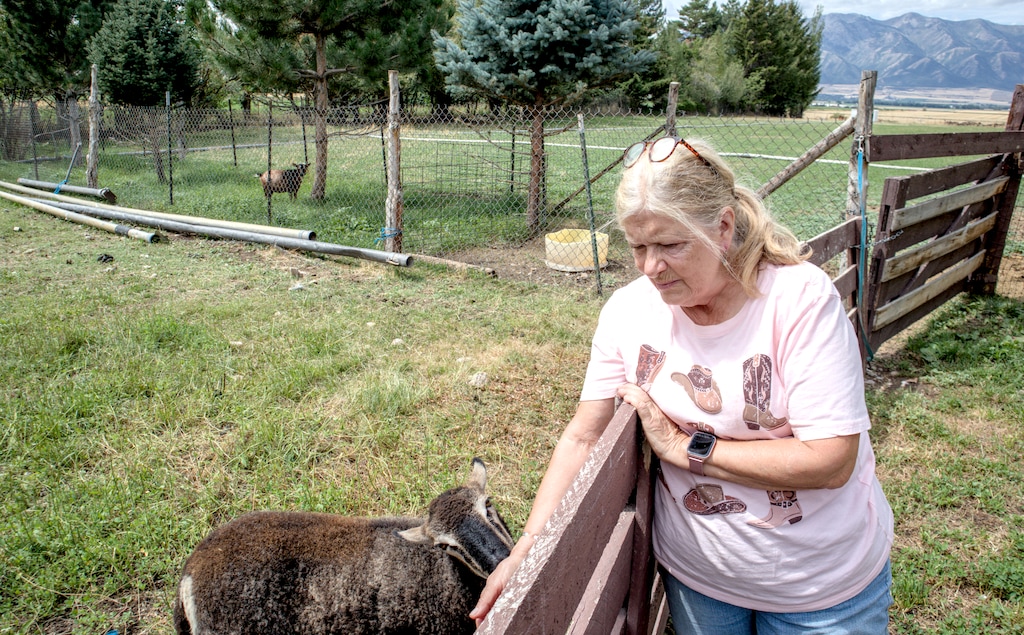
(Brock Marchant | The Salt Lake Tribune) Sheri Schiess' farm in Nibley. She and her husband, Boyd, entered the land into a conservation agreement that spares it from future development.
Schiess’ hay-bearing farm, for example, was preserved as working agricultural ground.
And, Murray added, things like wildlife habitat conservation or waterway preservation may call for protections without public access.
“There’s many different things that qualify something for a conservation easement,” he said.
In an interview earlier this summer, Christopher Sands — a member of the Cache Open Space Advisory Committee, which guides Cache County’s open space preservation efforts — said skipping outright land purchases is a sensible way to stretch a buck.
“When you’re purchasing an easement,” he said, “you’re just buying the development rights off the property.”
‘We did it’
For Schiess, who lives just a few blocks away from the farmland, the preserved ground means she can keep feeding hay to sheep, whose wool she teaches school kids how to dye.
It also means that those who walk along the popular 4000 South will always see the open expanse of her late husband’s family farm speaking to the agricultural roots of the area.
The effort to lock the property into its preservation agreement started before Bear River Land Conservancy even existed, and took 14 long years of a bureaucratic nightmare, she said.
“I kept saying, ‘I just want my husband to live long enough to appreciate what his dream was, because that’s what he wanted,’” she said. “And by cracking, we did it!”
Note to readers • This reporting position is a partnership with Utah Public Radio, a division of Utah State University.
 I’m Brock Marchant, The Salt Lake Tribune’s Cache Valley reporter in partnership with Utah Public Radio. As a valley native, I’ve seen firsthand the issues that people face everywhere from Richmond to Avon — unaffordable housing, dwindling open space and a rapidly increasing population that has cities struggling to keep up. I want to explore local problems by reporting on the ground, not just quote elected officials and news releases. As residents work diligently to overcome challenges, I want to tell their stories and share their solutions. Smart, hard-working people have built the valley’s history, and I’m certain they will frame its future.
As a nonprofit newsroom we rely on donations from readers like you to make this work possible. Donate today to support this reporting.