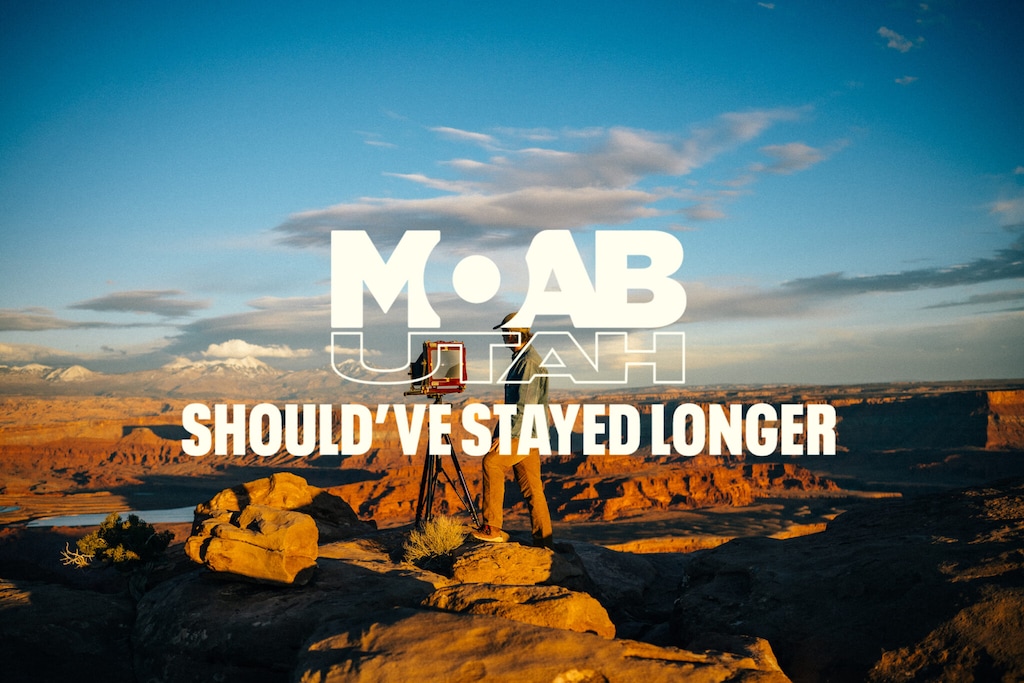
Moab’s new marketing approach begins with a realization the tourism office says it repeatedly hears from visitors: They should have stayed longer.
“Should’ve Stayed Longer” is the first advertising campaign under a new Moab tourism brand. It grew out of a broader research process that included visitor interviews, community discussions and reviews of tourism data and social media. The tourism office said visitors interviewed during the research repeatedly described finding more to experience than expected and wishing they had allowed more time.
The brand and campaign were developed through a yearlong, $749,450 project commissioned by the Moab Office of Tourism, which unveiled them Sept. 8.
The project produced a tourism strategy, a new visual and verbal identity — including a logo, color palette, writing style and design standards — and an expanded collection of photographs and videos for the department’s website, advertising, travel publications, visitor kiosks and other materials.
The tourism office and its agency partners say the strategy is intended to present Moab as more than a “bucket-list” destination for a quick trip to a few famous attractions. It also seeks to encourage longer and repeat visits, attract more travelers during slower periods, direct them toward a broader range of places, activities and local businesses and promote a more intentional, respectful approach to the area.
Camp4 Collective, a creative production company, and TOURIST, a travel-focused strategy and creative agency, developed the brand and campaign. Representatives presented the work during a roughly four-hour Moab Tourism Advisory Board workshop and summarized it at the board’s meeting that afternoon before an evening public launch.
(Andrew Christiansen | The Times-Independent) Merchandise featuring the new Moab tourism logo and “Should’ve Stayed Longer” campaign was available at a Sept. 8 launch event.
Building a unified identity
Although they launched together, the brand and campaign are designed to operate on different timelines.
“The brand will live for a long time. The campaign will live for a short time,” said Alexandra Fuller, founder and chief creative officer of TOURIST.
The brand establishes Moab’s broader visual and verbal identity, while “Should’ve Stayed Longer” applies it through a particular message and set of advertisements. Campaigns can change as the tourism office’s priorities evolve.
The agencies said previous tourism materials varied considerably in appearance and messaging and lacked a consistent identity tying together experiences ranging from motorized and human-powered recreation to national parks, solitude and downtown businesses.
Tourism Director Michael Soleta illustrated the problem through a common branding exercise.
“Put everything an organization produces on a table and ask whether it all looks like it came from the same place,” Soleta said in a written response to The Times-Independent. “When we began, ours unequivocally did not.”
Soleta said a consistent identity was also intended to help Moab stand out among the many messages competing for prospective visitors’ attention.
“We needed a distinct, recognizable identity tied directly to Moab’s strategy and values, so everything we put into the world works together, is recognizable as Moab, and has a better chance of getting — and keeping — someone’s attention,” he wrote.
(Moab Office of Tourism) An example billboard design pairs the campaign refrain, “Should’ve Stayed Longer,” with the message, “One arch down. 2,000 to go.”
The original Camp4 and TOURIST contract was $744,550. A $4,900 overage for design work brought the original branding scope to $749,450, Soleta said. The work covered research, strategy and positioning, a visual and verbal identity, campaign development and implementation, and production of the initial campaign’s photographs, videos and designs.
The figure did not include advertising placement, which the tourism office handles separately through its media agency, KHM. Camp4’s subsequent work on the Sept. 8 launch event also fell outside the original branding scope, Soleta said.
Research shapes a new strategy
Fuller said research last fall included visitor interviews in town and on trails, an ethnographic researcher embedded in Moab and discussions with residents, local leaders, tourism business owners and tourism board members. The agencies also reviewed existing research and marketing materials, economic and travel-industry data, competing destinations and social media discussions.
Fuller said participating residents wanted tourism to feel more connected to the community and landscape and less transactional. Visitors interviewed were often surprised by Moab’s scale and the number of available experiences. Local leaders emphasized longer stays, deeper experiences and less seasonal fluctuation rather than simply attracting more people.
The tourism office reported that more than 90% of the visitors interviewed either planned to return or wished they had allowed more time. Camp4 said the figure was based on about 100 people interviewed in small groups in national parks, at downtown shops and restaurants and in outdoor areas beyond the parks.
Soleta said the interviews were qualitative research intended to identify recurring attitudes and insights rather than a statistically representative survey of Moab visitors. He said the predominant theme was that participants discovered more to experience than expected and wished they had allowed more time.
Fuller said those findings helped shape a campaign focused more on what people may experience after arriving than on listing what Moab offers and why they should visit.
“This campaign line is not about a regret,” Fuller said. “It is a refrain that’s worth repeating. It’s an argument for spending one more day. It’s a reason to come back.”
(Moab Office of Tourism) An example mountain biking advertisement shows how the “Should’ve Stayed Longer” campaign can be tailored to different activities.
Soleta said the tourism office plans to use the brand to encourage longer stays, increase visitation during late summer and late fall and direct visitors toward more destinations and activities. Roughly half as many people visit Canyonlands National Park as visit Arches National Park, he said.
Soleta said KHM will track advertising performance through impressions, clicks, engagement and view time. The tourism office will examine broader indicators, including length of stay, seasonality and visitor dispersal. Individual advertisements and placements can be adjusted, he said, but the larger campaign needs time and repetition to become associated with Moab.
Soleta said longer stays could also reduce visitor turnover. Multiple families making shorter trips over a week could occupy a room for the same number of nights as one family staying all week, but generate more arrivals, departures and traffic.
“Encouraging people who are already coming to stay longer gives them time to show up, slow down, and connect with the place,” Soleta said.
What visitors and residents will see
Visitors will encounter the strategy through messages tailored to different activities and audiences, including “One arch down. 2,000 to go” and “The Colorado River’s in no hurry. So, why are you?” Each is paired with the campaign refrain, “Should’ve Stayed Longer.”
In its launch announcement, the tourism office said the campaign will appear on billboards, in print and digital advertising, on streaming television and social media and on the exterior of the new free Moab-Arches shuttle. The office is also working with lodging properties to offer incentives for stays of at least three nights.
Jessica Kunzer-Pearson, managing director at Camp4 Collective, said Camp4 and TOURIST produced two 30-second videos and shorter versions tailored to particular seasons, activities and audiences. The videos, campaign imagery, mockups and other brand assets appear in an online presentation of the work. Production across three seasons also expanded the tourism office’s collection from fewer than 30 usable photographs to more than 300 selections.
The visitor-facing logo spells Moab in bold, block-style letters, with a circle replacing the conventional “O.” “Utah” was included because agency research showed some prospective visitors did not know where Moab is.
(Moab Office of Tourism) A mockup shows a Colorado River advertisement created for the “Should’ve Stayed Longer” campaign as it could appear in a magazine.
The palette avoids red-orange shades already prominent in landscape photographs. Brand guidelines call for a playful but plainspoken voice that shares knowledge without lecturing and makes room for quiet and high-adrenaline recreation.
The identity is being incorporated into the Discover Moab website, travel planner and adventure guide. Soleta said the guide features trails the office considers able to sustain visitation, including places with adequate parking and, in some cases, restrooms. The office does not promote every available trail.
Kunzer-Pearson said new visitor kiosks expected around town this fall will include an illustrated map, information about guided activities and rotating facts about the area. She said unveiling the work marked only the beginning.
“It’s really up to everybody here and the community to determine how this continues to live into the future,” she said.
This story was first published by The Times-Independent.