 Megan Banta
Backers of the Stratos data center plan hope a sentence added to state law four years ago can help keep the project off the ballot in Box Elder County, but opponents say it can’t override voters’ constitutional right to a referendum.
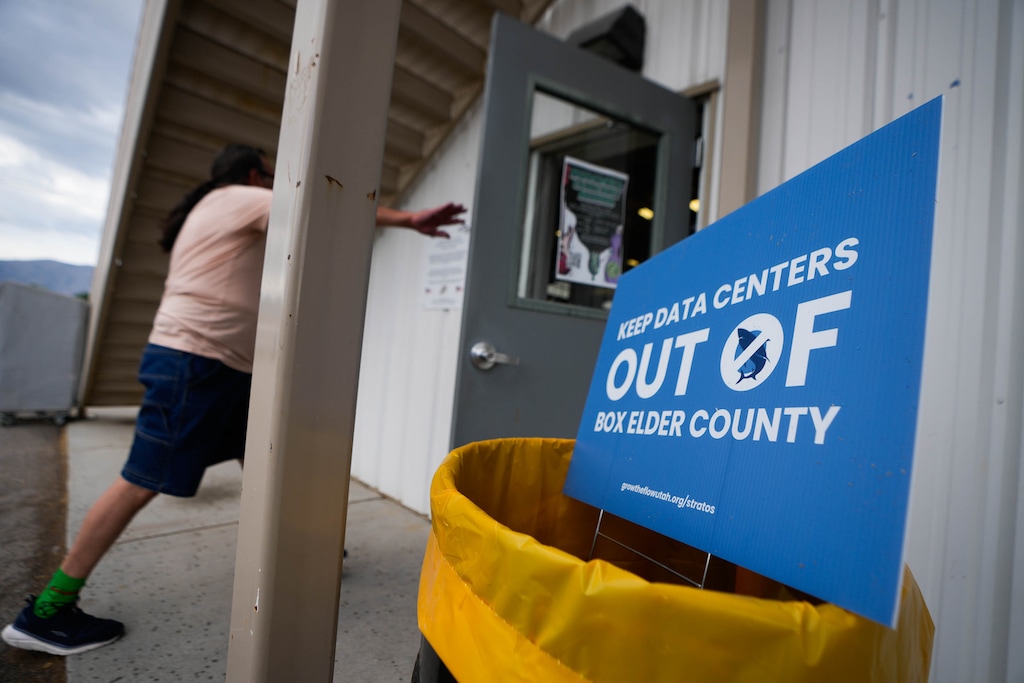
Box Elder Accountability Referendum, or BEAR, mobilized shortly after county commissioners in May greenlit a massive data center complex backed by celebrity investor Kevin O’Leary and Utah’s Military Installation Development Authority, or MIDA.
The group then asked a judge to intervene after the county attorney decided that the commission’s approval — in the form of two resolutions — did not qualify to be put on the ballot as referenda for voters to support or reject.
Both sides now have argued that the state court judge should be able to decide the case without holding a trial. The case hinges on two things: Whether state law makes a MIDA project area completely “irrevocable” and whether the commissioners’ decisions on the resolutions were legislative or administrative.
‘Can’t be constitutional’
At the center of one argument is a single word in the MIDA Act: “irrevocable.”
SB232, passed in 2022, added language to the law making consent from counties, municipalities and landowners “irrevocable.”
MIDA, which essentially holds the same powers as local government within its eight project areas, can then rely on that consent for long-term planning, contracts and issuing bonds.
Attorneys for O’Leary Digital and the county argue that means voters can’t use a referendum to undo the county commission’s consent to the project area.
“Through the MIDA Act, the Legislature has determined that a County’s consent to a MIDA-proposed project plan area is not referable” to voters, O’Leary Digital attorneys write in a motion to dismiss the lawsuit. “Because the County cannot reverse the decision, neither can the citizens on the County’s behalf.”
BEAR’s attorneys, though, write the law only applies to the commissioners’ vote and “does not address questions of consent by the people of Box Elder County.”
“There’s no way that’s true,” Brenna Williams, one of the key co-sponsors of the proposed referenda, said of O’Leary Digital and the county’s interpretation. “It can’t be constitutional.”
The state constitution has “vouchsafed,” or given voters the “right to act as legislators through direct, democratic means such as initiatives and referenda,” attorneys for BEAR argue in a motion that asks a judge to rule in its favor without a trial.
Lawmakers who sponsored the change to state code linked it specifically to the local government and property owners’ consent and making the law consistent with MIDA’s existing contracts.
“We can’t create a project area that [includes] private property without the consent of local government and the private property owner, but they can’t back out of it after they’re in,” Sen. Jerry Stevenson, a Layton Republican, said during a hearing on the bill.
Stevenson has served on MIDA’s board since 2008. Neither he nor Rep. Val Peterson, an Orem Republican who sponsored the bill on the House floor, responded to a request to clarify the intent of the word “irrevocable.”
‘Hallmark of administrative’
Another crux of the case is whether the resolutions were legislative or administrative.
That’s important because only legislative actions can be put to voters.
Stratos’ backers argue the commissioners were simply carrying out the MIDA law. They say that makes their decision “fundamentally administrative” and therefore not subject to a referendum.
“Implementation is a hallmark of administrative rather than legislative action,” attorneys for the county argue in their motion to dismiss.
The resolutions establishing the county’s consent for the project area and the interlocal agreement “simply [applied] existing law to a given set of facts,” they write.
BEAR argues that the decisions were legislative because, among other things, commissioners weighed major policy questions about the project, including water, taxes, land use and environmental protections before giving approval.
“Both Resolutions make fundamental changes in the governance structures affecting Box Elder County, with the potential to disenfranchise county voters in significant ways,” their motion for summary judgment reads.
The case docket doesn’t include a timeline for when 1st District Court Judge Spencer D. Walsh will rule on the two motions.
O’Leary has previously said work on the data center is full steam ahead and he doesn’t plan to go anywhere — but neither is BEAR.
“We’re not going away,” Williams said. “We’ll make this as tough as possible, even if they win in the courts.”