 Paighten Harkins
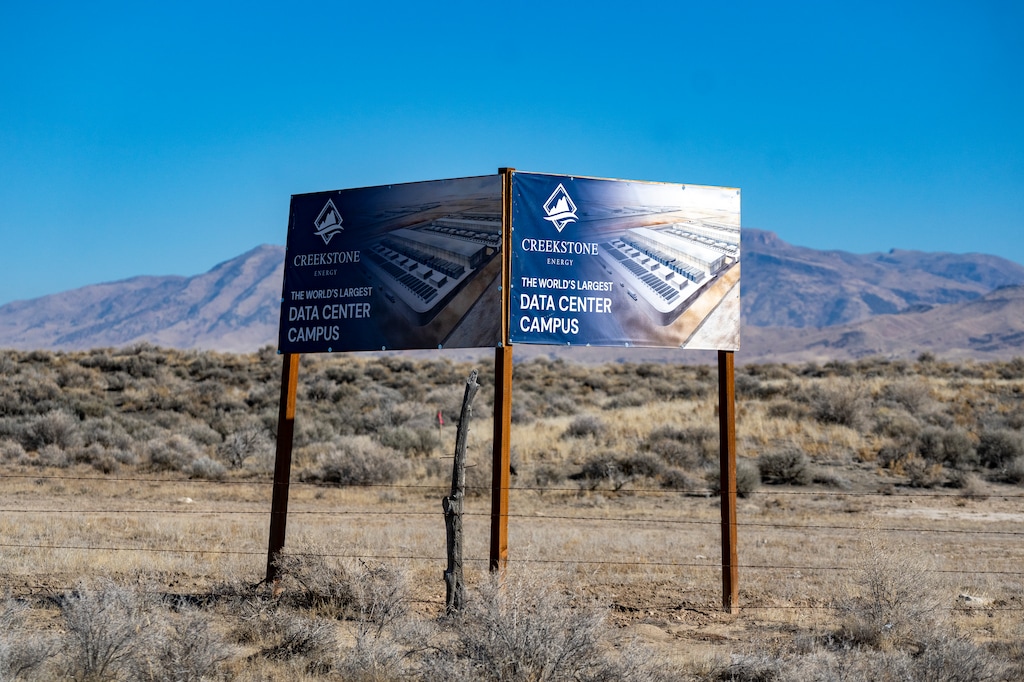
The company building a massive data center complex in rural Millard County is promising not just the “largest data center campus in the world,” but one that could recover “vastly” more water than it consumes.
“We don’t believe Utah should have to choose between economic growth and responsible water stewardship,” CEO Ray Conley told reporters.
Creekstone Energy, the company behind the massive 10-gigawatt Delta Gigasite project, applied to patent a new technology that he says will harness the condensation created by burning the natural gas that will power the data center.
The process is the same one that causes a car’s exhaust to drip water but at a “very large scale,” Conley said.
Conley thinks the site can produce around 4,000 acre-feet of water vapor per year. That’s enough water to cover 4,000 acres in water 1 foot deep.
A company spokesperson said that the site, about 9 miles southeast of Delta off U.S. 50, will use up to 2 acre-feet of water per 100 megawatts of power per year. At full build-out, a 10-gigawatt campus could use up to 200 acre-feet. It will rely on an “essentially waterless,” closed-loop system for cooling, Creekstone Energy says.
An industry changing innovation
Creekstone’s technology is relatively simple and works like a car’s engine and tailpipe. In this case, the power plant burning natural gas is the engine, and the tailpipe runs underground, through “a very large set of rocks,” Conley said.
The water created through combustion would condense on rocks and be captured in a pool beneath, he said, where it could be taken and then stored in tanks and eventually sold.
Conley said the science will determine the water’s “best, highest value use.” It’s hard to know right now, he said, because it’s not clear how acidic, for instance, the water may be. Potential uses include irrigation, geothermal energy cycles and perhaps, with filtration, drinking water, according to a news release.
Creekstone has contracted with the University of Utah’s Energy and Geoscience Institute to determine that as well as the viability of Creekstone’s idea, which the company is calling “Project Oasis.”
“If the results bear out, this could change the way the data center industry thinks about water,” said Milind Deo, with the Energy and Geoscience Institute, and the project’s lead investigator.
Rep. Jill Koford, R-Ogden, who ran a successful bill last session that enacted water use reporting requirements on data centers, was quoted in the company’s announcement, saying Creekstone’s process “goes well beyond compliance.”
Conley said he expects the U. will return its initial results by next summer.
What happens if the U. researchers find the technology doesn’t work as planned? It could spell the end for Project Oasis, Conley conceded, although he is confident in the science. It’s still worth getting an outside opinion, he said.
“That’s why we do it, right? Before you go and spend a bunch of money,” he said, “you need to double-check the math and the chemistry and make sure that you’re doing it right.”
But it wouldn’t end the data center project, Conley said. The project would move forward regardless.
Millard County officials approved a zoning change to allow the data center to operate and issued a conditional use permit for the 1,143-acre campus in summer 2025. Construction for the site’s natural gas infrastructure is underway. Conley anticipates research on the water vapor reclamation project will conclude in about two years.