 Tony Semerad
It’s weird and wild and uniquely Utah, and Salt Lake City hopes to keep it that way.
Officials in Utah’s capital want to make quirky Gilgal Sculpture Garden in the East Central neighborhood an official city landmark, partly to protect it against future development.
The small and strange garden space set deep into the block north of 500 South, between 700 East and 800 East, celebrated its 25th anniversary as a city park last fall.
At the request of Mayor Erin Mendenhall and with backing from community supporters, city planners are now pursuing a special landmark designation for the stone and green curiosity, starting at the city’s Historic Landmark Commission.
(Francisco Kjolseth | The Salt Lake Tribune) A feature of Gilgal Sculpture Garden in Salt Lake City.
The near half-acre spot is the former backyard of Thomas Battersby Child Jr., a Latter-day Saint stonemason who died in 1963. The sanctuary delights daily visitors with an assortment of eccentric and religiously themed folk-art rock sculptures, giant boulders and native plants.
The sculpture garden is already listed as a contributing property in Salt Lake City’s East Side National Register District, also known as Bennion-Douglas district, but officials say this move would go further in ensuring its preservation.
Adding it to the list of local landmarks, according to a formal request lodged with the Historic Landmark Commission, would more fully shield the site from demolition and give city experts direct review in making sure any future alterations are historically appropriate.
(Salt Lake City) A vicinity map for Gilgal Sculpture Garden at 749 E. 500 South in Salt Lake City.
With its proximity to downtown and mass transit running along 400 South, the neighborhood surrounding Gilgal Sculpture Garden has seen a surge in residential development in recent years, including a 266-unit apartment complex named Liberty Blvd, built in 2018, that abuts the park on one side.
The garden itself came to city hands in 2000, acquired through a community fundraising effort starting in the late 1990s as developers reportedly sought to buy the park and build town houses among its monuments.
(Francisco Kjolseth | The Salt Lake Tribune) Floor inscriptions at Gilgal Sculpture Garden in Salt Lake City.
Today, Gilgal is a popular attraction and Utah’s only identified “visionary art environment,” Judi Short, president of Friends of Gilgal Sculpture Garden, wrote in a letter to the commission.
“We are thrilled,” Short said on behalf of the nonprofit group, “to be honored by the designation of a landmarks site in Utah!”
The inner-city garden has more than a dozen stone sculptures, 30 engraved stones and as many as 70 floor stones featuring inscriptions, according to city planners. Its largest stone elements are boulders of between one and 78 tons, they say, brought there by Childs from various locations in Utah.
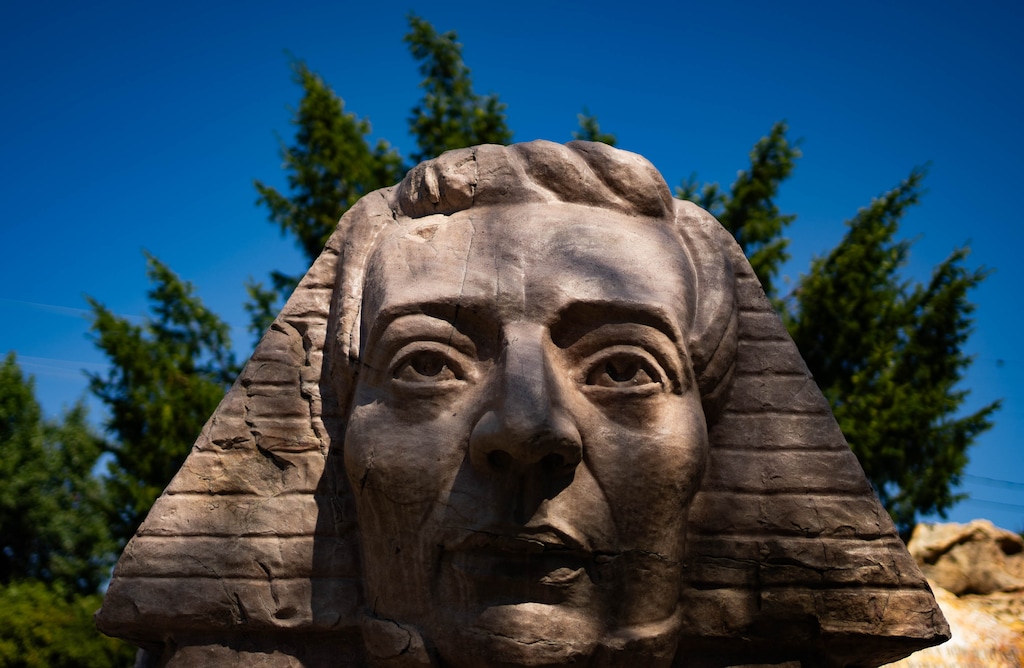
Gilgal is perhaps best known for a sphinx-like statue featuring what many believe to be the face of church founder Joseph Smith. Child also left a depiction of himself under a large ornate stone enclosure, surrounded by his tools and wearing brick checkered pants.
(Francisco Kjolseth | The Salt Lake Tribune) Gilgal Sculpture Garden in Salt Lake City.
Child, a former masonry contractor and bishop for the area’s 10th Ward of The Church of Jesus Christ of Latter-day Saints, used his works to depict characters and themes from the Bible and the Book of Mormon, as well as other inspirations from faith, philosophy and literature.
Child worked on the garden from 1945 to 1963. His artistry is said to have departed from the prevailing style at the time of literal and realistic depictions of religious figures, instead emphasizing “they were phenomenal, marvelous, miraculous,” according to Laura Howe, an art curator with the Utah-based faith’s Church History Museum.
(Francisco Kjolseth | The Salt Lake Tribune) Gilgal Sculpture Garden in Salt Lake City.
The site fell into disuse after Child’s death until it was purchased by the city with the help of private donors in 2000 and restored. Planners said nonetheless, the secluded spot “retains historic integrity in terms of location, setting, design, materials, workmanship, feeling, and association.”
The city’s request for landmark designation also includes creating what officials refer to as a “historic preservation overlay” for existing zoning maps specific to the park. That would ensure city review on any future changes on or near the site.
The Historic Landmark Commission will take up the requests on Thursday. Its recommendation would then go before the city’s planning commission for review, followed by review by City Council for ultimate approval.