 Mark Eddington
When Sky Chaney first trekked into Nepal’s high Himalayas as a tourist 17 years ago, he expected stunning mountain vistas, not a second calling.
What stayed with him, though, were not the peaks but rather the struggling people living in tiny Buddhist villages clinging to steep valleys, days from the nearest road.
From his Utah home in Kanab, the retired clinical psychologist now runs Village Light, a nonprofit that delivers food, medical and other supplies to Sama and Tsum, two remote valleys in northern Nepal near the Tibetan border. He estimates the charity, which operates on an annual budget of roughly $50,000, has provided $800,000 in aid over the past decade.
“We are working with small villages in the Himalayas,” he said, “to bring light into the lives of people who are struggling to survive.”
(Sky Chaney) Sky Chaney, Village Light's executive director, keeps expanding the nonprofit's work in Nepal.
From trekker to founder
In 2004, after his retirement, Chaney and his wife, Bobbi, traded Santa Rosa, California, for southern Utah’s redrock country. An avid trekker, Chaney soon set his sights on Nepal’s famed routes, hiking the Annapurna Circuit before exploring the Everest region.
For his third trip in 2014, Chaney transitioned from trekker to humanitarian, partnering with Tsum Valley native and guide Pema Tsumpa to launch a grassroots relief effort. After Chaney flew in with luggage packed with warm clothing and reading glasses, he and Tsumpa hired extra porters and mules to haul the supplies into the remote valley. They then coordinated with nearby villages to distribute the goods, ensuring the free resources reached the area’s most vulnerable residents.
“For a couple of days, we had a great time distributing the clothes and glasses,” Chaney said. “People were so thankful.”
One image has stuck with him: an “ancient lady” walking barefoot down the mountain to greet them.
“Her feet looked like they were gnarled roots of a tree,” he said. “She was just amazing. We gave her warm clothes. … A lot of the poor people have a hard time getting warm clothes.”
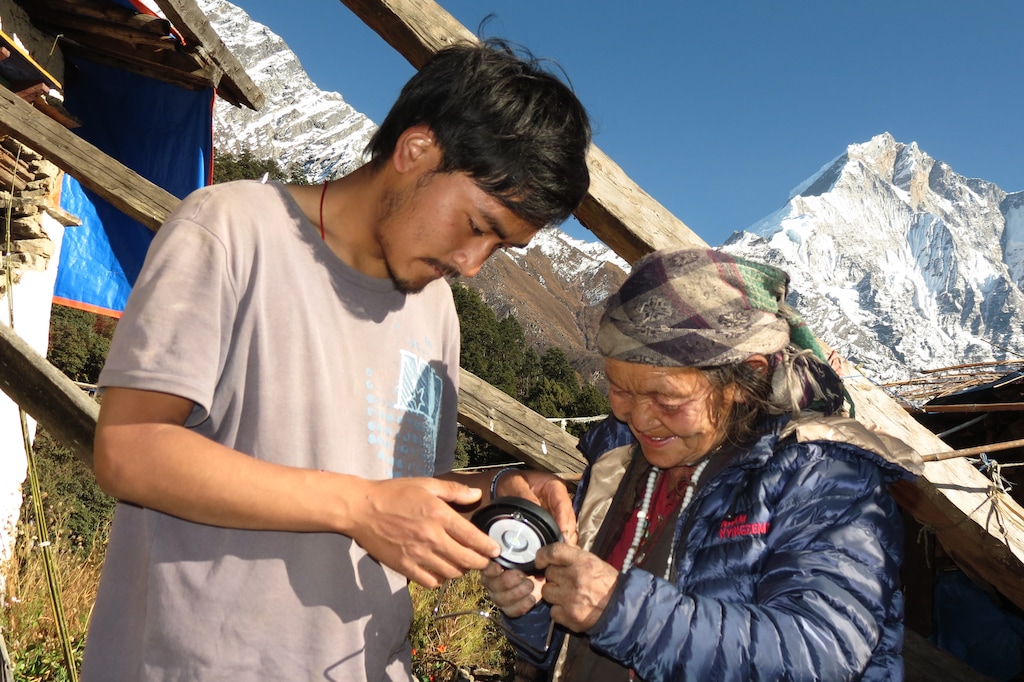
(Sky Chaney) Nepalese villagers are grateful for the aid they receive.
Inspired by this deep transformation, Chaney returned to Utah eager to bring hope to those in need, starting with small email requests to friends that eventually grew into an 800-person support base for Village Light.
Earthquakes, COVID
In 2015, two massive earthquakes hit Nepal, one of them in Gorkha District, where Sama and Tsum are located. Chaney said the quakes killed thousands of people and more than half the villagers’ thick stone houses were damaged beyond repair.
“When I arrived in 2016,” he recalled, “a lot of people were living in blue tarp tents next to what remained of their houses.”
Village Light — not a formal nonprofit at that point — funded six $1,000 rebuilding grants and began organizing mule trains to haul in rice, wheat flour, lentils and mustard oil. The relief effort ramped up again during COVID-19, when China closed the nearby Tibetan border that had supplied much of the villages’ extra food.
“People were trying to live on really skimpy rations,” Chaney said. “I don’t know anybody who completely starved, but the times were really tough.”
In the Gorkha District, Chaney explained, terrain makes everything harder. When conditions are favorable, the nearest road is a three- to four-day walk from Sama, and a two- to three-day slog from Tsum. During the monsoon season, he added, washed-out roads can add several more days. Supplies are transported by mules and porters along cliff-hugging trails that can turn slick with mud.
“We lost some mules on one trip,” Chaney said. “Two of them fell off the trail down into the river canyon below.”
Dangerous rockfalls on those routes have injured Tsumpa and Village Light’s Sama coordinator, Dawa Norbu, whose ruptured eardrum required surgery.
(Sky Chaney) Sky Chaney and the aid delivery team below Mount Manaslu, the eighth highest peak in the world.
Feeding elders, warming a school
Since achieving nonprofit status in 2019, Village Light has operated under the direction of Chaney as executive director. In Nepal, board President Tsumpa and Vice President Norbu oversee ground operations. Chaney noted that apart from modest salaries for the two board positions, every dollar donated goes straight into the organization’s projects.
For his part, Norbu said he enjoys the work.
“In the mountains from an early age we are taught to give more than we receive,” he wrote in an email. “It is an honor to be able to do this for the people of our valley.”
Today, Chaney said, the nonprofit focuses on delivering food and supplies to the most vulnerable, especially elders left behind as younger adults head to Nepal’s capital of Kathmandu or overseas for work.
“They are poor largely because of where they live,” he said, noting that the mountain villagers can grow only about 50% of their food on the scant available land, limiting them to one crop a year. They have to buy the rest.
On a recent visit to a cluster of monasteries and stone dwellings above Sama, a place where elderly Buddhist nuns and laypeople often end up with little family support, Chaney said, he and Norbu heard just how critical that aid has become.
“More than one of them said, ‘Without the food you’re giving me, I would not be alive,’” he said. “That really meant a lot to us.”
Another focus is Sama School, a small boarding school serving grades one through five. About 65 children live there most of the year, with another 20 walking in from nearby homes. Built after the earthquake, the school has yet to be finished.
Last November, Chaney spotted kids scattered around the schoolyard, warming their hands over tiny outdoor fires on a freezing day.
“There was,” he said, “absolutely no place in the school where the students could go to get warm.”
Seeking a solution, he said Village Light undertook a grueling, multiday trek from the nearest road to deliver two heavy commercial wood stoves. One replaced a broken kitchen unit that filled the dining room with smoke, while the other turned the dining hall into a comfortable, inviting gathering space.
In addition, he continued, the nonprofit bought a 55-inch flat-screen television for the dining hall so teachers can use it for lessons and occasional entertainment when the village’s satellite internet is working. This year, Chaney said, the charity is paying electricians and plumbers to rewire and replumb the school, adding lights to classrooms that have none, replacing dangerous wiring that has sparked several small fires, and installing showers, running water and dishwashing and laundry sinks.
Village Light also supplies two small mountain clinics with basic medicines and continues buying warm jackets, quilts and food for about 200 or more elderly villagers in Sama and Tsum.
The trek ahead
To create on-the-ground income, Chaney said Village Light supports a traditional weaving project in Sama. More than 100 people help collect, clean, spin and dye Himalayan and yak wool, then weave it into thick rugs with traditional designs. Village Light buys the rugs and sells them through its website, HimalayanMountainRugs.com, and plows the profits back into its philanthropic projects.
Bobbi Chaney, who serves as secretary for the nonprofit and helps catalog and sell the handwoven rugs, said her husband has relentless energy, driven by his deep affection for the people of Nepal.
“Once he starts something,” she said, “he doesn’t quit.”
Regular donor Pete Rogers of Amherst, Massachusetts, traces his giving to Village Light to a friendship that began in the small Mexican town of Alamos, where he and his wife, Sophie, met the Chaneys at a campground and became fast friends. That personal connection now guides their philanthropy.
“We love to support people that we feel are doing really good work,” said Rogers, noting that he feels drawn to the cause by Sky Chaney’s ability to connect with those in need and his readiness to act.
Chaney estimates he has traveled to Nepal about 10 times since he began this work. Now 75, he said he intends to keep going as long as he can.
“For me, it’s like a mountain trek,” he said. “The goal is to put one foot in front of the other and to do what needs to be done.”