 Megan Banta
Snowville • The July sun beats down on dust and sagebrush in rural Box Elder County.
Up the road from where the proposed Stratos Data Center would go, steers bellow and calves stick close to their moms.
Journalists from The Salt Lake Tribune have toured this area twice in the past two months.
There was still some water in springs lining the road in June, and cattle were out grazing in more than one spot along the road. Birds flitted around the springs near the old shoreline.
(Megan Banta | The Salt Lake Tribune) Water flows through springs that eventually feed the Great Salt Lake during a tour of multiple sites near or in the project area for the proposed Stratos data center project on Tuesday, June 9, 2026.
By July, it was baking at more than 100 degrees, and the land above the north arm of the Great Salt Lake looked like a desert wasteland during a tour around the land slated for the contentious data center.
Here’s a look at what we saw:
Salt Wells Flat
From a hill crest in the Promontory Mountains, there was once a view of the Great Salt Lake.
What used to be shore is now a sandy lake bed as far as the eye can see. And the Salt Wells Flat doesn’t have the water it had just a month before.
(Bethany Baker | The Salt Lake Tribune) the Salt Wells near the Great Salt Lake are dry on Monday, July 13, 2026.
The spot isn’t far southeast, as the crow flies, from where Wonder Valley Utah is planned.
It’s where cattle graze in the winter, and there’s evidence of that (stinky evidence in June, though it’s dried out by July) near large stock tanks that dot the road.
Those cattle don’t need a lot of water to drink, Rhonda Lauritzen said, and definitely not as much as a data center uses.
(Bethany Baker | The Salt Lake Tribune) Rhonda Lauritzen talks about grazing on the range by a stock water trough near the proposed site for the Stratos data center project.
“We’re talking about massive water use that’s not being used now,” said Lauritzen, who’s part of the fight against the data center through Box Elder Accountability Referendum, or BEAR.
While Kevin O’Leary, the celebrity investor who is pushing for the data center, has said he plans to pipe water back to the Great Salt Lake, it’s still unclear how that would happen as there are no public plans for the project.
Monument Point and “Lone Rock”
Lauritzen and her family have seen that play out in real time.
At Monument Point, a historic railroad spot, she and her brother Val Anderson stand with a picture of their father from the 1990s. In the photo, he’s standing in water that reaches halfway up to his shin. Lauritzen recalls floating in the water nearby.
(Bethany Baker | The Salt Lake Tribune) Val Anderson, right, stands with his sister Rhonda Lauritzen at Lone Rock and speaks about his family's history near The Great Salt Lake as he holds a framed photograph of his father in a spot that's now dry lakebed.
Today, the water’s edge of the Great Salt Lake is nearly out of sight from this location.
Lauritzen and her husband tried to measure the distance to the water by drone last year and turned it around right at the waterline about four miles away when they got an alert that the drone’s battery was going to die.
(Bethany Baker | The Salt Lake Tribune) Dry lakebed stretches for miles near Lone Rock along the northern arm of the Great Salt Lake.
The lake is 15 feet lower than it would be naturally, said Ben Abbott, executive director of Grow the Flow.
“We’re in a total state of emergency,” he said, and the conditions on a scorching summer day were the perfect example of what a heat island from the data center – something one physics professor predicted – would feel like.
Anderson family land
Lauritzen’s family has known the lake is in crisis for a while.
The land they own for their business, Mineral Resources International, used to be beachfront.
Now they source brines – highly concentrated solutions of salt in water – from elsewhere because a canal they dug using an easement with the state no longer reaches the water.
(Bethany Baker | The Salt Lake Tribune) A group of media gather as Ben Abbott, the executive director for Grow the Flow, speaks about the dire conditions of the Great Salt Lake, which is a dry lakebed in the background.
“We dug a little further and further until we just couldn’t reach it anymore. And that was a decade ago,” she said.
Even in good water years, she said, the trend has been down.
Locomotive Springs
A few miles down the road, Locomotive Springs is a prime example of that trend.
(Bethany Baker | The Salt Lake Tribune) Vegetation lines the edges of the water at Bar M Springs, one of the natural freshwater springs located in the remote Locomotive Springs Waterfowl Management Area.
Phragmites line the shore of Bar M Spring, one of the main springs at the waterfowl management area fed by underground aquifers.
In June, meadowlarks were singing, birds were swimming in the water and all colors of dragonflies flitted around. Some dragonflies remained on the hot July afternoon, and the minnows still swarmed rocks around the edges of the spring.
(Bethany Baker | The Salt Lake Tribune) A dragonfly is seen at Bar M Springs, one of the natural freshwater springs located in the remote Locomotive Springs Waterfowl Management Area, near Snowville on Monday, July 13, 2026.
Hansel Valley
There’s a spot of water at Bar H Ranch, too — some springs and the Hansel Valley Wash sit on the western portion of about 10,000 acres where the data center would go.
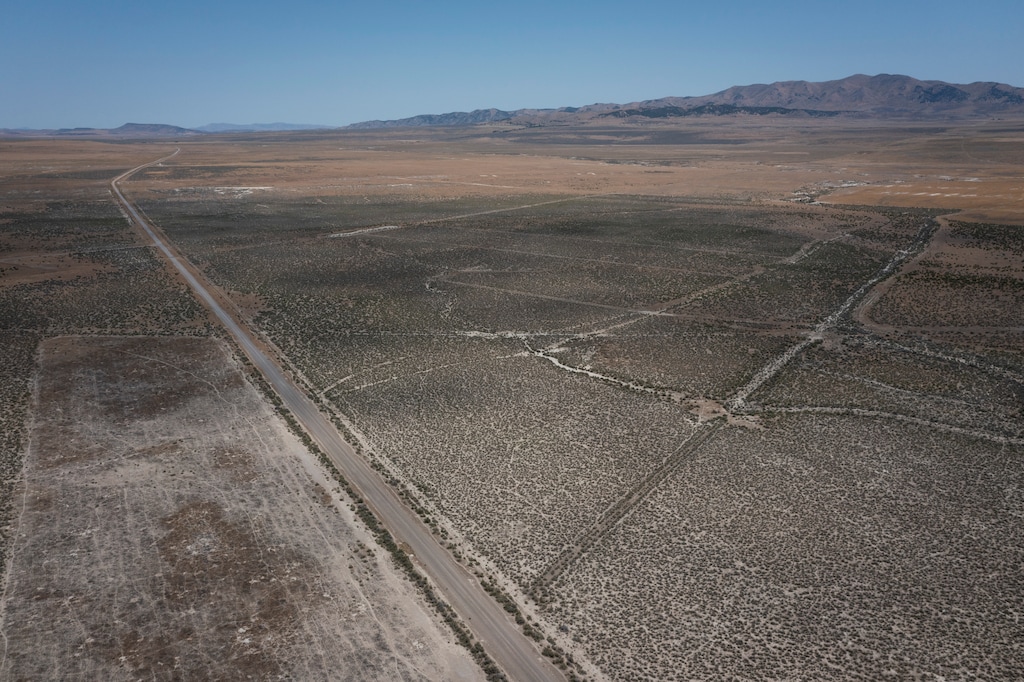
(Bethany Baker | The Salt Lake Tribune) A road runs through the Hansey Valley where the proposed Stratos data center project would go.
Waterfowl float through the channel in June as cattle graze on the ranch.
By July, most of the cattle are gone, and sagebrush stretches as far as the eye can see until rolling hills on both sides of the road.
(Bethany Baker | The Salt Lake Tribune) Cattle lounge north of the site of the proposed Stratos data center project.
Lauritzen describes it as the “mythical American West” and said she doesn’t want to see it transformed from something so special into something else.
“It’s not all about more jobs and more money,” she said. “We want a place where we want to live.”