 Brooke Larsen
When Andy Smith, chief of Grand County EMS, learned about a new federal health program that could funnel millions of dollars to rural Utah, he thought it might be the chance to transform what he called a “broken” system.
Providing emergency services in remote areas of Utah, where an ambulance ride typically lasts three times longer than it does along the Wasatch Front, requires paramedics with more advanced skills. Yet there are often local funding gaps, and many rural EMS services are staffed by volunteers.
“Rural EMS isn’t sustainable,” Smith told The Tribune. “The model is broken.”
Since the state has been rolling out its federally-funded Rural Health Transformation Program, though, optimism about its potential has simmered.
“Absolutely this money is helpful,” he added. “Is it going to solve anything? No, it’s not.”
Utah received $195.7 million as part of the first year of funding from the Rural Health Transformation Program, a $50 billion federal initiative that was launched in the “One Big Beautiful Bill Act,” passed last year. That same bill cut funding to Medicaid and Affordable Care Act premium tax credits, which healthcare professionals told The Tribune may disproportionately affect rural communities.
Some of those cuts, as well as the expiration of enhanced premium tax credits, have already gone into effect, while others won’t start until 2027 or later, according to a timeline from KFF, an independent health policy organization.
With rural hospitals set to receive less from Medicaid next year, Rep. Logan Monson, R-Blanding, said he hopes the new program could help stabilize hospitals by improving the workforce in rural areas, strengthening rural EMS systems and modernizing rural healthcare with tools such as telehealth. Monson is a registered nurse and sits on the state’s legislative oversight committee for the Rural Health Transformation Program.
The rural health fund is not meant to replace potential revenue that hospitals and clinics may lose as uninsured rates increase, though. Rather, it’s meant to “reinvent how we offer healthcare in rural America,” said Kasey Shakespear, director of the Rural Health Association of Utah.
“It’s an opportunity to really get at the core of some of the challenges we have and resolve them and move forward,” he added.
(Kasey Shakespear) Kasey Shakespear stands outside Blue Mountain Hospital in Blanding on July 29, 2025. Throughout last summer, he visited rural hospitals and clinics across Utah.
Will the money actually help rural Utah?
Some of the money is not going to direct healthcare services or providers, though. Matthew McCullough, the Utah Hospital Association’s rural hospital improvement director, told The Tribune in June he’s concerned about funding making its way to Utah’s rural hospitals and clinics.
The Utah Department of Health and Human Services has categorized funds between 24 different activities. Much of the money is going to enhance healthcare infrastructure and staff, such as equipment at hospitals, telehealth projects, a community paramedicine program and recruitment and retention incentives.
Some funds to improve the healthcare system aren’t going directly to hospitals and clinics, but rather departments like the Utah System of Higher Education for career training or organizations with advanced technical skills to support new data and AI programs.
About 15% of the funds will also go to broader health programs, such as water treatment, physical education programs in schools, trail signs, food producers and active transportation projects.
“I don’t think it will move the needle,” McCullough said. “My worry is we may have clinics or hospitals who have to close down services, and at the same time we’re allocating money to building trails. That’s not the point of the program.”
“The whole point of the program was to build up and strengthen the rural health care system,” he continued, “and we haven’t seen that happening yet.”
The state has to try to align with President Donald Trump’s administration, McCullough added, and that includes Health Secretary Robert F. Kennedy Jr.’s “Make America Healthy Again” plans. Using the funds for things like trail infrastructure and local food may help appease that.
“We want our kids to be healthy. We want there to be healthy food. It’s nice when there’s trails in our community for active living,” McCullough said.
But he’s concerned about rural hospitals and clinics that give people care 20 to 30 minutes from their home staying open. If those close, rural residents may have to drive an hour or more for care.
(Moab Regional Hospital) Dr. Zoe Cross, a family medicine physician who also practices obstetrics at Moab Regional Hospital.
Hospitals are generally frustrated with the program so far, McCullough added.
“It was built up as a way to financially sustain them through hard times, and they don’t feel like it’s turning out to be that,” he said. “They look at the RFPs that the state is releasing, and they don’t see a lot of things that apply to them directly.”
McCullough is still hopeful, though. In a follow-up email in July, he noted that the state had released more grant applications. “That is great news and I hope funding will start moving quickly now to the rural hospitals and clinics,” he wrote.
There’s also a lot that goes into health beyond just healthcare infrastructure, Brittney Okada, former director of Utah DHHS’ rural health transformation program, told The Tribune before she left her position in July.
DHHS saw a “broad picture of health” in the feedback they received last fall and crafted the state’s application to provide a “unique holistic approach to improving health and wellbeing in rural Utah,” she said.
Beyond the type of activities being funded, some rural health advocates and legislators have also raised concerns about who will access this money.
Because of the complexities and requirements of the grant, the process may be easier for large entities or health centers with the support of a more resourced network, said Rachel Craig, Association for Utah Community Health’s government affairs manager.
“Spending money isn’t as easy as it sounds … especially when you restrict the funds,” Craig said.
Larger entities have more administrative support to get these projects off the ground in the time required, Craig added. Small, rural private practices may have never even applied for state funds before.
That concerns Smith too. “I have a big fear that much of it will not end up in rural communities hands because of vendors or large healthcare organizations gobbling most of it up,” he said.
(Trent Nelson | The Salt Lake Tribune) Danielle Pendergrass meets with a patient at Eastern Utah Women’s Health in Price on Wednesday, March 13, 2024.
Small clinics and health organizations “are going to feel the most confused about the process,” Monson said during a federal funds oversight committee meeting in June.
“This program is intentionally made for them,” he added, “but they potentially are the ones that could get left out.”
Limitations
Rural health advocates, providers and legislators also told The Tribune the program has been off to a slow and complicated start and the short-term nature of the funds creates additional hurdles.
Most of the money is not flowing to rural communities yet. Of the $195.7 million, only $71.3 million had been obligated as of July 14, according to Utah’s DHHS.
Most of the money obligated so far has gone to other state and public entities, such as the Utah State Board of Education and the Utah Department of Public Safety, to distribute.
The program will last five years and the state must reapply for more money each year. If all funds received in the first year are not obligated by Oct. 30, 2026, the Centers for Medicare and Medicaid Services, which is administrating the program, will clawback those funds, Okada said.
The first year of the program will be a “trial and error” period, Monson said.
There are “significant limitations on the money,” though, said Sen. Evan Vickers, R-Cedar City, who also sits on the legislative oversight committee. The funds can’t be used for major construction, loan forgiveness or ongoing expenses.
“You can’t do any kind of an ongoing program, even from year to year, and so those limitations make it a little harder,” said Vickers. “[That] doesn’t mean that we won’t figure it out, and we won’t be creative and do some really good things with it.”
The short-term nature of the funds also concerns Smith. “This money is not going to fix the problem, just to be flat out honest,” Smith said. “This is a one-time dose of large dollars that everybody is trying to grab at and take every little bit they can.”
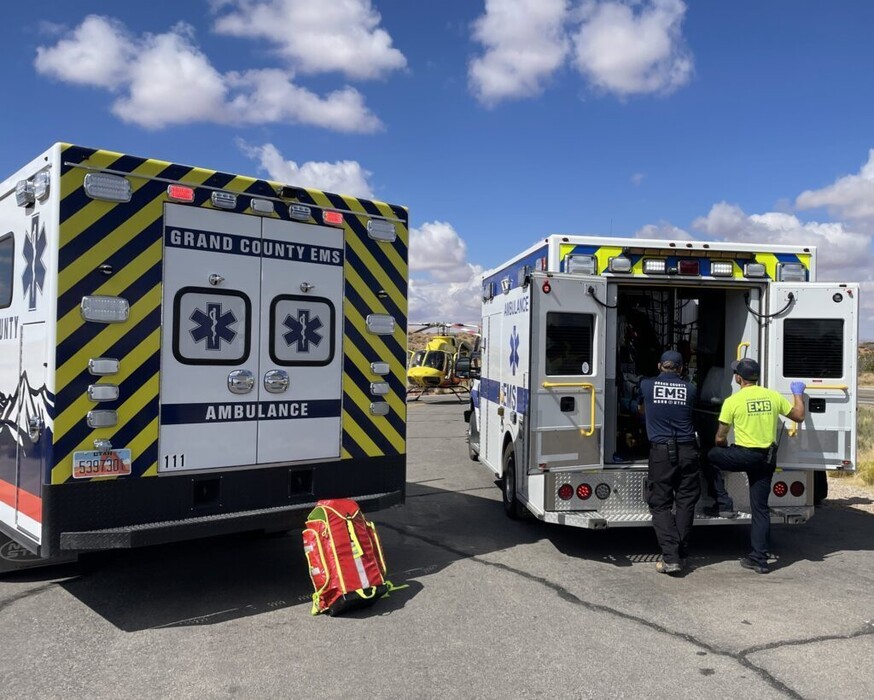
(Grand County EMS) Grand County Emergency Medical Services vehicles are parked outside the agency’s building in Moab on Aug. 14, 2025.
For rural EMS agencies, it may just help them “dig themselves out a little bit” to start looking at long-term solutions, Smith said.
“I think the state is just as confused as we are in how this money is supposed to roll out,” he added. “They’re really trying to meet that guidance from the federal government, which is also confusing, and so it’s a lot of blind leading the blind.”
The federal government has substantial involvement in overseeing the health program, including reviewing information released to the media, approving budgets, emailing frequently and meeting at least every other week, Okada said.
“I feel like Utah DHHS should really be commended with the herculean effort they’ve already put forth with this,” Shakespear said, “and I don’t know how you can fairly ask them to speed it up.”
More hurdles on the horizon
Once a small health provider receives funds, demonstrating success in a tight timeframe may create additional hurdles.
In rural communities, metrics like “number of people” won’t necessarily work, Monson said, because these programs are operating in small populations.
More effective ways to measure success in rural communities, Monson added, may include rates of recruitment and retention of healthcare workers, usage of smaller walk-in clinics instead of emergency rooms, response times for emergencies, chronic disease management and behavioral health calls.
(Doug McMurdo | The Times-Independent) San Juan Health’s Spanish Valley Clinic, located just south of Moab on Spanish Valley Drive and Old Airport Road, is part of the San Juan Health system that also operates a clinic in Blanding and hospital in Monticello.
Ultimately, the success of the program will depend on whether or not the funds lead to lasting transformation rather than temporary relief, Monson said.
Limitations on the program won’t deter people from being optimistic, though, said Shakespear.
“A defining characteristic of rural Utah is we’re very resilient, hopeful people,” he said, “and I don’t think any amount of delays or hurdles are going to stop us from being hopeful about what we could do with the funding.”