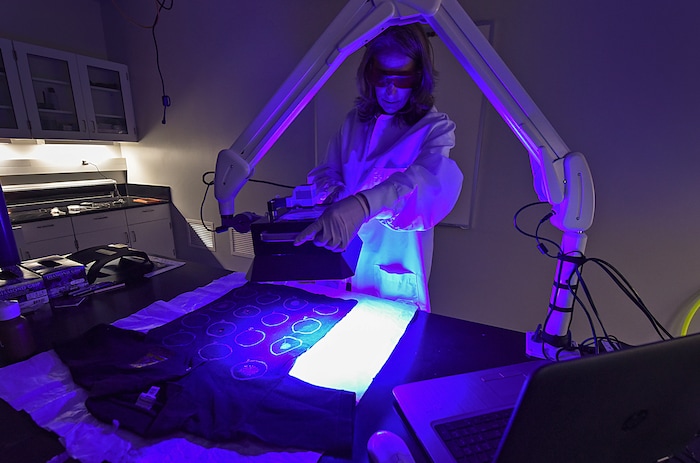
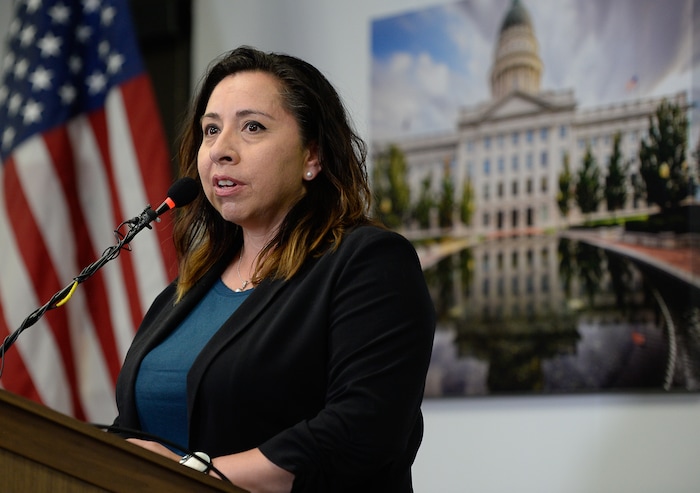
(Francisco Kjolseth | The Salt Lake Tribune) Pilar Shortsleeve, Chief Forensic Scientist talks about some of the tools the office of the medical examiner uses to possibly augment evidence that might be involved in a rape, including using lights of various wave lengths to reflect different types of stains or fluids on materials such as clothing on bedding on Wed. June 6, 2018. A new tracking system provides sexual assault survivors with the ability to anonymously track the location and status of their Sexual Assault Kit from point of collection through forensic analysis. The tracking system provides real-time information to sexual assault survivors regardless of when and where their sexual assault kit was collected in the state of Utah.
If a rape victim didn’t fight throughout the assault, it must have been consensual.
If a person traumatized by a crime can’t remember the events leading up to it, he must be lying.
If a sex assault survivor delays reporting the crime, she must be making it up.
These misconceptions, long known to hurt crime victims and stymie justice, are now being addressed one by one in Utah’s police academy.
The training upgrades, announced Wednesday, are part of wider reforms to the how the state handles sex crimes — including a new online tool for people to track their rape kits through the crime lab.
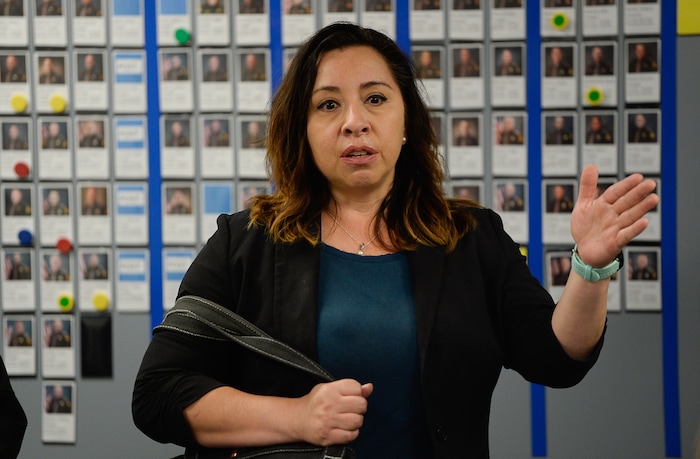
“What I want to say to victims out there is, ‘We care about you and we want to make sure justice is served,’” said Rep. Angela Romero, D-Salt Lake City, who sponsored legislation in 2017 to mandate testing of rape kits and trauma-sensitivity training for officers.
In addition to academy training, the Utah Department of Public Safety created a video series for law enforcement employees and the public, along with advanced training for investigators specializing in sex crime.
“When I say ‘rape,’ everybody has an idea what a rape is,” said Maj. Scott Stephenson, the state’s director of police training. “I guarantee it’s not what you typically think it is.”
The new training is designed to help officers unlearn sexual assault “myths” they may have internalized. The notion that someone should fight their attacker, for example, is unrealistic when 85 percent of victims know their attackers, they may have been groomed — and they may very reasonably fear that resisting an assailant will provoke him to further violence.
“People think, ‘I’ll just let them finish and then they’ll go away,’” Stephenson said. “Some people just freeze — and that’s not consent.”
If officers go into interviews misunderstanding the dynamics of sexual assault and the effect of trauma on victims’ behavior, they could stand in the way of important facts and re-harm the victim.
“Officers do not have the luxury of being able to have those preconceptions enter into an investigation — particularly at the point of contact,” when victims are extremely vulnerable, Stephenson said.
Common myths around sexual assault are addressed in a video found through dpsnews.utah.gov.
State officials also unveiled a new website that allows sexual assault survivors to input a case number and view where their rape kit is: At the clinic or hospital, at a law enforcement office, or at the lab. It also alerts victims when testing is complete.
“In the past, survivors haven’t had that information,” said victim advocate Lauren DeVries. That can leave them feeling forgotten and out of control of the process.
“Information can… aid healing in that process,” DeVries said.
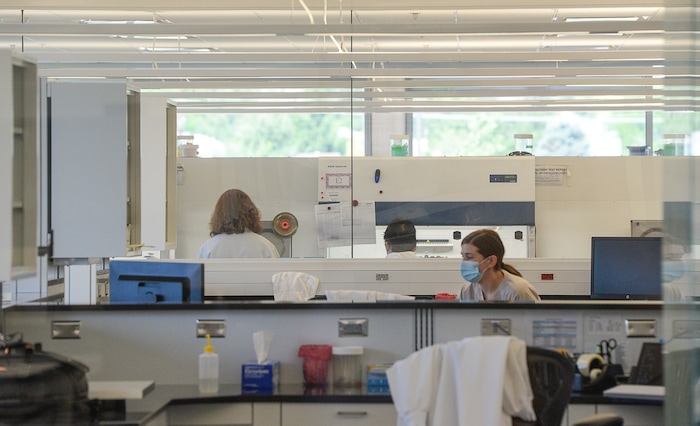
While Romero’s legislation secured extra funding for new crime lab staff, victims still face a long wait. More than 1,900 recent rape kits are waiting to be processed, along with about 1,100 “cold case” kits police departments submitted in recent years as part of an initiative to leave no rape kit untested. The state crime lab has processed about 2,200 cold case rape kits, DeVries said.
A person who receives a forensic exam today may not have the samples tested for more than a year, crime lab staff said — though criminal proceedings can begin before the kit is processed.
The goal written into the legislation is a maximum 60-day wait.
“We’re working toward [that],” Romero said. “That’s the goal once we address the backlog.”