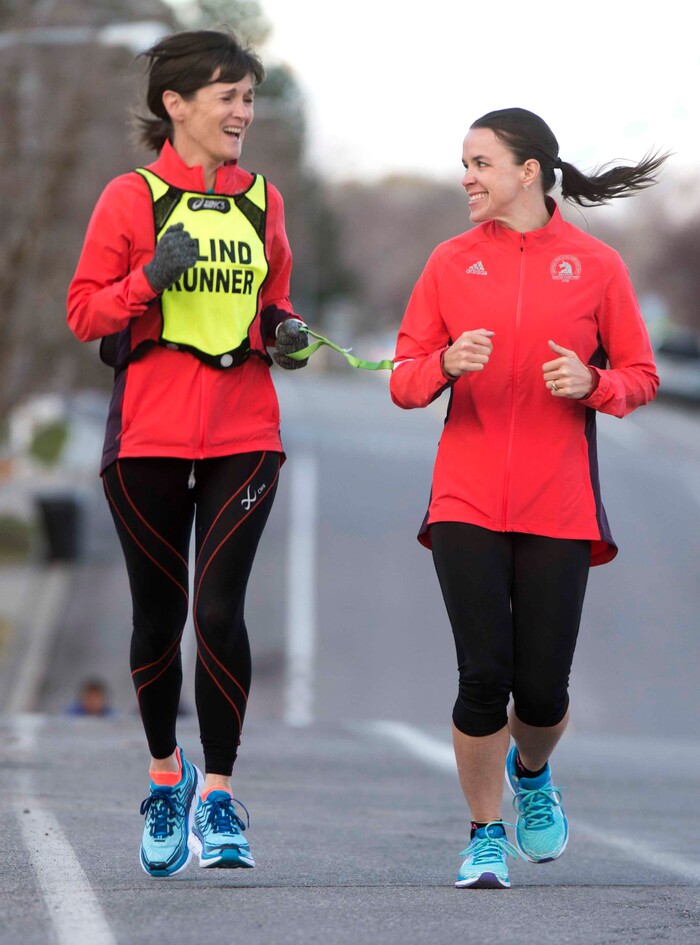
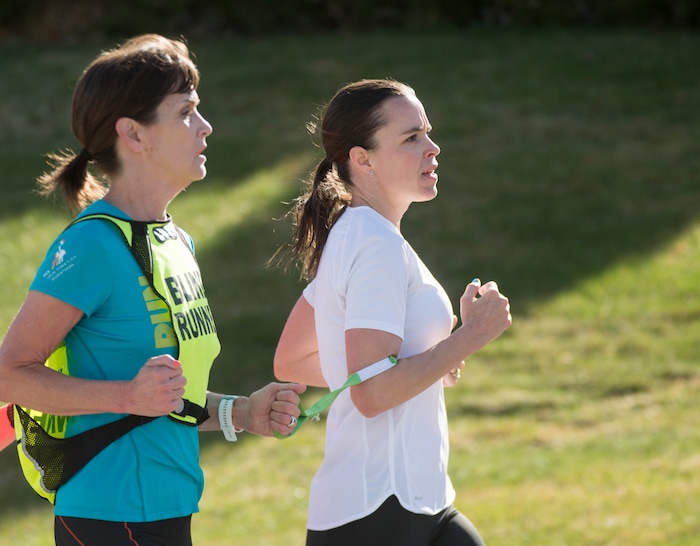
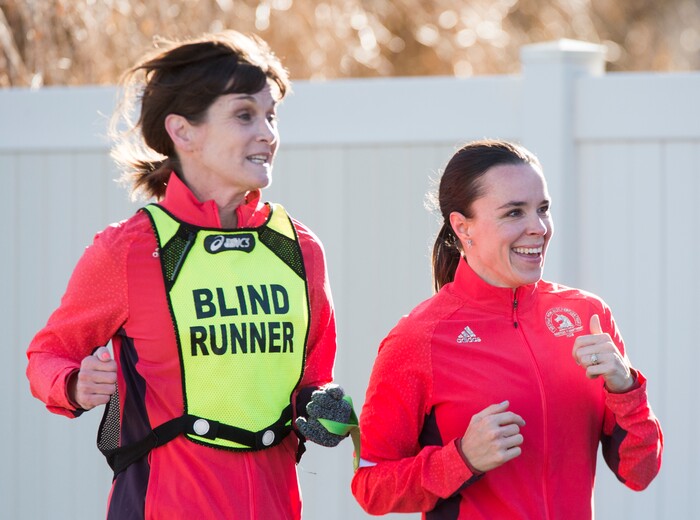
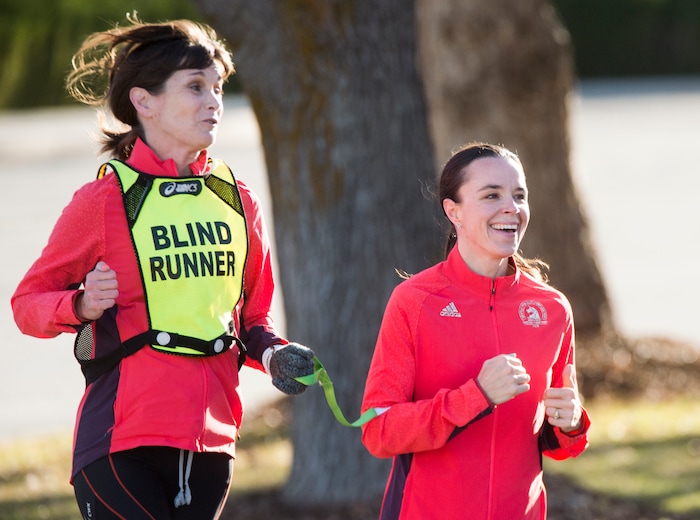
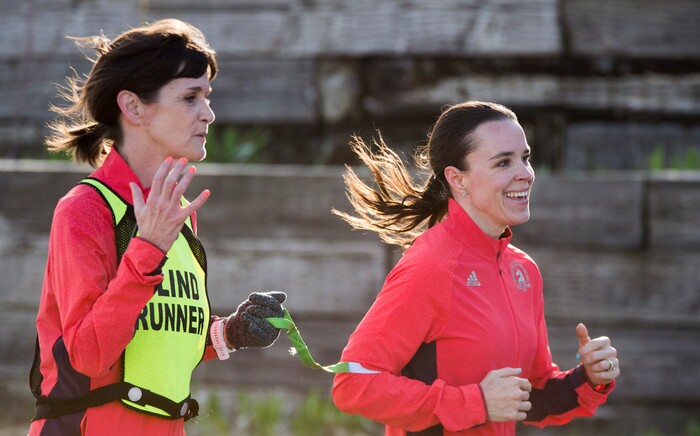
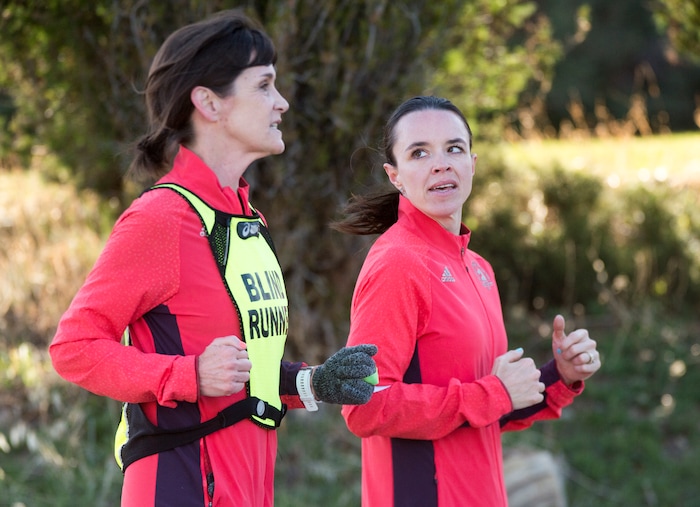
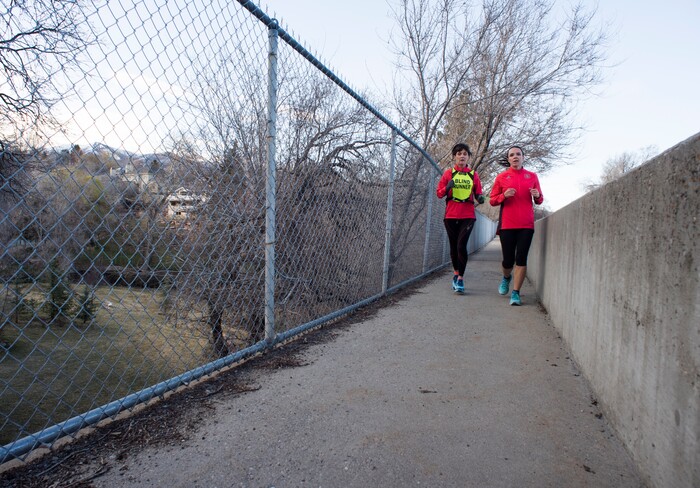
(Rick Egan | The Salt Lake Tribune) Becky Andrews and Alanna Whetsel train for the Boston Marathon by running along David Blvd in Bountiful, Thursday, March 29, 2018.
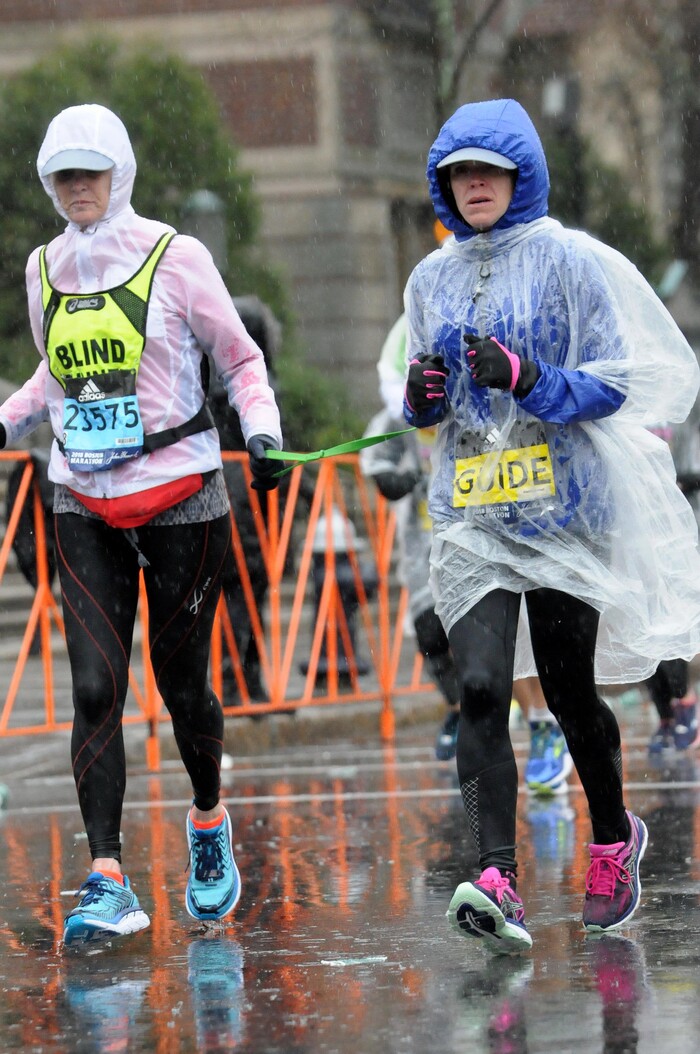
Becky Andrews and Alanna Whetsel were 9 miles into the Boston Marathon when doubts crept in.
The two Utah women had been warned of hypothermia in the subfreezing wind chills. Their ponchos clung to their soaked jackets, and their gloves dripped uselessly at their belts. The 35 mph wind gusted so ferociously that they couldn’t hear each other speak — a particular disadvantage for runners in the visually impaired division.
Pelted by rain and slogging through ankle-deep puddles, Andrews began to imagine the Braille alphabet, dot for dot, step for step. Whetsel, her guide, concentrated on finding trip hazards through sheets of rain.
Seventeen more miles to go.
The path to last week’s race in Boston was long for the Utah runners, both of whom have degenerative eye conditions. Andrews, 53, is legally blind. In the 35 years since being diagnosed with retinitis pigmentosa, her peripheral vision has darkened around a small “peephole” of central vision that remains. Whetsel, 39, still has her sight but is diagnosed with Stargardt disease, which doctors say could one day erode her vision from the center outward.
Whetsel sought out Andrews for advice to cope with the shock and stress of her diagnosis five years ago. The possible implications for her future sank in when a doctor cheerfully informed her she’d still be able to dress herself — as if being able to perform that mundane task could somehow make up for all that she might not see.
Whetsel went home and wept as she tried to memorize her four children’s faces.
“I didn’t know what it meant — the difference between legal blindness and total blindness. How much would I be able to see?” said Whetsel, who teaches preschool and lives in Sandy. “I was having a difficult time digesting it.”
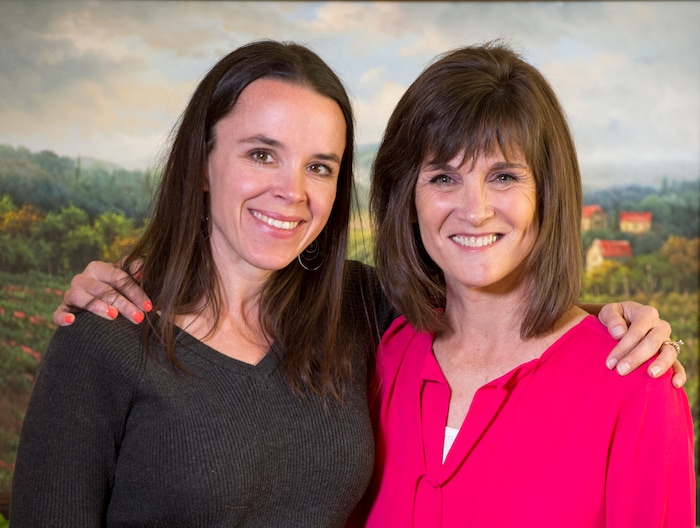
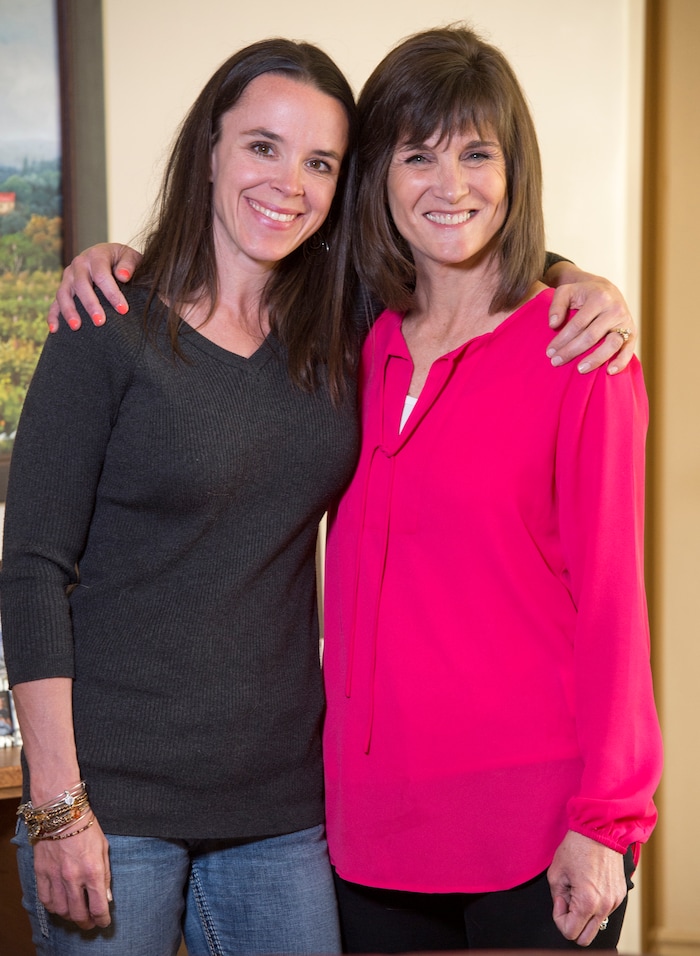
Medical staff directed Whetsel to Andrews, who is a therapist and writer in Bountiful. After Whetsel commented on Andrews’ blog, the two women became friends. Andrews, who already navigated parenthood and a career with impaired sight, mentored Whetsel through the psychological process of accepting a new vision for her future.
The two women bonded over running, a shared interest. Andrews wanted to run the St. George half-marathon, but couldn’t do it alone.
“I can be there for you and support you — and you can be my eyes and guide us through this marathon,” Andrews recalled saying.
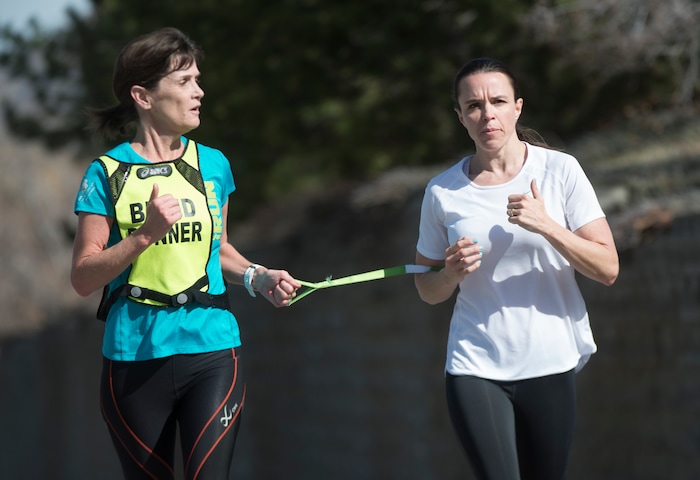
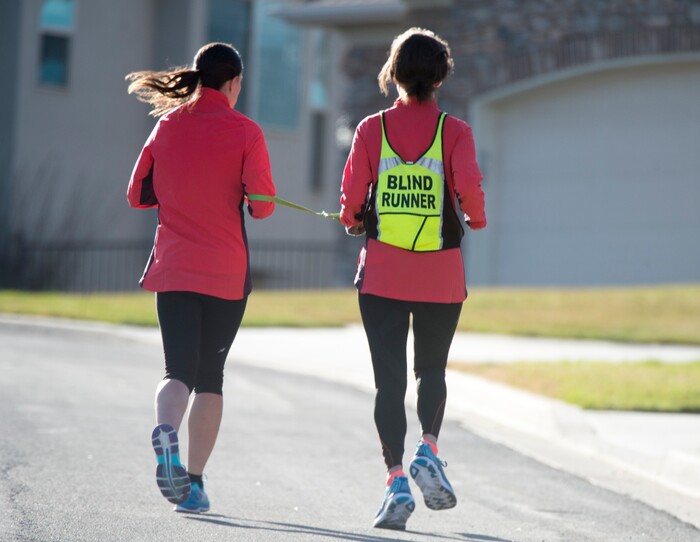
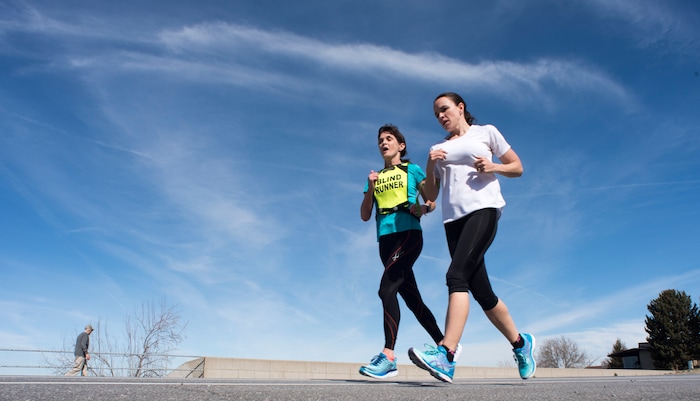
The teamwork of blind marathoning is a nuanced blend of physical and verbal cues. Andrews and Whetsel run tethered to each other by a 12-inch cord; Andrews reads Whetsel’s tugs and Whetsel talks Andrews around obstacles, like potholes, garbage and other runners.
Andrews first ran the Boston Marathon in 2015, without Whetsel. Friends took turns guiding her through the course on a cool day that did not compare to the violent, icy storms that hammered last week’s race.
“We had no idea what we were getting into,” Whetsel reflected on her first Boston run. “This was our fifth marathon we’ve done together. This one was the hardest.”
Frigid headwinds pushed against runners through much of the course. Whetsel accepted snacks from volunteers but could barely move her numb fingers to open the plastic bags.
At mile 12, Whetsel said, they started to struggle under their soggy clothes.
“I lowered my arm,” she said, “and like 2 cups of water poured out of my sleeve.”
Runners, weighed down by wet fabric, chucked clothing all over the road, each item an obstacle for Andrews and Whetsel. Guiding a runner down a street with no cars might sound simple — until you factor in a gantlet of ponchos and sweatshirts and hats that one runner cannot see. Whetsel and Andrews weaved through the mess, trying to keep their cord-linked arms moving in unison.
“You don’t realize as you’re running, you kind of sway sometimes,” Whetsel said. “It’s hard to not trip and fall — that’s always been a fear of mine, especially in this Boston [race]. I thought for sure we were going to get tangled up.”
Because of the unique challenges of tethered, guided running, vision-impaired runners have a longer qualifying time for the Boston Marathon — 5 hours, which is longer than all sighted groups except the oldest categories of women.
But as the storm in Boston raged on, Whetsel and Andrews said they lost interest in their time and focused on just finishing.
“It was intimidating thinking, this is survival,” Whetsel said. “This is not about a medal. We need to just get through this without having hypothermia.”
Several elite runners, including champions from previous Boston Marathons, had dropped out of the race before the finish line. Whetsel began to notice stretchers carrying shivering runners along the course, one after another.
“I didn’t tell Becky this because she can’t see them,” Whetsel said.
By mile 18, medical help was looking more necessary: Andrews’ knee injury had flared up, and she had to hobble up hills to keep pain from shooting through her leg. Walking breaks meant less pain, Whetsel said, but running was the only thing keeping their body temperatures up.
At times the rain was so heavy even Whetsel struggled to see ahead of them. She wisecracked about the blind leading the blind — a joke made more wry by the fact that her vision could deteriorate rapidly at any time, with little warning.
Whetsel said racing with Andrews has helped her prepare for that by disrupting her assumptions about what it’s like to live with impaired sight. It’s hard to see blindness as a dead end when you’re running alongside a blind marathoner.
“People say you’ll have challenges, but good things will come of it,” Whetsel said. “I could not see that. I look back now, five years later, all these things that have transpired since then, these things that I would not have experienced. ... I never would have run a marathon had [Andrews] not needed a guide.”
But their earlier races had an element that was missing for the first 25 miles or so of the Boston Marathon: pleasure.
“Most of the other runs we’ve had so much fun,” Whetsel said. “But we didn’t talk at all this time because it was just so much mental energy to get one foot in front of the other.”
Grim, cold and hurting, the pair neared the end of the race. The piles of discarded ponchos grew more dense.
At the first glimpse of the finish line, Whetsel began to sob.
Andrews did not need to see it to know it was there.
“Alanna was saying, ‘We’re getting there! We’re coming close!’” Andrews said. “I could hear our families, I started to hear them [yell], ‘Becky and Alanna! You did it!’ The noise was amazing, the crowd was incredible. It was dumping rain, and people were lined up. ... [Alanna] was saying, ’Pick up your feet! It’s in front of us, keep going!’”
Finally standing on the bright blue and yellow finish line at Copley Square, after five hours in pounding rain, Andrews and Whetsel grabbed each other in a tearful hug.
“You knew you were going out into this difficult situation with this wild weather, you didn’t know how your body was going to hold up — like a lot of things in life, it’s showing up,” Andrews said. “That was the victory for this one.”