 Kolbie Peterson
When chef Hiro Tagai wanted to build a restaurant around one certain type of ramen, a lot of people asked him if he was serious.
Tagai wanted to focus on shoyu ramen, made with a clear broth flavored with soy sauce, unlike the creamy tonkatsu broth that Americans are more familiar with.
He said Japanese noodle distributors asked if that was really what he was going to do. Tagai got the sense they thought shoyu wouldn’t sell, he said.
But his decision to highlight shoyu paid off. In August, Tagai’s Japanese restaurant Koyote at 551 W. 400 North — which he co-owns with chef Felipe Oliveira — received a recommendation from the Michelin Guide.
And now, more people than ever are tucking into steaming bowls of Tagai’s ramen, especially now that Koyote has expanded to Park City.
Getting a ramen education
(Rick Egan | The Salt Lake Tribune) Koyote co-owners Felipe Oliveira and Hiro Tagai, on Tuesday, May 13, 2025, in their other restaurant, Junah. Koyote won a Michelin recommendation this year.
Tagai was born in Japan, and lived there until he was 7, eating plenty of ramen, he said.
Years later, he worked as a sushi chef for Happy Sumo, starting in the Provo location and eventually coming to the Salt Lake City location. Around 2008, Tagai and a group of other sushi chefs went on trip to Japan that turned into a “food trip,” and he remembered how good Japanese ramen was.
Before that, ramen “wasn’t really prevalent in America,” Tagai said. “It was like, everyone knew Maruchan or like Top Ramen.”
But in the 2010s, after the openings of places like Ippudo and Momofuku in New York City, Tagai thought people might be ready for the type of ramen he grew up with. So, he started experimenting at home, trying to recreate the flavors he knew.
Without a lot of ramen-making tutorials online to guide him, “obviously it wasn’t up to par at that point,” he said.
In 2016, he resigned from Happy Sumo and moved back to Japan, getting jobs at two ramen shops in Tokyo.
The first, a popular eight-seat shop called Matador, specialized in clear-broth ramen made with beef.
The second, called Hokkaido Ramen Ginrin, was a neighborhood spot close to where he lived that focused on creamy miso ramen.
(Rick Egan | The Salt Lake Tribune) Diners eat at Koyote on Monday, Nov. 23, 2026.
Working at Matador, he learned what it takes to run a ramen shop.
“They give it their all, for everything and anything, even the smallest of things,” Tagai said. “And that’s one of the parts about Japan that I really respect and love, because you know everyone takes a lot of things very seriously.”
Tagai knew he’d have to hone in on all those details if he was going to bring the experience back to the United States, he said.
“I wanted to work at both kinds of shops to figure out what exactly that I can serve here,” he said.
Tagai decided to focus on ramen with creamy broth, called “paitan,” and went to ramen school in Japan with that priority in mind.
During his time at Tokyo Ramen Academy, he lived in a double trailer with seven other men (and one shower), surrounded by farmland in Chiba City, all while learning from famous ramen shop owners the art of how to make ramen.
One chef in particular, Hiroyuki Kanehara, had such a big impact on Tagai, with his clear stock (called “chintan”) and hand-pounded noodles, that Tagai decided he was going to make clear-broth ramen instead of creamy.
Kanehara’s ramen was “life-changingly good,” Tagai said.
When Tagai and Oliveira opened Koyote officially at the beginning of 2024, the ramen that Tagai served was an “homage” to Kanehara and an introduction to Tokyo-style clear-broth ramen for Utah diners, Tagai said.
Flagship dish powers expansion
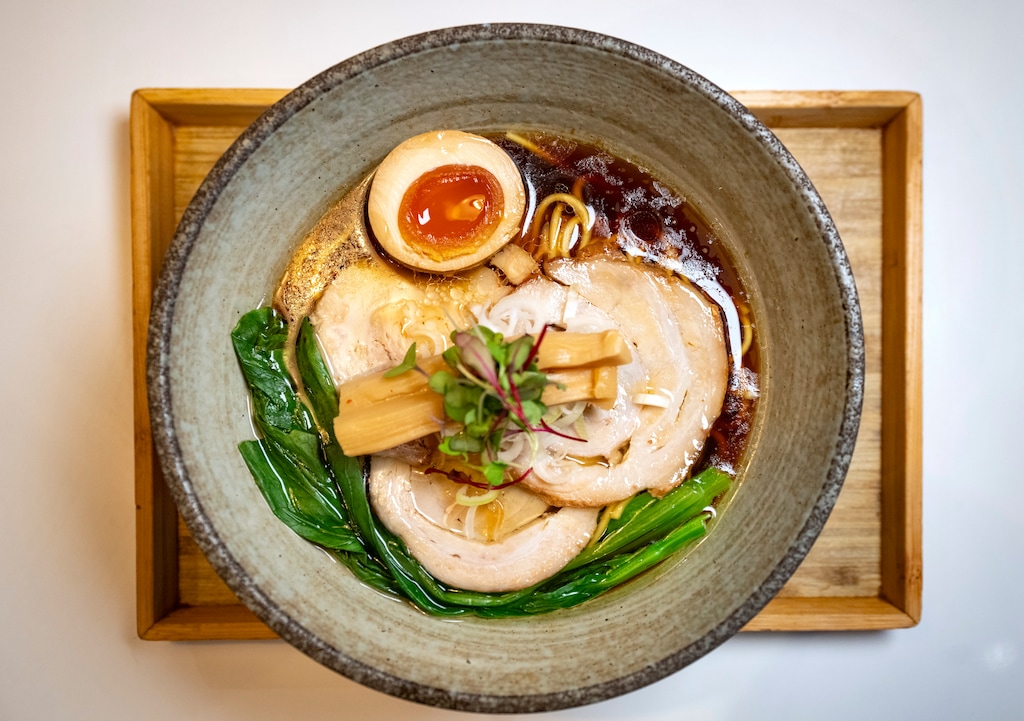
(Rick Egan | The Salt Lake Tribune) Koyote's chuka soba, a shoyu ramen, is shown at Koyote on Monday, Nov. 23, 2026.
Koyote’s flagship dish is its soy sauce chuka soba (another term for ramen) called The Classic, made with straight egg noodles and a clear stock made with chicken and pork, topped with chashu pork, a jammy soft-boiled egg, naga negi (Japanese green onions), micro greens, blanched spinach and tender seasoned menma (bamboo shoots).
When you eat this comforting dish, put your face directly above the steam rising from the bowl and close your eyes for a moment. Then dig in, savoring the chewy noodles, velvety chashu and crystal-clear broth with droplets of fat shimmering on top. Don’t expect to scroll on your phone while you eat, and conversations may take a brief pause; this experience calls for your full attention.
Unlike a bowl of tonkatsu ramen that’s usually greasy and heavy, The Classic is light yet satisfying.
“I wanted to get something that people can eat not just once a week, but multiple times a week,” Tagai said. “And especially me, I can eat it multiple times a week.”
Tagai sells about a hundred bowls of The Classic every day.
(Rick Egan | The Salt Lake Tribune) The whipped tofu appetizer is shown at Koyote on Monday, Nov. 23, 2026.
Koyote is also known for its crunchy karaage wings (Japanese fried chicken, gluten-free in this case) and delicious whipped tofu, blended with confit garlic and sesame paste and served with savory scallion pancakes. American shoyu ramen (with brisket on top), tonkotsu tsukemen (dipping ramen) and a couple varieties of shio (salt-based) ramen round out the ramen menu.
Earlier this month, Tagai and Oliveira expanded Koyote to Park City, a smaller space in Kimball Junction at 6546 N. Landmark Drive, Suite D.
Unlike the Salt Lake City space, the look of which Tagai describes as “grandpa basement” with bar signs and mid-century furnishings, he says the Park City location is darker and “more vibey.” Less of the decor came from Tagai’s own home, at least.
When asked why they wanted to bring Koyote to Park City, Tagai said it’s colder at the higher elevation, and better weather for selling ramen.
(Rick Egan | The Salt Lake Tribune) Diners eat at Koyote on Monday, Nov. 23, 2026.
One thing Tagai said he’s noticed at the new spot is more families with kids are coming in.
“The first few days was like, ‘Oh my gosh, there’s a lot of kids in here,’” he said, laughing. “Like, I’ve never seen this many kids before.”
Tagai said Japanese culture is so popular and beloved that people can sometimes want to take ownership of it. But that’s the antithesis of what he and Oliveira are doing at Koyote.
“It’s really meant for everyone, and that’s our mantra,” Tagai said. “We don’t want to be exclusionary with this concept. Just, please, come try us.”