 Kolbie Peterson
On a scorching day in August 1985, Jorge Fierro first arrived in Salt Lake City’s Pioneer Park — having given a Mexican man gas money for a ride from Wyoming.
He slept behind the Rio Grande Depot that night. All he had on him was a sleeping bag, a backpack with a change of clothes, and about $1,000 cash he had earned tending sheep.
Twelve years later, after building a new life for himself in Utah, learning English and working for other people, Fierro decided it was time to pursue his dream and start his own business. In 1997, he went back to Pioneer Park, selling bags of cooked pinto beans out of a cooler at the Downtown Farmers Market, under the name Rico Brand.
Last fall, Fierro ended his stint at the Downtown Farmers Market. He was honored last week by the Downtown Alliance with a 2026 Downtown Creator Award for bringing his “passionate” entrepreneurship to the farmers market for almost 30 years.
Now he’s preparing for his next big move: taking Rico Brand to a new national level and working out a deal with Costco.
“Retirement is for the birds, not for me,” he said.
Life in Mexico
Fierro was born in 1960 in Mexico’s Chihuahua state. He grew up in a city called Delicias, in a family with seven other children.
His dad “provided well,” Fierro said, as the owner of a small grocery store that later became a supermarket, two ranches and a distribution operation that delivered groceries to rural areas. Fierro’s father grew cotton, jalapeños and wine grapes, and raised cows, sheep, ducks, chickens and pigs.
As Fierro was growing up, food “was definitely a great affair every day” in their home, where his mother would do most of the cooking, he said.
His grandfather was also a talented cook. He owned a bar, and he would make botanitas (finger foods) and serve them with beer during the day, Fierro said.
“He was so popular that people [would] come to his bar to have a beer or two with my grandfather’s food, and it always caught my attention,” Fierro said.
Having his taste buds “awakened,” Fierro said, he “started seeing something interesting in food.”
(Rick Egan | The Salt Lake Tribune) Jorge Fierro says a few words after receiving the American Dream Award in 2012. The Salt Lake Chamber and United Way of Salt Lake recognized the contributions immigrants make every day in Utah.
His parents wanted him to become an attorney, he said. But Fierro kept feeling the pull to go to America and start his own “journey,” he said, so he dropped out of law school during his second year, when he was 24, and left Mexico against his parents’ wishes.
Fierro goes to America
He landed in Rawlins, Wyoming, in the middle of winter, hoping to find work.
“I immediately wanted to come as deep as I could into America,” Fierro said. “I didn’t want to be anywhere near the border, because everybody speaks Spanish, and I wanted to force myself to learn English.”
Needing a job, Fierro went to a Mexican restaurant and learned from the owner that a local sheep-herding operation was hiring. He ended up herding sheep with just a horse and a dog for about five months, which he said was a “wake-up call.”
He spent his time cold in the hills with the sheep, but he said he took the time as an opportunity to think on what he really wanted to do in America.
“I was so gung-ho about my new life, it just didn’t faze me at all,” he said.
When summer came, Fierro went down into the valley to get his long hair cut and buy a new pair of boots, and he went to the local high school to ask if they had an ESL program.
They didn’t, but they said he could find resources like that in Salt Lake City.
After his first night in Utah’s capital, Fierro stayed at homeless shelters and other temporary housing.
While staying at the Fisher Mansion, he reconnected with his parents when they called to tell him his grandparents on his mom’s side had died.
“The one that I loved so much was my grandfather,” Fierro said. “He was from Yucatan, and because of him I love to cook.” Fierro stayed in touch with his parents after that.
Years later, after learning English and working for a food distributor and a healthcare company to stabilize his financial situation, Fierro was ready to start his own business.
“I wanted the American dream, and I knew how to make it happen, because I come from an entrepreneurial family,” he said.
Walking through a grocery store, trying to find pre-made Mexican food that he could heat and eat, Fierro said he could only find frozen items, “and the quality was really pathetic.” He realized he’d found his “niche.”
With Rico Brand, Fierro wanted to sell food in supermarkets that didn’t have any preservatives or additives, made fresh from ingredients like the ones he grew up eating with his brothers and sister in Mexico.
Using his mom’s recipe, he started with cooking beans de la olla (“in the pot” in Spanish), made with just dried beans, water, salt and onion. He sold two bags at his first market in Pioneer Park.
“Everything started with beans, and it’s because ‘beans [are] my beansness,’” Fierro said, winking, referencing one of Rico Brand’s slogans.
The ‘Mexican food guy’
Fierro kept adding more Rico Brand products, testing them first with shoppers at the Downtown Farmers Market.
(Rick Egan | The Salt Lake Tribune) Jorge Fierro, owner and founder of Rico Brand, in his office on Friday, July 10, 2026.
He made frozen burritos and fresh salsas, and started selling his food out of his own store, Rico Market, which he ran with his commissary kitchen in the back, in the building where the Bagel Project is now on 500 East.
Using white shoe shine, he would write on the windows to advertise the menudo and posole he’d sell there on the weekends. People would bring their own pots, and Fierro would fill them with the fragrant stews.
One day, while Fierro’s parents were visiting from Chihuahua, and they were making beans together in his commissary kitchen, someone knocked on the door.
They had seen the Rico Brand logo on the building, and asked if Fierro made tamales.
His mom said to come back tomorrow to pick them up, Fierro said. So he went straight to the store to buy ingredients, and they started making chicken tamales.
At the time, Fierro said, there weren’t a lot of places to get real Mexican food in Utah. The La Frontera restaurants were popular then, but they served New Mexico-style food — cheesy, smothered, lots of rice and refried beans — not Mexican food, he said.
“Maybe I can be the Mexican food guy in town,’” he thought.
By 1998, Rico Brand was selling 11 products, including three kinds of tamales, two kinds of salsa, handmade flour tortillas, chips and a creamy salsa that his mom made.
He’d load up his 1967 Chevy truck with his tent, tables and food and go sell his products at Pioneer Park and the Park City Farmers Market. And he started selling Rico Brand in the now-defunct Orchard Street Markets.
His big break came in 2003, when a buyer from Kroger asked if he had enough supply to start selling his products in Smith’s stores.
Fierro said he didn’t have the capacity to sell in multiple markets, so they came to an agreement that he would sell in one Smith’s location, in Kimball Junction.
“I seldom say no when I see opportunity,” Fierro said. “I said, ‘Absolutely.’”
‘I didn’t come to America to give up’
Early in the 2000s, Fierro moved Rico Brand’s headquarters into a red-brick warehouse in the gritty Granary District (in a building that’s now the Woodbine Food Hall). Rico needed more production space and room to get a meat processing permit from the USDA.
Around then, Fierro opened the Mexican restaurant Frida Bistro in the front of his building (where Drift Lounge is now). The bistro “distracted” him from Rico Brand, he said, but it was one reason the Granary District started to become the popular dining location it is now.
The building changed hands in 2019, and the new owners evicted Rico Brand in 2020.
Rick Egan | The Salt Lake Tribune) Rico Brands new location on Folsom Avenue, on Tuesday, January 4, 2022.
Fierro had 60 days to get out, and was in danger of declaring bankruptcy if he couldn’t find a new location in time, he said.
“I was so desperate, because I thought, ‘Oh my goodness, it’s the end of my company,’” he said.
He reached out to Kathy Stephenson, then The Salt Lake Tribune’s food reporter, who wrote a story about how the Granary District’s revival might force Rico Brand to close.
“I didn’t come to America to give up,” he said. “I didn’t come to America to be successful and all of a sudden let someone step all over me.”
The article prompted the owners of Fierro’s current warehouse, on the city’s west side, to reach out with the opportunity to lease the building rent-free for 90 days.
(Fierro later served a stint on The Tribune’s board of directors.)
Fierro eventually bought the building for $750,000, and set up his operation there.
The building is probably worth much more now, Fierro said, partly because of the Power District development being built nearby.
‘How engaged can I be in this community?’
(Rick Egan | The Salt Lake Tribune) Jorge Fierro, the owner of Rico Brand Mexican products, at his warehouse in the Granary District, on Thursday, July 23, 2020.
Today, Rico Brand products can be found in about 250 stores, including Smith’s Food & Drug, Harmons, Fresh Market, Whole Foods and Associated Foods stores, and in eight other states from Idaho to the Dakotas.
After announcing he wasn’t returning to the Downtown Farmers Market, Fierro said many people asked why he spent 28 years there, selling his food.
“I built up something very comfortable to my soul,” he said. “For me, it’s not how much money I have in the bank. For me, it’s how many people I know. For me, it’s: How engaged can I be in this community?”
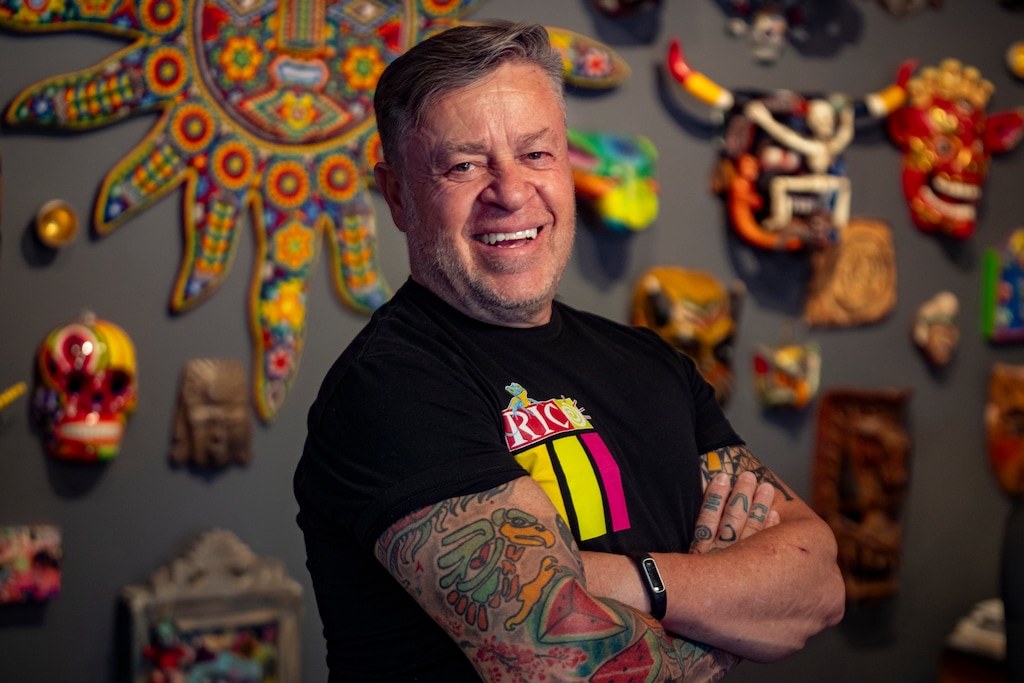
Among the many vibrant tattoos on his right forearm is one that reads, “Pay it forward.” It’s his “mantra,” he said, because, “I have to pay what I have received.”
During the interview for this article, Fierro had to call it quits after a time to help volunteers from the Burrito Project, a group that hands out burritos to unhoused people.
He said he often tells volunteers to make the best burritos they’ve ever made, because they’re for “VIPs.”
“If you give them a nice burrito, nicely wrapped and warm, they can get the message,” he said. “... It’s about them. They’re the VIPs today. And this is how people should be treated.”
Fierro estimated that Rico Brand is now worth upward of $5 million. Recently, he made a $2 million investment in a Hiperbaric pressure pasteurization machine, which can increase the shelf life of packaged food using high-pressure water to destroy bacteria — without subjecting the food to heat or preservatives.
There are only four or five of these machines in Utah, he said. With the machine, Fierro would be able to sell more products that would last longer. For example, he said he could even make a shrimp ceviche that would stay fresh for 60 days.
He’s ready to hit the road, to negotiate with stores in California and on the East Coast about selling Rico Brand products. And he’s negotiating a contract with Costco.
Buying the machine was a risk, he said. But it was a risk to leave his family in Mexico.
Fierro said coming to the U.S. was the kind of risk that “you have to take to better yourself, to get to know you better, to get to know yourself in such a way where you can be happier. Life is really short.”