 Palak Jayswal
In the 1970s, this slice of downtown Salt Lake City was, to many, a safe haven.
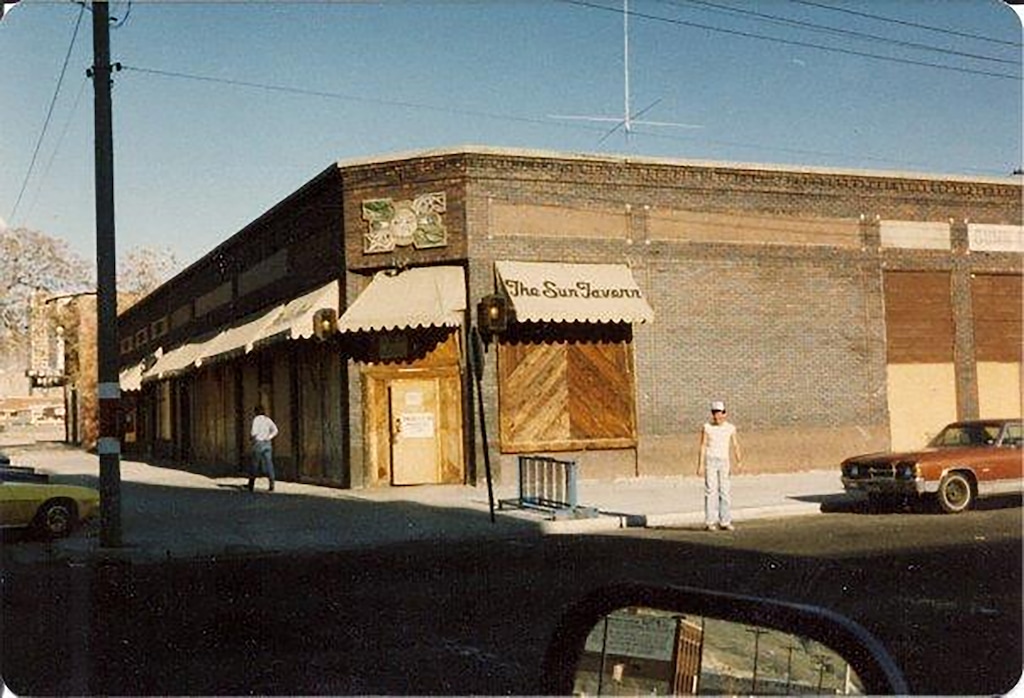
The sprawling building on the northwest corner of South Temple and 400 West is long since gone, but its legacy as the site of a community hub and its vital role in the history of Utah’s capital is being commemorated.
Last month, supporters placed a permanent historic marker honoring the Sun Tavern, Utah’s first gay-owned and gay-centric bar. The sign is across the street from where the bar once stood because the corner is now occupied by the Delta Center.
(Mildred Berryman Institute) Community members unveil a historic marker for the Sun Tavern in downtown Salt Lake City on Sunday, Oct. 4, 2026.
Nikki Boyer is one of the people who witnessed the impact of the Sun Tavern firsthand. She worked at the bar on and off for over two decades, including when it moved locations in the 1980s.
“The Sun was a place where the community felt safe, but it was also a melting point for the city. On any given Saturday night, there was a half-and-half crowd: half straight, half gay,” Boyer said.
She is glad to see the brown plaque that highlights the bar and its owner, Joe Redburn.
“We need to show the entire history of Salt Lake,” she said. It reminds her of her best memories of the Sun Tavern — of dancing, gathering and simply being.
“We were dancing our rights, so to speak. You know, we got loose in the ’60s, and it was time to party and celebrate,” she said.
No ‘queer Utah’ without Sun Tavern
The Mildred Berryman Institute for LGBTIQ2S+ Utah History submitted the pitch for the Sun Tavern’s marker to Salt Lake City through a relatively new city program.
Randell Hoffman, a co-founder of the history nonprofit, said the Sun Tavern first opened in 1973. A decade later, as downtown developed, the bar moved to 200 South and 700 West, he said.
When a tornado downtown hit in 1999, the new building was severely damaged. Prior to that, in 1991, Redburn also opened The Trapp, a country gay bar. Rob Goulding eventually purchased the properties and opened The Sun Trapp, which is still open.
“It’s pretty hard to tell the story of queer Utah without talking about the Sun Tavern,” Hoffman said. “Everyone has a memory about the Sun Tavern.”
Through his work as a historian, Hoffman said the gay and lesbian organizing in the 70s and 80s in Utah often happened at the Sun.
Redburn, Boyer and others also organized the first Utah pride celebration in 1975.
(Leah Hogsten | Tribune file photo) Joe Redburn receives the Utah Pride Center's Lifetime Achievement Award in 2008.
Redburn helped fund and sponsor organizations. This community work helped lay the groundwork for future pride celebrations and political advocacy in the state.
“He was very much in the business of enabling others and providing the funds to have people go set up whatever they wanted or let the community make pride what it needs to be,” Hoffman said.
Redburn died in 2020 at a homeless shelter in South Salt Lake.
Sixth-generation Utahn and Salt Lake City Council member Chris Wharton, who helped secure funding for the new marker and develop the program to highlight historic places, said the Sun Tavern plaque is “extra meaningful” to him as an openly gay man.
Utah’s history largely focuses on Mormon pioneers, he said, but there were “lots of different communities that came here or came through here, and so I wanted a program that would show some of those other stories that are not represented currently.”
The Sema Hadithi Foundation submitted a similar pitch for a marker for Thomas Coleman, a former slave who was lynched on Capitol Hill. Coleman’s marker was unveiled earlier this year.
Submissions to the program are considered by the Salt Lake City mayor’s Office of Access and Belonging and the Human Rights Commission.
(Francisco Kjolseth | The Salt Lake Tribune) The Sun Tavern received a marker to commemorate its place in Salt Lake City history.
History, Wharton said, is having a moment.
“There’s just a general thirst for getting to know these kinds of lesser-known parts of history,” he said. “Those stories should be celebrated.”
Mike Evertsen, a former regular of the Sun Tavern, took the most frequently used photos of the bar.
He first visited the bar on the night of his 21st birthday, when his friend brought him down from Utah State University. The bar was full and they had to wait in line.
He remembers being eager to get in.
“For our little community that we had, it was a place where we could go, where we could be ourselves. It didn’t matter if you were very masculine, very feminine, if you wanted to dress in drag, if you didn’t,” Evertsen said. “It was a place we could go and relax … a place that we could go that we could actually be ourselves without having to worry.”
At the bar, Evertsen said, there was the sense of freedom, of finally finding a place. It was safe.
He said it’s a credit to the dedication of Redburn, who often used to joke that the bar was “in the shadow of the temple.”
“The Sun was a place you went to have fun,” Evertsen recalls. “It’s important with the marker to just remind people, yes, this was something important that happened ... It was something that helped shape our city.”
(Mildred Berryman Institute) A historical marker for the Sun Tavern in downtown Salt Lake City, Sunday, Oct. 4, 2026.