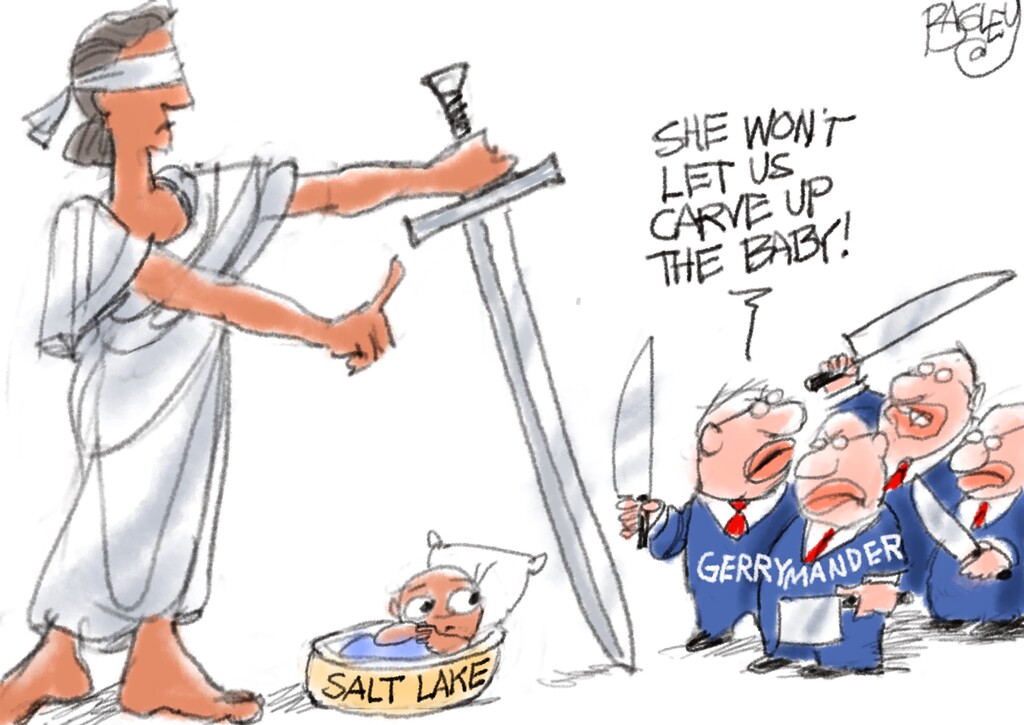
The people of Utah have spoken. Members of the Legislature, as is their wont, have ignored them.
Now, thanks to a state judiciary that clearly cares more about democracy than most elected officials hereabouts, the people’s voice may be heard again, at least on the matter of drawing fair congressional districts in Utah.
Though, if Utahns want their voices to actually mean something this time, they should speak up a lot louder.
Voters must take to their phones, their email accounts, the Legislature’s own websites, the United States Postal Service, public demonstrations and any other lawful means of instructing their elected officials to obey the will of the people as expressed in the 2018 Better Boundaries Initiative, and as backed up by state courts.
Otherwise, they can expect their legislators to obfuscate, legislate and litigate away the people’s right to oversee their government.
Building on a unanimous Utah Supreme Court ruling issued last year, District Court Judge Dianna Gibson Monday ordered the state to scrap the map of the state’s four congressional districts as drawn by the Legislature because lawmakers were clearly in violation of the voter-approved anti-gerrymandering initiative, formally known as Proposition 4.
Republicans on the state and federal level are open about their belief that they are supposed to hold all the cards. Whenever a court anywhere makes a ruling they don’t like, they scream “activist judges” and threaten impeachment. They make it clear that they have no regard for the core genius of the American system, the division of power among three branches of government and between the government and the people.
The Better Boundaries proposition exercised the right of the electorate, as enumerated in the Utah Constitution, to propose and pass legislation on its own. It is a right that the courts of Utah respect but that the Republican super-majority of the Legislature selfishly denies and undermines at every opportunity.
Proposition 4 instructed the state to create a nonpartisan creature called the Utah Independent Redistricting Commission, and to charge that seven-member committee with drawing maps for congressional and legislative districts that were free of partisan taint, kept districts as geographically compact as possible and avoided breaking up cities, counties and communities of interest.
Republicans in the Legislature were having none of it.
Having no goal other than to deny the more liberal voters of Salt Lake County any voice in choosing members of Congress, lawmakers obliterated the voting power of Salt Lake County’s constituents by splintering it across all four congressional districts, drowning the state’s more likely Democratic voters in four seas of Republican-leaning areas. The very dictionary definition of gerrymandering.
Rightly, our courts were less interested in the results than in the process. It wasn’t that the Legislature’s map was bad for Democrats (though it was) but that it blatantly ignored the lawful role of Proposition 4 in setting up the redistricting procedures.
As the Utah Supreme Court ruled last year, the right of the people to design their own form of government is at least as important, constitutionally, as the power of the Legislature to make laws. When the people exercise that right, as they did with Prop 4, the Legislature has no power to undermine or countermand it. If it did, the constitutional right of the people to propose and pass legislation would become meaningless.
Judge Gibson’s ruling gave the Legislature 30 days to come up with congressional maps that respect Proposition 4. That may seem like a compressed timeline but, fortunately, amid all the political fuss, the Utah Independent Redistricting Commission kept its focus and did the job the voters hired it to do.
The commission produced three good maps for Utah’s congressional districts, options that minimize the fracturing of communities and amplify the voice of an electorate that otherwise would be unconstitutionally muted.
In more blatantly partisan language, those maps don’t guarantee a Utah Democrat a seat in Congress, but they make it conceivable. Which is all a fair system is expected to do.
Constituents throughout Utah should be telling their lawmakers to abandon any thought of appealing Judge Gibson’s correct ruling. That decision so closely followed the pattern laid down by the state Supreme Court that asking the justices to overrule it would have no purpose other than delay.
Gov. Spencer Cox should call a special session at the earliest possible date so that lawmakers can adopt one of the independent commission’s maps by the end of September. Thus may the 2026 elections, at least in Utah, go forward outside the shadow of gerrymandering.
Editorials represent the opinions of The Salt Lake Tribune editorial board, which operates independently from the newsroom.