 Leia Larsen
Note to readers • This story is made possible through a partnership between The Salt Lake Tribune and Grist, a nonprofit environmental media organization.
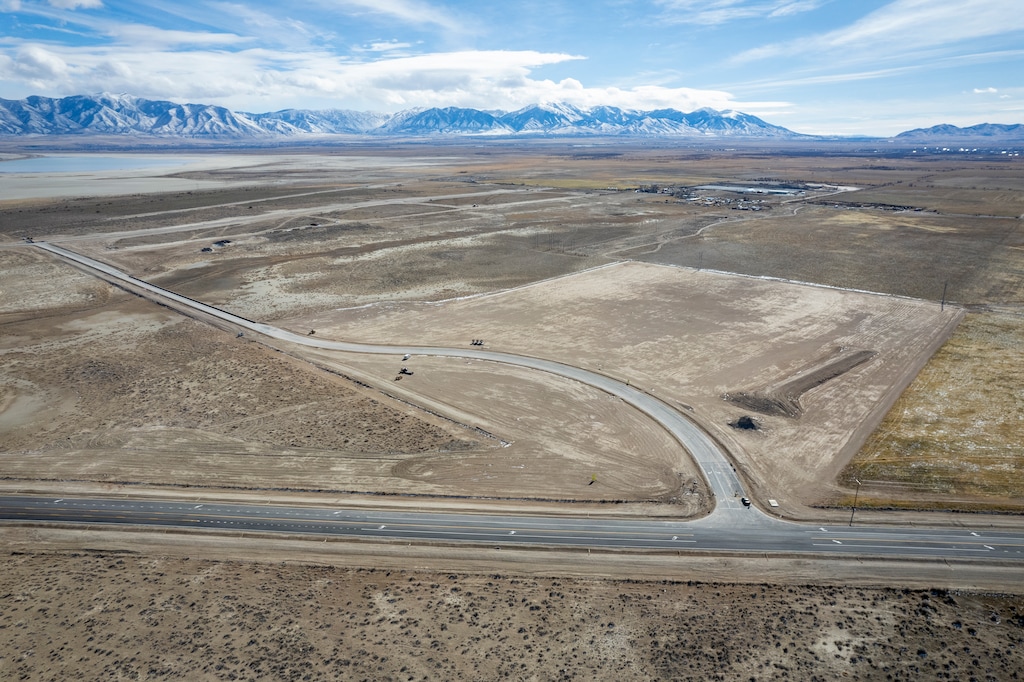
Patrick McAtee has watched an asphalt road slice through some of Tooele County’s only wetlands — a strip of habitat where American avocets and pelicans once gathered by the thousands.
The road will serve a massive new industrial development called the Tooele Valley Project Area, slated to include a data center campus so large it will require its own power plant.
Environmental advocates worry the project is a sign of what’s to come as Utah’s Inland Port Authority expands industrial zones across the state — even in water-strapped areas near the shrinking Great Salt Lake. The passage of a new bill that removes guidance on how much water port projects can use — even those near the beleaguered Great Salt Lake — is only adding fuel to those concerns.
“I’m an advocate for development as a species,” said McAtee, a lifelong Tooele County resident and birder. “But we’ve got to be realistic. … We’re a desert out here.”
Over the decades, he’s watched ephemeral streams in the Tooele Valley dry to a trickle. Ponds have disappeared. His own father had to pay to drill a deeper well last year, he said.
“It’s not the place I grew up in,” McAtee said.
(Rick Egan | The Salt Lake Tribune) Patrick McAtee in Tooele on Thursday, Feb. 19, 2026.
Formed by the Legislature in 2018, the Utah Inland Port Authority collects property taxes within project areas to build roads and waterlines, spur industrial development and facilitate rail.
The Tooele Valley developer, Charles “Chuck” Akerlow, said in an interview his project wouldn’t be possible without the incentives and financing provided by the port authority.
Akerlow declined to disclose which company plans to build the computing complex there.
“But I can tell you,” he said, “that you’ll recognize who they are.”
As port areas have expanded in recent years, concerns about water use in the nation’s third-driest state have cropped up.
Salt Lake City adopted limits on industries using more than 200,000 gallons of water per day. This year, however, lawmakers passed SB 225, removing a requirement that the port authority develop environmental protections for projects with the same daily cap. The bill directs the port authority to instead lean on local ordinances and standards adopted by the cities and counties where port projects are built.
Sen. Jerry Stevenson (R-Layton), the bill’s sponsor and a port authority board member, along with port authority director Ben Hart, called it a “cleanup” bill.
“There are other communities that are OK with users that may be using a little bit more water,” Hart said in an interview. “So this is just an attempt to help clarify.”
But some Great Salt Lake advocates call SB225 irresponsible. Port project areas have also sprung up near Great Salt Lake and Utah Lake wetlands in Box Elder, Weber and Utah counties. Other projects have surfaced in parts of the state that don’t exactly have water surpluses either.
“We’re very worried,” Deeda Seed, senior Utah campaigner for the Center for Biological Diversity, said in an interview.
‘The hope is that this will be a catalyst’
The Pony Express project area in western Utah County doesn’t lie within wetlands or lake habitat. But Seed became alarmed when a representative with Zions Bank touted the potential to build more data centers when the city of Fairfield asked the port authority for $1.6 million to fund a new well in January.
“The hope is that this will be the catalyst,” said Ariane Gibson, the port authority’s chief financial officer, during a public meeting, “and the growth will come in.”
Opponents of the port worry the authority will facilitate new data centers in Fairfield and put more pressure on limited water supplies. Fairfield directly neighbors Meta’s massive data center campus in Eagle Mountain. Another tech company, QTS Data Centers, also has a complex under construction in the area.
Data centers have previously used evaporative cooling to keep their rows and rows of computing servers from frying. Some newer facilities have adopted technologies that use less, although Utah has no explicit requirements to use those systems.
Lawmakers this session did approve HB76, however, which requires new large data centers to report their water consumption to state regulators.
In an email, Fairfield mayor Hollie McKinney denied her city was targeting any data centers in its port project. The well and funding from the port authority is meant to support existing residents and businesses, she said.
“Any future large-scale water allocation,” McKinney wrote, “would require careful review, engineering analysis, and public process.”
(Francisco Kjolseth | The Salt Lake Tribune) A data center, being built by QTS, begins to take shape west to the Meta facility in Eagle Mountain on Tuesday, Dec. 30, 2025.
Another developer announced plans to build the $30 billion Antelope Data Center near Cedar City, a water-strapped part of the state where extensive groundwater pumping has caused the ground in some areas to sink. Residents said they worry the Antelope artificial intelligence complex will ask to be annexed into the Iron Springs Inland Port project, as reported by St. George News. But reports note the facility plans to use less water-intensive closed-loop cooling.
Hart asserted the inland port authority is not specifically targeting data centers. Manufacturing, he said, is the quasi-governmental agency’s primary focus.
“If there are data centers who want to come in and take advantage of public infrastructure that the port pays for,” Hart said, “they absolutely could do that, as could any industrial user, but we’re not subsidizing their operations.”
Of the 14 port project sites across the state, planning documents note the potential for data centers at the Tooele Valley and Iron Springs ports, along with the Twenty Wells port project also in Tooele County, the Juab County Agri-Park and the West Weber port project on Great Salt Lake wetlands near Ogden.
Plans for the Tooele data center and port
Seed remains concerned port projects like those in Tooele County, and the proposed data campus at the Tooele Valley port in particular, could damage habitat for the Wilson’s phalarope, a shorebird her organization and others have petitioned for listing under the federal Endangered Species Act.
“All the activity that’s going on in this area is so contrary to the stated goal of protecting Great Salt Lake,” Seed said. “This is harming Great Salt Lake.”
A coalition of environmental nonprofits, including the Center for Biological Diversity, issued a report last month. It dings inland port incentives as contradictory to Gov. Spencer Cox’s goal to refill the Great Salt Lake by the 2034 Olympics.
Wetlands aren’t only important for supporting migrating birds. They clean and filter water polluted by farms and cities. They also give runoff a place to go so it doesn’t flood communities. And most of Utah’s wetlands lie around the Great Salt Lake and Utah, many of which include largely undeveloped, privately owned tracts now eyed by builders.
(Trent Nelson | The Salt Lake Tribune) Weber County property slated for an inland port on Friday, April 5, 2024.
The port authority offers incentives to developers to avoid paving over wetlands, and at least 1% of the tax revenue it collects in the Great Salt Lake basin is dedicated to wetland protection.
Hart said he wasn’t aware Akerlow’s development had built a road through a potential wetland in Tooele. He added all project areas are required to map and report any environmentally sensitive areas.
In an interview, Akerlow said his road was greenlit by the U.S. Army Corps of Engineers, which is charged with overseeing and protecting wetlands.
“Every now and then I hear some people say that we’re going to be drawing too much water out of the Great Salt Lake,” he said. “We don’t draw any water out of the Great Salt Lake.”
The port project will rely on wells drilled hundreds of feet deep, Akerlow said, to meet its water demands.
His development isn’t the first to impact the lake’s playa and ecosystem, the developer noted. Construction of the interstate, historical railroads and more have blocked surface and groundwater that was once interconnected with the lake.
(Rick Egan | The Salt Lake Tribune) Inland port site near Tooele on Thursday, Feb. 19, 2026.
The developer said he intends to protect about half of his 1,200-acre port project as a conservation district to help protect sensitive lands between the freeway and the Great Salt Lake.
“They’ll just stay wetlands,” Akerlow said. “We’re not going to try to fill them in or do anything like that. That’s silly.”
The data campus itself will cover 200 acres, Akerlow said, and it won’t use traditional evaporative cooling.
“They won’t be using any more water than any other large building,” Akerlow said.
At full build, the center will use at least 500 megawatts — about an eighth of Utah’s total current energy consumption. Like many data centers in the state, the facility hasn’t been able to secure enough power from Utah’s largest electrical utility, Rocky Mountain Power. Instead, it will join a growing trend of data centers building their own power plants fueled by natural gas generators -- a tide that has renewed fears about more emissions and worsening air quality in the Salt Lake Valley.
Other prospective businesses and tenants at Akerlow’s Tooele Valley port include a truck stop set to break ground this spring, rail facilities and possibly tiny home manufacturers. He’s turned away other potential business partners, like food processors, because of their water demands, the developer said.
“That hasn’t slowed down the progress of our [industrial] park,” Akerlow said. “We’re not trying to be stingy about the water.”
He’s currently focused on building water tanks, a wastewater treatment plant, pump houses and gutters for flood control. A big rainstorm that blew through the area in October, the developer said, demonstrated the efficiency of his new infrastructure, all made possible with inland port incentives.
“I drove out the next morning,” Akerlow said. “I was so pleased with the fact that, on the land itself, there were no puddles.”
Editor’s note, 10:35 a.m., March 16 • This story has been updated to correct Chuck Akerlow’s name and a photo caption.
Leia Larsen is a sixth generation Utahn and a water and land use reporter reporter for The Salt Lake Tribune. She has covered environment, energy and political issues throughout the West. When she’s not chasing the news, Leia can be found exploring the Wasatch Mountains, sleeping in the desert or rooting around her garden.